

Review of Political Revolutions

Presentation
•
Social Studies
•
7th Grade
•
Hard

Timothy Lindsey
Used 37+ times
FREE Resource
9 Slides • 6 Questions
1
Review of Political Revolutions
Overview of the Characteristics that Spark Change

2
Multiple Select
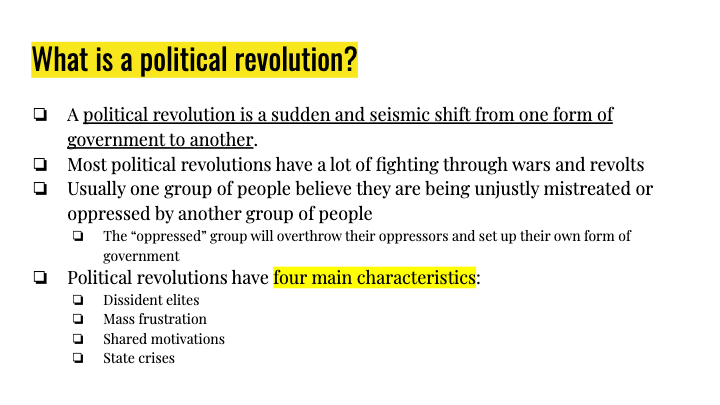
The four characteristics of a political revolution are:
Mass frustration
Dissident elites
Shared motivations
Satisfied population
State crises
3
Instructions for Video
In your level 0 voice (no talking)
Watch the following video on the characteristics of political revolutions
Use this video as a refresher to what we have already learned about political revolutions
4

5

6
7
Multiple Select
Political revolutions often deal with a change in what part(s) of society? Check all that apply.
Changing or erasing the social institutions that may oppress or restrict certain groups of people.
The way in which people do certain things in their academic fields such as science, medicine, or law.
Replace the old government with a new government. Sometimes occur with violent action.
Change the way that people live. For example, moving people from their jobs as farmers in rural areas to earn more money with a factory job in a city.
8

9
Multiple Select
One of the causes of a (political) revolution is dissident elites. What are some characteristics of these elites? Check all that apply.
These elites are usually tired of the political, economic, and social institutions of the system they live in.
These elites usually have wealth or access to wealth.
These elites have an education. They may be doctors, lawyers, or work in a profession that requires extensive education.
These elites have political power. They may be politicians, have ties to politicians, and/or may belong to groups that have access to power.
These elites are currently oppressed in the system they are living in.
10
Multiple Choice
Which of the following scenarios depict (show) the "mass frustration" characteristic of a revolution?
The desires that bring people of all backgrounds together to rebel against the existing government.
The problems that a government face that causes them to fail to meet the needs of their people
A large part of the population is upset at the problems caused by their political, economic, and/or social institutions.
The society's elite are frustrated with the existing government and want for there to be changes.
11

12
Multiple Choice
True or false: With the "shared motivations" characteristic, a dissident elite and a frustrated common person both have something to gain through a revolution.
True
False
13

14

15
Multiple Select
The Age of Enlightenment was a period in which European philosophers and academics were promoting new ideas about people in their role in society and the roles of government and laws. The Enlightenment influenced and was also influenced by the Scientific Revolution. The Scientific Revolution was a period in which new scientific discoveries were being promoted and used to change the way in which astronomy, medicine, and engineering were being done. Both the Age of Enlightenment and the Scientific Revolution can be best defined as:
Political revolutions
Technological revolutions
Cultural revolutions
Intellectual revolutions
Review of Political Revolutions
Overview of the Characteristics that Spark Change
Show answer
Auto Play
Slide 1 / 15
SLIDE
Similar Resources on Wayground

14 questions
Spanish Colonial Era in TEXAS Lesson Part 1
Presentation
•
7th Grade
10 questions
Lesson 17: Explorers Technology
Presentation
•
7th Grade
11 questions
La Salle
Presentation
•
7th Grade
12 questions
Middle East and North Africa Physical Geography
Presentation
•
7th Grade
11 questions
Plastic from Land to Sea GIS
Presentation
•
7th Grade
11 questions
The Preamble of the Consitution
Presentation
•
7th Grade
10 questions
7 Constitutional Principles
Presentation
•
7th Grade
14 questions
Africa Geography Regions Review
Presentation
•
7th Grade
Popular Resources on Wayground
10 questions
How much do you know about our Portrait of an Eagle?

Quiz
•
10th Grade
10 questions
Fast Food Slogans
Quiz
•
6th - 8th Grade
21 questions
Continents and Oceans
Quiz
•
6th Grade
20 questions
Parts of Speech
Quiz
•
5th Grade
16 questions
Subject & Predicate
Quiz
•
5th Grade
25 questions
Multiplication Facts
Quiz
•
5th Grade
12 questions
Map Skills
Quiz
•
3rd Grade
22 questions
Continents and Oceans
Quiz
•
5th Grade
Discover more resources for Social Studies
10 questions
Exploring the Age of Exploration: Key Events and Figures

Interactive video
•
6th - 10th Grade
13 questions
13 Colonies Map Quiz
Quiz
•
6th - 8th Grade
19 questions
Unit 3 Spanish Colonial Era
Quiz
•
7th Grade
10 questions
Pillars of Free Enterprise
Quiz
•
6th - 8th Grade
26 questions
QA 1 Review
Quiz
•
6th - 8th Grade
10 questions
Exploring the 13 Colonies Regions
Interactive video
•
6th - 10th Grade
21 questions
ss.7.cg.1.1- Ancient Influences
Quiz
•
7th Grade
21 questions
Unit 2 Age of Contact 7th gr
Quiz
•
7th Grade