Search Header Logo
The Cell

The Cell

Assessment

Presentation

•

Science, Biology

•

6th - 8th Grade

•

Medium

•
NGSS
MS-LS1-1, MS-LS1-2, MS-LS3-1

Standards-aligned

Created by

Jawara Senghor

Used 62+ times

FREE Resource

10 Slides • 21 Questions

1

The Cell

Structure, Function and Organization

Slide image

2

What is a cell?

A cell is smallest functional and structural unit of all living organisms. According to cell theory, there are 3 basic characteristics

- All organisms are made of one or more cells

- The cell is the basic unit of all organisms

- All cells come from existing cells

Slide image

3

Slide image

4

Multiple Choice

Question image
Which of the following statements is not part of the cell theory?
1
Cells are the basic unit of structure and function in all living things.
2
All cells are produced from other cells.
3
Only animal cells are composed of cells.
4
All living things are composed of cells.

5

Multiple Choice

The _______ is the smallest structural and functional unit of a living thing. (this will be matching on the test)

1

cell

2

metabolism

3

nutrition

4

defense

6

Multiple Choice

Question image

What is one way in which all living things on Earth are alike?

1

All living things have hair.

2

All living things are made of cells and come from other cells.

3

The cells of all living things have chloroplast.

4

All living things can move.

7

Multiple Choice

What type of organisms does the cell theory apply to

1

bacteria

2

multicellular organisms

3

plants and animals

4

all of the above

8

Multiple Choice

What type of organisms does the cell theory apply to

1

bacteria

2

multicellular organisms

3

plants and animals

4

all of the above

9

Types of cells

  • Eukaryotic - Contains membrane bound organelles and its DNA is located in the nucleus. All multi-cellular organisms are eukaryotic.

  • Prokaryotic - A single-celled organism that does not have a nucleus or membrane bound organelles and its DNA is located in the cytoplasm

Slide image

10

Prokaryotic cell structure

  • Cytoplasm - fluid that fills cell

  • DNA - contains genetic material

  • Ribosomes - a specialized organelle that produces proteins

  • Flagellum - a tail-like structure that enables the cell to move

  • Cell wall - gives the cell structural support and protection, also acts as a filtering mechanism

Slide image

11

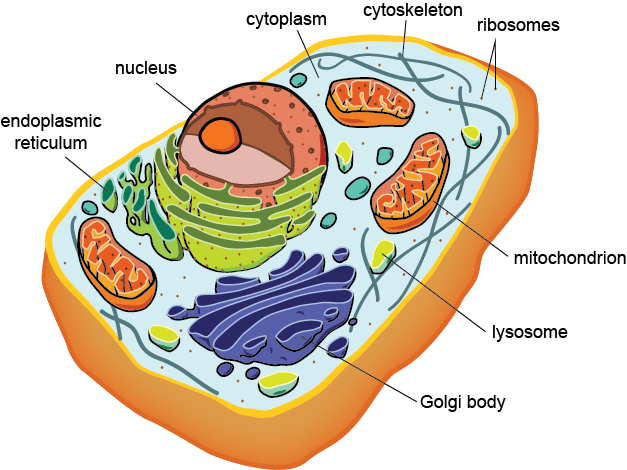
Eukaryotic cell structure

Although eukaryotic cells can differ in their structure, they do share the following common parts.
- Cell membrane
- Cytoplasm
- Cytoskeleton (protein filaments that gives cells shape and support)
- Organelles (small bodies that perform specialized functions)
- Nucleus (organelle containing genetic information)

Slide image

12

Slide image

13

Multiple Choice

Question image

What type of cell is pictured?

1

Prokaryotic

2

Eukaryotic

3

Plant

4

Animal

14

Multiple Choice

Question image

What kind of cell is this?

1

Eukaryotic

2

Prokaryotic

15

Multiple Choice

Question image

All cells have cell membranes. What is the function (job) of the cell membrane?

1

Allow certain things to enter and exit the cell.

2

Allows all things to enter the cell.

3

Does not allow anything to enter and exit.

4

It is made out of wood.

16

Multiple Choice

Plants and animal cells are examples of ___ cells

1

prokaryotic cells

2

eukaryotic cells

17

Multiple Choice

Question image
What is cytoplasm? 
1
The outside of the cell
2
Another name for cells
3
Another name for a nucleus
4
The gel like liquid inside all cells

18

Multiple Choice

Question image
Chromosomes (DNA) are found in the __________________ in eukaryotic cells.
1
Nucleus 
2
Ribosome
3
Cell Membrane 
4
Cytoplasm 

19

Multiple Choice

Question image

What does it mean when you see a nucleus in a cell?

1

The cell is empty

2

The cell is prokaryotic

3

The cell is eukaryotic

4

This would not be a cell

20

Animal cells

One organelle an animal cell has that a plant cell does not is a lysosome. These are cells containing digestive enzymes which break down worn out or damaged organelles.

Slide image

21

Plant cells

The following are additional parts plant cells have that animal cells do not.

- Cell wall (rigid structure that surrounds the membrane)

- Large central vacuole (filled with water and provides support)

- Chloroplasts (where photosynthesis occurs)

Slide image

22

Slide image

23

Multiple Choice

Tiny cell structures that carry out specific functions within the cell.
1
membranes
2
nucleus
3
organelles
4
animalicules

24

Multiple Choice

This organelle is in both plants and animals. It is a barrier between the cell and the environment. It controls what goes in and out of a cell.

1

cell wall

2

cell membrane

3

cell organelles

4

mitochondria

25

Multiple Choice

What organelle is called the "powerhouse" of a cell?

1

Endoplasmic Reticulum

2

Nucleus

3

Mitochondria

4

Nucleolus

26

Multiple Choice

Which organelle belongs in both plant and animal cells?

1

Cytoplasm

2

Chloroplast

3

Large Central Vacuole

4

Cell Wall

27

Multiple Choice

Question image

An animal cell has the following except a/an...

1

Nucleus

2

Lysosome

3

Cell Wall

4

Endoplasmic reticulum

28

Multiple Choice

Question image
The vacuoles in ________ cells are smaller.
1
Animal
2
Plant

29

Multiple Choice

Question image
Which cell can change it's shape?
1
Animal
2
Plant

30

Multiple Choice

Which is the best description of a cell wall's function?

1

keeps the organelles inside of the cell

2

holds the cell up and keeps a square shape so the cell can stack on top of each other

3

responsible for directing the activities of a cell

4

is responsible for turning carbon dioxide and water into sugars and oxygen

31

Multiple Choice

Choose the statement below that is TRUE.

1

Plant and animal cells both have cell walls so the cell can maintain its shape.

2

Animal cells do not have chloroplasts because animals do not require the use of photosynthesis to produce their food.

3

Plant cells do not have a nucleus because plants are not living organisms like animals are.

4

Animal cells do not have cytoplasm because an animal cell's organelles are free to move around as they please.

The Cell

Structure, Function and Organization

Slide image

Show answer

Auto Play

Slide 1 / 31

SLIDE