

Search Header Logo
IRI Face Off

IRI Face Off

Assessment

Presentation

English

Professional Development

Easy

CCSS
RI. 9-10.10, RL.2.6, RI.11-12.10

+5

Standards-aligned

Created by

Michaela Lindemuth

Used 2+ times

FREE Resource

19 Slides • 6 Questions

1

IRI Face Off

QRI-6 vs. Flynt/Cooter Comprehensive Reading Inventory-2


Michaela Lindemuth
Slide image

2

Multiple Choice

An IRI is...

1

Something I have NOT spent all semester studying

2

An Informal Reading Inventory

3

Something Not the Least Bit Helpful

4

Truly just a lot of work

3

Flynt/Cooter Comprehensive Reading Inventory


CRI-2

Slide image

4

Within the Book

  • Interest Inventory/Reading Attitude Survey (K-5)

  • Phonemic Awareness and other Alphabet Tests

  • Concepts of Print

  • Phonics and Decoding Tests

  • Vocabulary Assessment

  • Comprehension & Fluency Assessments

  • Student Summary Form

5

CRI-2

What's in it for me?

  • Pearson product (well known brand)

  • Comes with a PDKit Online Resource

  • Ranges from PrePrimer to 9th Grade Passages

  • Can be used for students PrePrimer to 12th

  • Validity: Independently researched and assessed

6

Interest Inventory & Reading Attitude Survey

  • Both give you an understanding of how the student feels about reading

  • Helps the examiner get to know the student

  • Not all questions are about reading

  • Gives you an informed understanding before begining

  • Get ready for an example from each!

7

Open Ended

Question image

Interest Inventory Question:


What are some famous people that you like?


Does not have to be someone in the picture!

8

Poll

Reading Attitude Question:


How do you feel about reading books in the summer when school is out?

9

Concepts of Print Assessments

  • For Pre-School through Grade 1

  • Checking for basic knowledge of how books work

  • Assesses students understanding of letters, words, sentences, and stories

  • Includes assessment of reading left to right, top down, punctuation and more

10

Phonemic Awareness and Other Alphabetic Tests

**All Verbal

  • Initial Consonant Sounds Test: hear, segment, and produce beginning sounds

  • Phonemic Segmentation Test: hear whole spoken words and then segment them

  • Blending Sounds Test: hear and blend spoken sounds to produce words

  • Letter Naming Test: identify each of the 26 letters in both Upper and Lowercase randomly

11

Phonics & Decoding Tests

  • Phonics: verbally pronounce words in the most common phonics patterns

  • Often referred to as the PT

  • Oral Reading and Analysis of Miscues Section: accompanies each graded passage (narative and expository)

  • Helps the examiner understand the reason why the mistakes were made

12

Vocabulary Assessment

  • Also known as the High Frequency Word Knowledge Test

  • Just read the list of words!

  • Sometimes vocabulary questions are included but not always

  • Can print of the PDKit Flashcards and laminate for regular use

13

Comprehension Assessment

  • Narrative and Expository Assessments

  • Two forms for each style (A-B Narrative) (C-D Expository)

  • Grades 1-8 have silent reading comprehension

  • 9-12 nonfiction/expository passages are used

  • Can choose to measure listening comprehension for levels above the frustration level--can help you find the students "potential"

  • Students retell and any answers not given the examiner asks

14

Fluency Assessment

  • Assessed by the Phonics Test and the Oral Reading rate (wpm)

  • Graded Sentences help guide the examiner which passage level to begin at

15

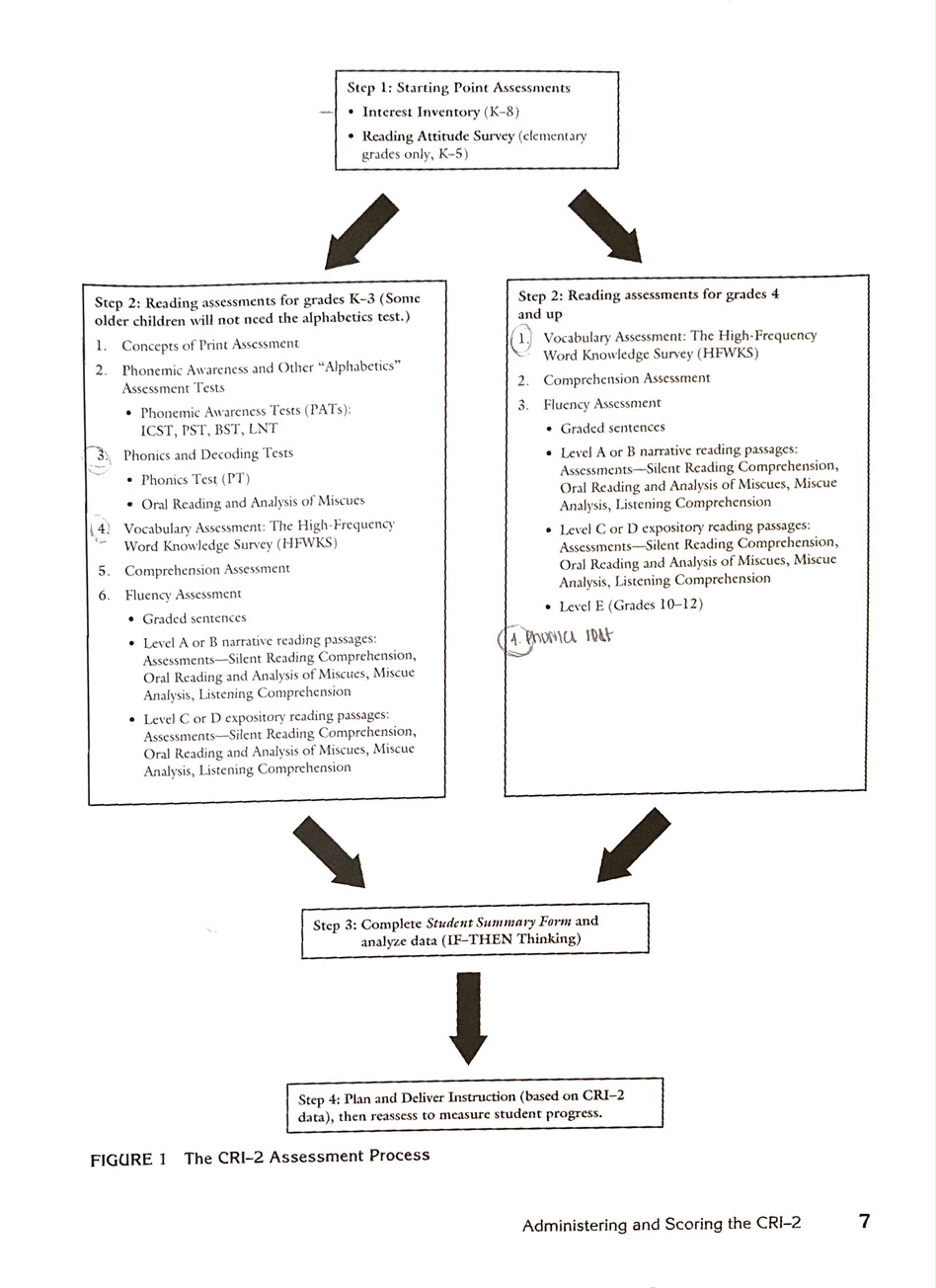
Where Do I Start?

Everyone should start with the Interest Inventory (K-8 applicability)


Reading Attitude Survey (K-5 only)


When testing is completed there are if-then charts to help identify remediations for each need
Slide image

16

Example: Iris, 5th grade

  • Began with Reading Attitude Survey to get to know student

  • Completed the HFWKS (100%) and Phonics Assessments (1 error)--considered proficient in both

  • Initial Passage Sentences for Narrative--she read all without mistakes so began at Level 9 (No higher level so stopped here)

  • Initial Passage Sentences for Expository--she read all without mistakes so began at Level 9

  • Level 9 was too hard so after the questions went to Level 8 and was considered adequate

17

Example: Iris, gr. 5

  • Upon completion of the passage fill out the Assessment Protocol noting any Fundamental Behaviors, Word Attack Behaviors, and Miscues

  • Iris was Narrative Level 9 made one mistake, marked as Visual Substitution

  • Based upon how many Silent Reading Comprehension/Oral Reading Accuracy will determine what happens next

  • Can become a judgement call

Slide image

18

Student Summary Form

  • Helps keep track of the entire testing protocol

  • Ranging from Interests/Background knowledge, any Tier 1-2 Instruction, section to identify strengths and weaknesses

  • Example: Final Page of Student Summary Form

Slide image

19

Pros of Both the CRI-2 and the QRI-6

  • Both have excellent quantity of passages to choose from

  • Both work on retell, questioning, and gramatical elements such as inference, comparisions, cause and effects, and literal response

  • Both have options to read aloud and silently measuring both silent and oral reading

20

Specific Pros for Each

  • QRI-6: clear and easy to follow with direct instructions

  • QRI-6: only two types of tests so easy to follow how to give

  • CRI-2: many types of tests that can identify different areas of weakness

  • CRI-2: section to identify fundamental behaviors and word attack behaviors

21

Cons of CRI-2

  • It is a bit outdated! Get a newer version

  • There are a lot of tests to give and it can feel overwhelming

  • Not nearly as straightforward as the QRI-6

22

Cons of the QRI-6

  • Does not test any phonics skills or high frequency words specifically

  • Requires the examiner to pay attention to word attack skills and fundamental behaviors

  • Does not have a reading attitude survey or a reading interest survey

23

Poll

Based upon what you have heard which do you prefer?

QRI-6

CRI-2

24

Poll

If you could add a piece of the CRI-2 to the QRI-6 what would you add?

Student Summary Form

Reading Attitude/Interest Inventory Test

Concepts of Print Assessments

Specific Phonemic Awareness Tests

Phonics and Decoding Tests

25

Poll

One more Reading Attitude Survey Question!


How do you feel about the stories you reading in reading class (meaning the books you are teaching!)

IRI Face Off

QRI-6 vs. Flynt/Cooter Comprehensive Reading Inventory-2


Michaela Lindemuth

Slide image

Show answer

Auto Play

Slide 1 / 25

SLIDE
