

Classification of Volcanoes

Presentation
•
Science, Geography
•
9th Grade
•
Practice Problem
•
Medium

Perlita Sanchez
Used 33+ times
FREE Resource
19 Slides • 9 Questions
1
Classification of Volcanoes
Mrs. Perlita V. Sanchez
Grade 9 - Science

2
3
4

5
6
Classifications based on Activity
PHIVOLCS (Philippine Institute of Volcanology and Seismology classified volcanoes as:
1. Active
2. Potentially Active
3. In active

7
Active Volcanoes
Volcanoes are considered active if they have erupted within the last 600 years. Erupted within historical times, accounts of these eruptions were documented by man erupted within the last 10,000 years based on the analyses of material from young volcanic deposits.

8

Here is the list of some active volcanoes in the Philippines and the number of their historical eruption.
9
Potentially Active Volcanoes
Morphologically young-looking but with no historical or analytical records of eruption.
Ex. Mount Apo in Davao

10
Inactive Volcanoes
No recorded eruptions physical form has been intensively weathered and eroded, bearing deep and long gullies.
Ex. Mount Arayat in Pampanga

11
Multiple Choice
12
Multiple Choice
13
Multiple Choice

Mount Arayat in Pampanga is an example of a ________ volcano.
14
Multiple Choice
15
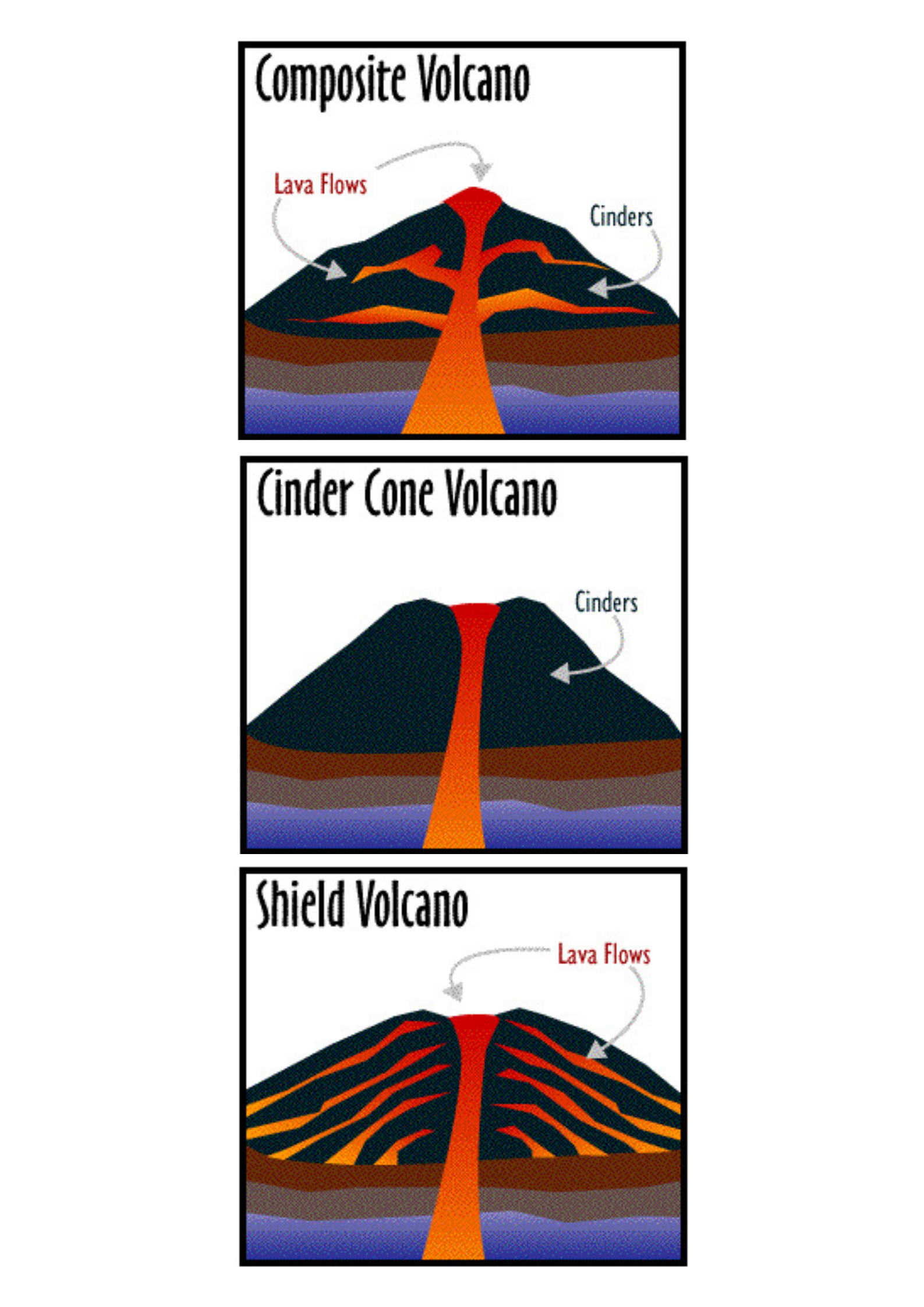
Classification based on Form
These are shield, cinder cone and composite volcano
16
Shield Volcano
Shield volcano exhibits the shape of a broad, slightly domed structure that looks like a warrior shield.
Shield volcanos are formed by the accumulation of mild eruption of larger volumes of basaltic lava.
Its magma has low silica contents.
Ex. Mauna Loa in Hawaii

17

Mauna Loa is one of five volcanoes that form the Island of Hawaii in the U.S. state of Hawaii in the Pacific Ocean.
The largest subaerial volcano in mass and volume, Mauna Loa has historically been considered the largest volcano on Earth.
18
Cinder Cone Volcano
These volcanoes are also known as scoria cones and are produced from ejected lava fragments that form the appearance of cinders as they started to harden in flight.
Cinder cone are steep-sided with slopes between 30-40 degrees.
They also have large, deep craters and the magma has high amaount silica contents.
Ex. Mount Paricutin in Mexico

19

Paricutín presented the first occasion for modern science to document the full life cycle of an eruption of this type. During the volcano's nine years of activity, scientists sketched and mapped it and took thousands of samples and photographs. By 1952, the eruption had left a 424-meter-high (1,391 ft) cone and significantly damaged an area of more than 233 square kilometers (90 sq mi) with the ejection of stone, volcanic ash and lava.
20
Composite Volcanoes
Composite cones or stratovolcanoes are characterized by nearly symmetrical structure consisting of alternating interbedded lava flows and layers of pyroclastic debris.
These volcanoes are large with steep summit area and with gradually sloping flanks.
Composite Volcanoes are composed of magma that varies in silica content.
Ex. Mayon Volcano in Albay

21

Mayon volcano is an active stratovolcano in the province of Albay in Bicol Region, on the island of Luzon in the Philippines.
22
23
Multiple Choice

This shield volcano that can be found in Hawaii is considered as the largest volcano in Earth.
24
Multiple Choice
25
Multiple Choice
26
Multiple Choice
27
Multiple Choice
28
Classification of Volcanoes
Mrs. Perlita V. Sanchez
Grade 9 - Science
Show answer
Auto Play
Slide 1 / 28
SLIDE


