

One dimensional motion - Distance and displacement

Presentation
•
Physics
•
6th - 8th Grade
•
Practice Problem
•
Medium
Standards-aligned

JHOAN MOTATO
Used 59+ times
FREE Resource
10 Slides • 6 Questions
1
One-dimensional motion - Distance and displacement
Jhoan M. Gaviria M.
Objective: To review some terms that are used to describe the motions of objects.

2
Kinematics
is the science of describing the motion of objects using words, diagrams, numbers, graphs, and equations. Kinematics is a branch of mechanics. The goal of any study of kinematics is to develop sophisticated mental models that serve to describe (and ultimately, explain) the motion of real-world objects.

3
4
5
Scalars and vectors
The mathematical quantities that are used to describe the motion of objects can be divided into two categories. The quantity is either a vector or a scalar. These two categories can be distinguished from one another by their distinct definitions:

6
Scalars and vectors
Scalars are quantities that are fully described by a magnitude (or numerical value) alone.
Vectors are quantities that are fully described by both a magnitude and a direction.

7
Multiple Select
8
Multiple Select
9
Distance and Displacement
Distance and displacement are two quantities that may seem to mean the same thing yet have distinctly different definitions and meanings.
Distance is a scalar quantity that refers to "how much ground an object has covered" during its motion.

10
Distance and Displacement
Distance and displacement are two quantities that may seem to mean the same thing yet have distinctly different definitions and meanings.
Displacement is a vector quantity that refers to "how far out of place an object is"; it is the object's overall change in position and can be calculated as
11
Exercise
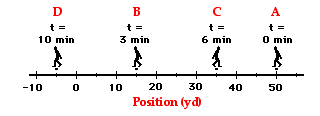
The diagram below shows the position of a cross-country skier at various times. At each of the indicated times, the skier turns around and reverses the direction of travel. In other words, the skier moves from A to B to C to D.

12
Multiple Choice

Use the diagram to determine the distance traveled by the skier during these three minutes.
13
Multiple Choice
Use the diagram to determine the resulting displacement traveled by the skier during these three minutes.
14
Exercise
As a final example, consider a football coach pacing back and forth along the sidelines. The diagram below shows several of coach's positions at various times. At each marked position, the coach makes a "U-turn" and moves in the opposite direction. In other words, the coach moves from position A to B to C to D.
15
Multiple Choice

What is the coach's resulting distance of travel?
16
Multiple Choice
What is the coach's resulting displacement of travel?
One-dimensional motion - Distance and displacement
Jhoan M. Gaviria M.
Objective: To review some terms that are used to describe the motions of objects.
Show answer
Auto Play
Slide 1 / 16
SLIDE

