
Unit 1 and 2 - LEAP Review 20-21
Presentation
•
Science
•
8th Grade
•
Hard
Anonymous Anonymous
Used 3+ times
FREE Resource
6 Slides • 56 Questions
1
LEAP Review 20-21
Mrs. Petroski's 8th Grade Science Class
2
Earth's Layers
Unit 1
3
Multiple Choice
What layer is shown by letter D?
Crust
Mantle
Outer core
Inner core
4
Multiple Select
Select the types of crust (Select all that apply)
continental
garlic butter
oceanic
volcanic
5
Multiple Choice
6
Multiple Choice
7
Multiple Choice
8
Multiple Choice
Scientists who study the layers of the Earth are called...
biologists
astrologists
geologists
botanists
9
Multiple Choice
10
Multiple Choice
11
Multiple Choice
Which layer of Earth is broken up into giant moving plates?
Asthnosphere
Lithosphere
Inner core
Outer core
12
Multiple Choice
Which of the following best describes Earth's asthenosphere?
Liquid rock that can reach the surface
Solid rock that is broken into plates
Dense molten rock that moves the crust
Metal rock at the center of the Earth
13
Multiple Choice
Oceans and other bodies of water are found on which layer of Earth?
Outer core
Crust
Mantle
Inner core
14
Multiple Choice
Why does hot mantle rise (go/move up)?
hot = less dense
hot = no change
hot = more dense
15
Convection in the Mantle
Unit 1
16
Multiple Choice
If magma decreases in temperature (cooler) what will happen to the magma?
It will move down (sink)
It will rise up (float)
17
Multiple Choice
If magma increases in temperature (get hot) what will happen?
It moves down (sinks)
It moves up (rises)
18
Multiple Choice
What layer of earth changes because of the convection cycle?
Crust
Core
Mantle
19
Multiple Choice
Which state of matter is least dense?
Solid
Liquid
Gas
20
Multiple Choice
What is magma made of?
solid rock
melted rock
small pieces of sediment
21
Multiple Choice
Which material is more dense?
solid
liquid
gas
22
Multiple Choice
A diagram of Earth's layers is provided. Which letter in the diagram identifies the layer scientists believe to be in a liquid state?
Location A
Location B
Location C
Location D
23
Multiple Choice
Which layer of the Earth is the thinnest?
Crust
Mantle
Outer core
Inner core
24
Multiple Choice
Which layer of Earth do scientists believe is most likely made of solid matter?
Crust
Mantle
Outer Core
Inner Core
25
Continental Drift
Unit 1
26
Multiple Choice
27
Multiple Choice
Originally the Continental drift theory was not well received by other scientist. Why?
There was a competing theory at the time that was more believable.
There was no data showing the continents ever moved.
The scientists did not know the force responsible for moving the continents.
The scientist presenting the data was unreliable.
28
Multiple Choice
What is the force that moves the continents?
Conduction
Convection
Radiation
Conveyor belts
29
Multiple Choice
30
Multiple Choice
31
Multiple Choice
32
Multiple Choice
33
Multiple Choice
What is it called when on plate is pushed usder another plate as they collide?
earthquakes
subduction
34
Multiple Choice
35
Multiple Choice
36
Plate Tectonics
Unit 1
37
Multiple Choice
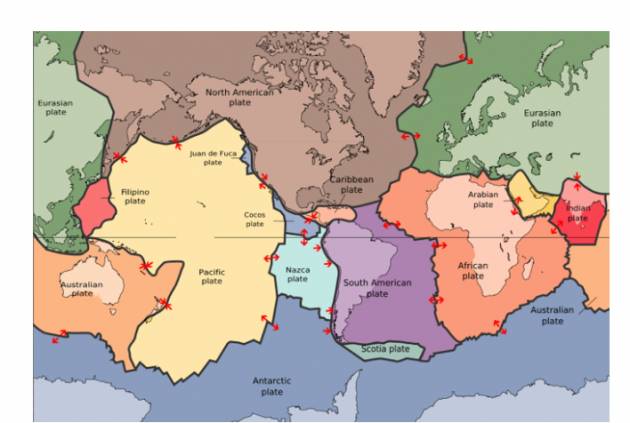
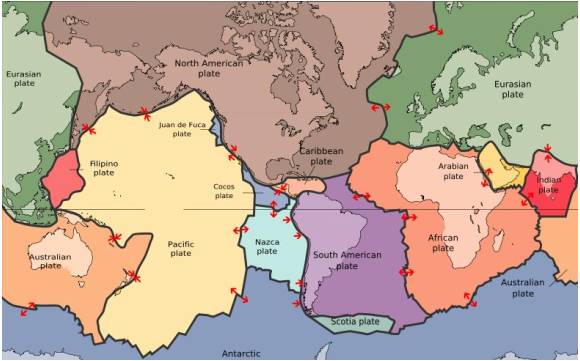
In some areas of the world, like California and Japan, earthquakes are a common occurrence. How can this best be explained?
The strong ocean currents are undermining both areas causing earthquakes.
Both areas are located near the edge of the Pacific Ocean, the unstable sand causes earthquakes.
Both areas are subjected to strong ocean wind and waves that causes earthquakes.
Both areas are on the boundary of active plates, the motion of the plates causes earthquakes.
38
Multiple Choice
What evidence was NOT used by Wegener as proof of continental drift?
land features
erosion
climate
fossils
39
Multiple Choice
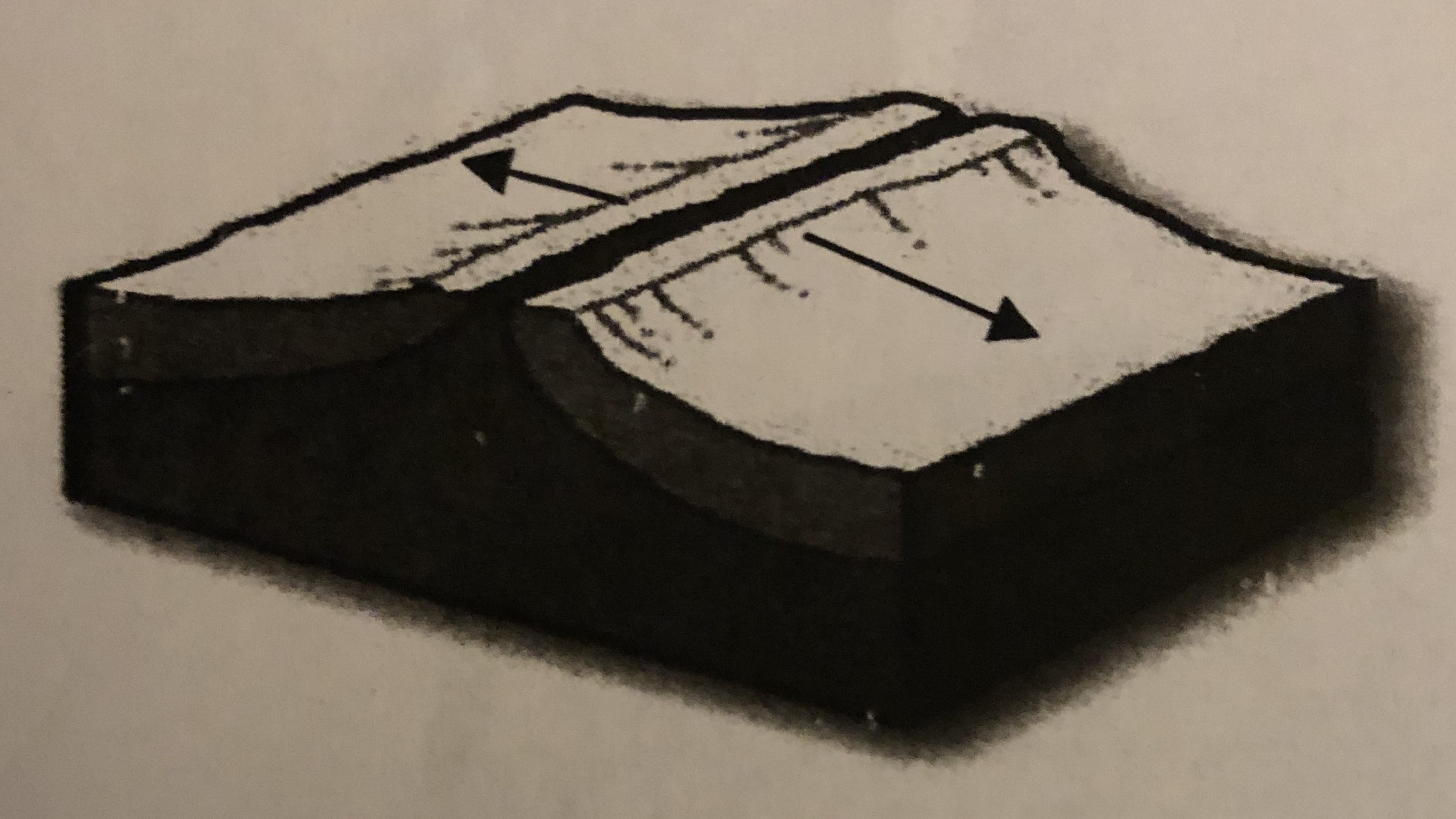
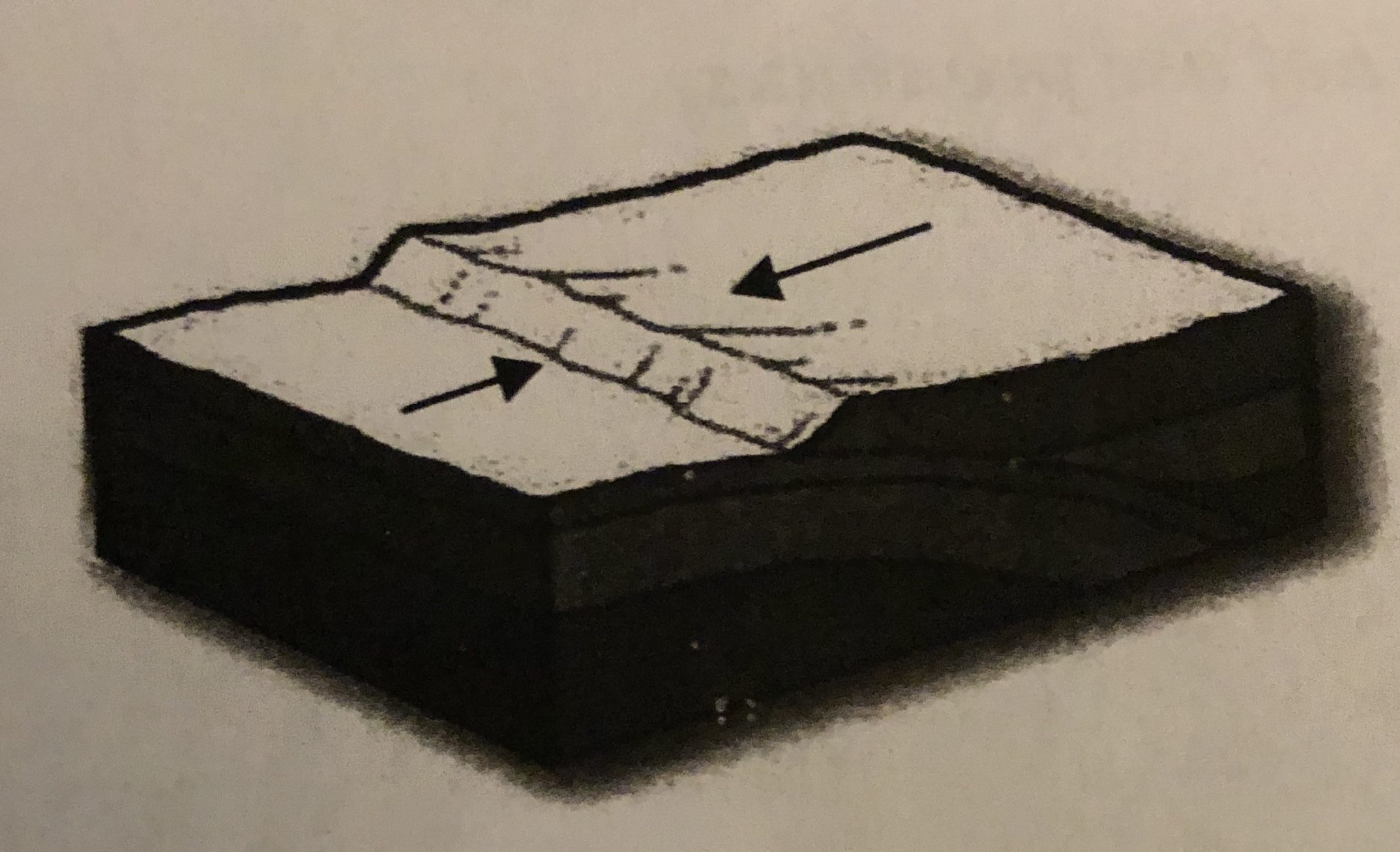
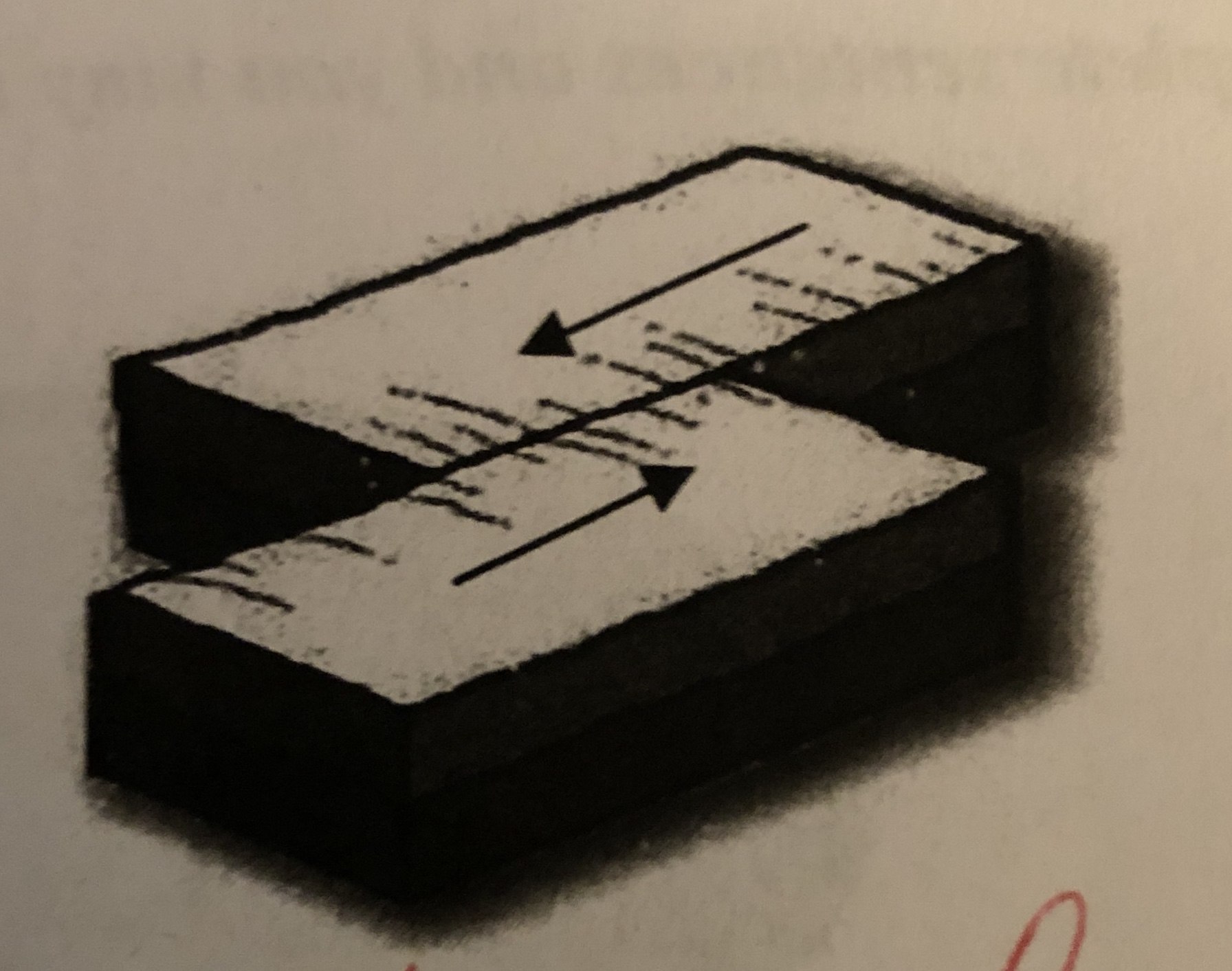
What type of boundary is this?
convergent
divergent
transform
40
Multiple Choice
What type of boundary is this?
convergent
transform
divergent
41
Multiple Choice
What type of boundary is this?
convergent
divergent
transform
42
Multiple Choice
The Marianas Trench, where the Pacific Plate descends under the leading edge of the Eurasian Plate, is the deepest sea floor in the world. These ocean trenches form when two oceanic plates collide
and the older, less dense of the two plates rides over the edge of the older plate.
when convection currents in the mantle force the older plate downward.
and the younger, denser of the two plates, rides over the edge of the older plate.
and the plates are approximately the same age and density.
43
Multiple Choice
The 2004 Indian Ocean tsunami was caused by a shift in two plates that pushed one section of the sea floor under another section of the sea floor by 5 meters. What type of boundary is this?
divergent
convergent
transform
metamorphic
44
Multiple Choice
Where are earthquakes MOST LIKELY to occur?
close to the equator
close to the center of tectonic plates
at divergent or convergent plate boundaries
at transform plate boundaries
45
Multiple Choice
The map in the picture shows tectonic plate boundaries. This map would be useful in predicting the location of future
droughts
hurricanes
earthquakes
tornadoes
46
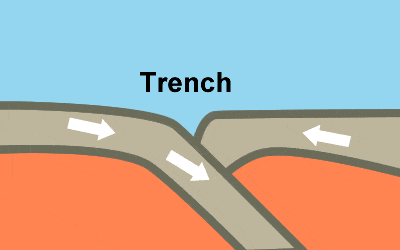
Multiple Choice
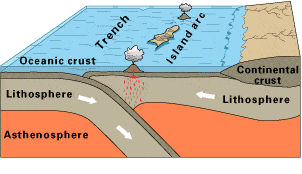
Observe this diagram of a plate boundary. One statement BEST describes what is happening. It is that
the oceanic crust is melting.
the denser ceanic crust is subducting under the less dense oceanic crust
volcanic islands are forming.
the tectonic plates are moving away from each other.
47
Multiple Choice
48
The Rock Cycle
Unit 1
49
Multiple Choice
What is underground molten rock?
Lava
Magma
Soil
Intrusive
50
Multiple Choice
What is it called when layers pile up and press down on the material below?
Compaction
Layering
Cementation
I don't know
51
Multiple Choice
What is aboveground molten rock?
Extrusive
Magma
Lava
Sedimentary
52
Multiple Choice
53
Multiple Choice
54
Multiple Choice
55
Multiple Choice
56
Multiple Choice
57
Multiple Choice
The process by which metamorphic rock changes to igneous rock begins with
melting
erosion
deposition
crystallization
58
Multiple Choice
59
Multiple Choice
60
Multiple Choice
61
Multiple Choice
Metamorphic rocks were once...
igneous rocks that cooled too quickly.
sedimentary rocks that were changed by time, heat, and pressure.
seashells that are pressed together.
layers of mud and sand that built up over time.
62
Multiple Choice
What causes igneous rocks to form
pressure
cooling magma and lava
compaction
cementation
LEAP Review 20-21
Mrs. Petroski's 8th Grade Science Class

Show answer
Auto Play
Slide 1 / 62
SLIDE

Similar Resources on Wayground
55 questions
Texas High School Chemistry
Lesson
•
8th Grade
55 questions
SOL REVIEW U8D5 Relationships/Evolution
Lesson
•
8th Grade
54 questions
MMS L1
Lesson
•
8th Grade
57 questions
Unit 8 Review Lesson
Lesson
•
8th Grade
56 questions
Correction Week 8 LCP Review
Lesson
•
8th Grade
60 questions
Components of the Universe
Lesson
•
8th Grade
59 questions
TUAS / MOMEN DAYA
Lesson
•
8th Grade
61 questions
Climate Zones
Lesson
•
7th Grade
Popular Resources on Wayground
15 questions
Fractions on a Number Line
Quiz
•
3rd Grade
14 questions
Boundaries & Healthy Relationships
Lesson
•
6th - 8th Grade
13 questions
SMS Cafeteria Expectations Quiz
Quiz
•
6th - 8th Grade
20 questions
Equivalent Fractions
Quiz
•
3rd Grade
25 questions
Multiplication Facts
Quiz
•
5th Grade
12 questions
SMS Restroom Expectations Quiz
Quiz
•
6th - 8th Grade
20 questions
Main Idea and Details
Quiz
•
5th Grade
10 questions
Pi Day Trivia!
Quiz
•
6th - 9th Grade
Discover more resources for Science
20 questions
Cell Organelles and Functions
Quiz
•
6th - 8th Grade
10 questions
Exploring the Layers of the Earth
Interactive video
•
6th - 10th Grade
21 questions
Waves and Wave Properties
Quiz
•
6th - 8th Grade
20 questions
Newton's Laws of Motion
Quiz
•
8th Grade
20 questions
Heredity Punnett square review
Quiz
•
8th Grade
13 questions
Plate Tectonics and Earth's Structure
Lesson
•
6th - 8th Grade
16 questions
Pedigree
Quiz
•
8th Grade
10 questions
Exploring Heat Transfer: Conduction, Convection, and Radiation
Interactive video
•
6th - 8th Grade