
Torque and Rotation Review
Presentation
•
Physics
•
11th Grade
•
Medium
+1
Standards-aligned
g Custer
Used 54+ times
FREE Resource
6 Slides • 17 Questions
1
Torque and Rotation Review
2
7.1 Rotational Kinematics
Describes the motion of rotating objects.
We assume a constant angular acceleration.
3
Multiple Choice
4
Multiple Choice
What happens to the angular velocity when a figure skater brings in their arms?
Increases her angular velocity
Decreases her angular velocity
Has no affect
5
Multiple Choice
Which statement is true about an object that is traveling in uniform circular motion?
The speed of the object varies.
The net force on the object is directed toward the center of the circular path.
The direction of the object's velocity is constant.
The net force on the object is directed away from the center of the circular path.
6
Multiple Choice
7
Multiple Choice
8
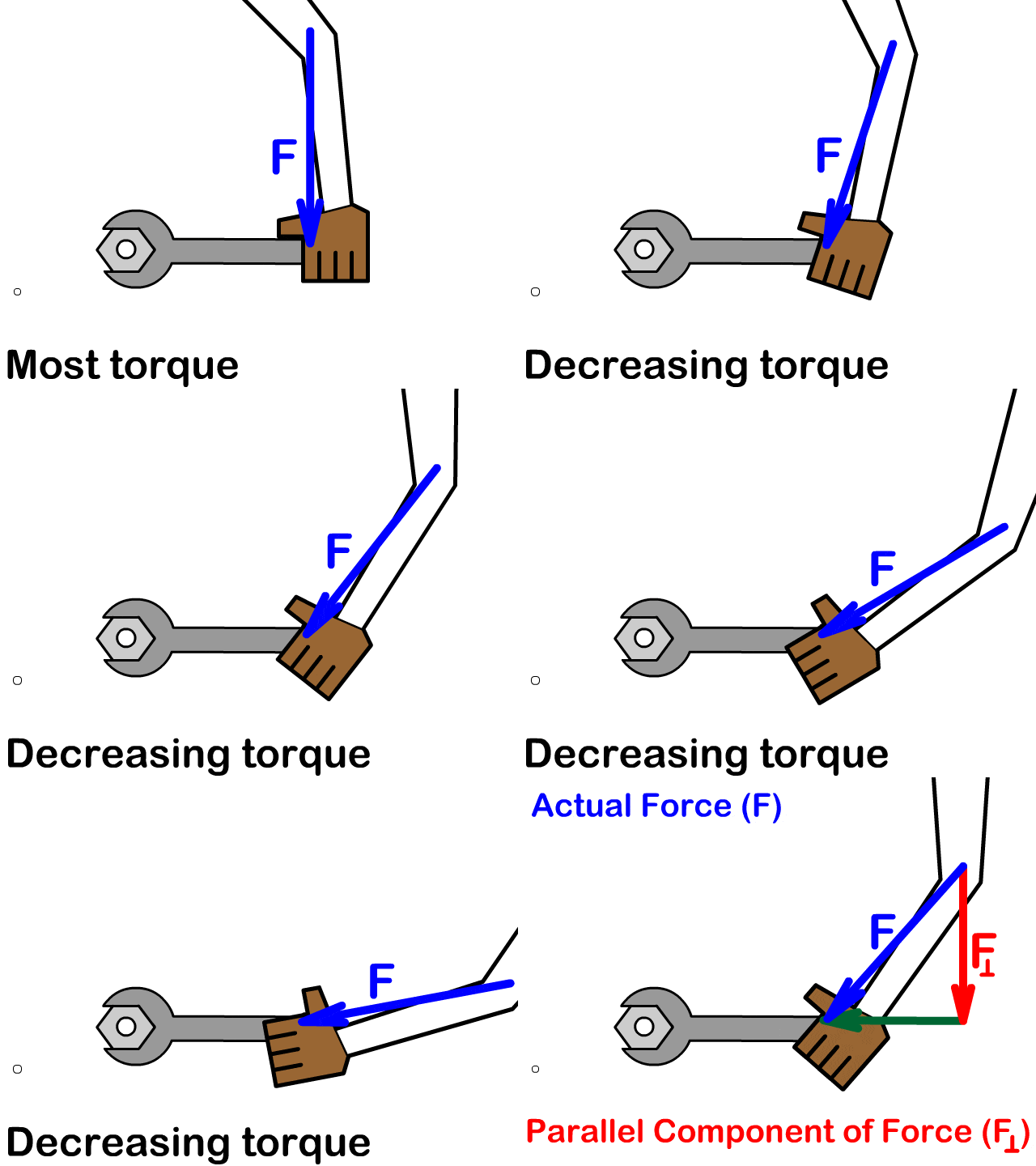
7.2 Torque and Angular Acceleration
Torque is the rotational equivalent to a Force. A net torque applied on an object will cause the object to change its rotational motion.
If all the torques on an object are balanced (∑𝜏 = 0) then the object is in equilibrium.
9
Multiple Choice
When solving a torque problem, all lever arms are measured from the
end of the bar
pivot or fulcrum
center of the bar
center of the mass
10
Multiple Choice
Does a bridge anchored resting on two pillars have any torque?
No, it isn't moving
Yes, but it is at equilibrium
Yes, but it will soon break because of the torque
No, Bridges can't have torque
11
Multiple Choice
A state of equilibrium is also seen below. Each of the cars weighs the same 9800 N. Despite the fact that there is only one car on the left-hand side that is 9 m from the fulcrum, the torques balance because, the cars on the right-hand side, are ____meters from the fulcrum, compared to the car on the left-hand side.
4.5 m
3 m
1 m
2 m
12
Multiple Choice
You apply force to a wrench to tighten a bolt. The wrench breaks in half. Select the best answer for what happens next. Assume the force applied remains constant.
The torque is now half of what it was, because torque and distance are inversely proportional
The torque is now half of what it was, because torque and distance are directly proportional
The torque is now double of what it was, because torque and distance are inversely proportional
The torque is now double of what it was, because torque and distance are directly proportional
13
Multiple Choice
14
Multiple Choice
15
Multiple Choice
A seesaw is unbalanced with two people of different masses sitting equal distances from the center. Which of the following will result in equilibrium?
The larger person moving further away from the center.
Moving the smaller person closer to the center.
Moving the smaller person further from the center.
Making the larger person do nothing.
16
7.3 Angular Momentum
L is the angular momentum, I is the moment of inertia of the object, and 𝜔 is the angular velocity of the object.
A net torque causes a change in the angular momentum of the object.
17
18
19
Multiple Choice
According to the Law of Conservation of Angular Momentum, if I (momentum of inertia) increases, what will happen to ω?
Decrease
Stay the same
Increase
20
Multiple Choice
Which of these items is easier to turn?
Left
Right
Both are just as easy to turn
21
Multiple Choice
What happens to rotational inertia of an object when mass is moved close to axis of rotation?
Decreases
Increases
Stays the Same
22
Multiple Choice
A skater start spinning on the tips of her skates at low angular velocity with arm outstretched.
What would happen when she brings her arms close to her body
She will spin slower
She will spin faster
She will spin at the same velocity
23
Multiple Choice
What is happening to the ice skater?
Decreased Angular velocity, decreased rotational inertia
Decreased Angular velocity, increased rotational inertia
Increased Angular velocity, increased rotational inertia
Increased Angular velocity, decreased rotational inertia
Torque and Rotation Review
Show answer
Auto Play
Slide 1 / 23
SLIDE

Similar Resources on Wayground
18 questions
Law of Conservation of Linear Momentum and Impulse
Presentation
•
10th Grade
20 questions
Get Smart Plus 3 Topic 8 was/were
Presentation
•
1st - 4th Grade
20 questions
One Step Equations
Presentation
•
KG - University
18 questions
Thin Lens Formula
Presentation
•
11th Grade
15 questions
Intro to Waves Lesson
Presentation
•
10th - 12th Grade
20 questions
Hydraulics
Presentation
•
11th Grade
20 questions
Vectors
Presentation
•
11th Grade
20 questions
Specific Heat Capacity - Part 1
Presentation
•
11th Grade
Popular Resources on Wayground
20 questions
STAAR Review Quiz #3
Quiz
•
8th Grade
20 questions
Equivalent Fractions
Quiz
•
3rd Grade
6 questions
Marshmallow Farm Quiz
Quiz
•
2nd - 5th Grade
20 questions
Main Idea and Details
Quiz
•
5th Grade
20 questions
Context Clues
Quiz
•
6th Grade
20 questions
Inferences
Quiz
•
4th Grade
19 questions
Classifying Quadrilaterals
Quiz
•
3rd Grade
12 questions
What makes Nebraska's government unique?
Quiz
•
4th - 5th Grade