

Compare and Contrast Physical Maps of Europe

Presentation
•
Geography, Social Studies
•
6th - 8th Grade
•
Practice Problem
•
Hard

Shane Tanner
Used 1+ times
FREE Resource
4 Slides • 7 Questions
1
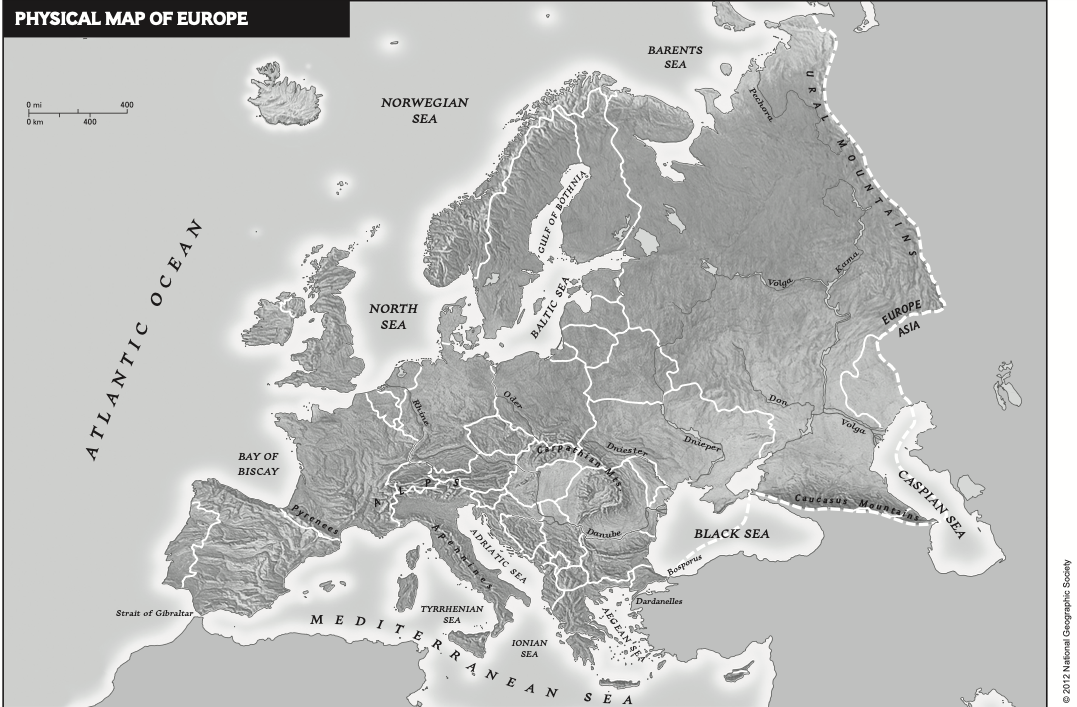
Compare and Contrast Physical Maps of Europe
https://www.nationalgeographic.org/activity/compare-and-contrast-historical-maps-of-europe/
2
Europe and World War I
In 1914, some of the most powerful countries of Europe formed rival alliances, with Germany, Austria-Hungary, and Italy in one alliance, and Russia, the U.K., and France in another.
When Russia and Austria-Hungary intervened in fighting that broke out in the Balkans, the rest of Europe was plunged into World War I, which lasted from 1914-1918.
In the years after World War I, revolution and civil war impacted Russia, Germany, and the remains of Austria-Hungary.
Europe as a whole was greatly changed as a result. Russia and Germany became dramatically smaller, and the Russian revolution of 1917 led to the creation of the Soviet Union. In addition, many smaller states appeared.
3
Multiple Select
In 1914, what alliances were formed?
Germany, Italy, Russia
U.K, Austria-Hungary, France
Russia, France, U.K.
Italy, Austria-Hungary, Germany
4
Multiple Select
Which of these changes came as a result of WWI?
some countries became smaller (like Germany)
the creation of the Soviet Union
the U.K. took over part of Germany
many smaller countries were formed
5
Europe and World War II
World War II began in 1939, when Germany's invasion of Poland forced Britain and France to declare war on Germany.
By 1942, most of Europe was under the control of Germany and its allies.
But by 1945, the German army was weakened by a reviving Soviet Union, and the war ended in spring of 1945.
Afterward, Germany was much smaller in size and divided into East and West.
And the U.S.S.R. included Estonia, Latvia, Lithuania and Ukraine, and occupied northern East Prussia.
6
Fill in the Blanks
World War II began in 1939, when Germany's invasion of Poland forced ________ and _________ to declare war on Germany.
Type answer...
7
Multiple Choice
By _______, most of Europe was under German control.
1939
1942
1945
1955
8
Europe - The European Union
At the end of World War II, many European intellectuals, politicians, and populations as a whole were tired of conflict.
They saw an opportunity to finally create a unified Europe that would not descend into violent conflict again.
Thus, the idea of a pan-Europe, or United States of Europe, was born. The European Union, or EU, started out as merely a treaty among six nations to trade steel and coal for free with one another.
After the fall of the Soviet Union in 1991, the geopolitical climate was ready for countries to join a true European Union—a Union with some political capacity—and to unify currencies.
The EU was established and signed into law in 1992. The Euro came in January 1, 2002. States gave up their own currencies and started using the Euro.
9
Multiple Choice
What does EU stand for?
Europe
European United States
Europe United
European Union
10
Multiple Choice
The EU is was formed in _______.
1992
1997
2002
2020
11
Poll
How well do you understand the background of Europe during WWI, WWII, and the formation of the EU?
not at all
a little
somewhat
I could teach this to others
Compare and Contrast Physical Maps of Europe
https://www.nationalgeographic.org/activity/compare-and-contrast-historical-maps-of-europe/
Show answer
Auto Play
Slide 1 / 11
SLIDE
Similar Resources on Wayground

7 questions
Immigration in the 1800s
Presentation
•
6th - 8th Grade
8 questions
John Adams' Presidency 7.4 (Slides 11 & 12_
Presentation
•
7th - 8th Grade
11 questions
Judicial Branch Review
Presentation
•
6th - 8th Grade
9 questions
Physical Geography Southeast Asia
Presentation
•
5th - 7th Grade
8 questions
Watsons go to birmingham chap 7
Presentation
•
6th - 8th Grade
9 questions
Magnetic Force
Presentation
•
6th - 8th Grade
9 questions
Direct and Indirect Object
Presentation
•
6th - 8th Grade
10 questions
Physical Geography-Regions of Texas
Presentation
•
7th Grade
Popular Resources on Wayground
10 questions
Safety Day 2026 – Student Review

Quiz
•
9th Grade
21 questions
Continents and Oceans
Quiz
•
6th Grade
20 questions
Parts of Speech
Quiz
•
5th Grade
16 questions
Subject & Predicate
Quiz
•
5th Grade
25 questions
Multiplication Facts
Quiz
•
5th Grade
12 questions
Map Skills
Quiz
•
3rd Grade
22 questions
Continents and Oceans
Quiz
•
5th Grade
15 questions
Rounding Decimals
Quiz
•
5th Grade
Discover more resources for Geography
21 questions
Continents and Oceans
Quiz
•
6th Grade
11 questions
49b Establishment of Israel Remediation
Presentation
•
7th Grade
38 questions
49a and 49c - Partitioning leads to Conflict Remediation
Presentation
•
7th Grade
21 questions
Key Vocabulary Definitions Quiz
Quiz
•
7th Grade
50 questions
50 States Quiz
Quiz
•
8th Grade
13 questions
Economic Systems
Quiz
•
6th Grade
48 questions
Government Test Review
Quiz
•
6th Grade
0 questions
U2 Physical Features
Quiz
•
7th Grade