Electricity & Magnetism Review

Electricity & Magnetism Review

Assessment

Presentation

Physics

10th - 12th Grade

Medium

NGSS
MS-PS2-3, HS-PS2-5, MS-PS2-5

+1

Standards-aligned

Created by

Briana McTillmon

Used 76+ times

FREE Resource

25 Slides • 22 Questions

1

Electricity & Magnetism Review

Slide image

2

Slide image

3

Multiple Choice

How do you calculate current
1
Resistance X Voltage
2
Voltage X Resistance
3
Resistance ÷ Voltage
4
Voltage ÷ Resistance

4

Multiple Choice

How do you calculate voltage?
1
Current X Resistance
2
Resistance ÷ Current
3
Current ÷ Resistance
4
Measure it with a ruler

5

Slide image

6

Multiple Choice

What is voltage measured in?
1
Ω (Ohms)
2
V (Volts)
3
A (Amps)
4
W (Watts)

7

Slide image

8

Multiple Choice

What is resistance measured in?
1
Ω (Ohms)
2
V (Volts)
3
A (Amps)
4
W (Watts)

9

Slide image

10

Slide image

11

Multiple Choice

What 'flows' in a wire?
1
Protons
2
Neutrons
3
Atoms
4
Electrons

12

Multiple Choice

Which direction does convention current flow?
1
Positive to negative
2
Negative to positive
3
Negative to Negative
4
Positive to Positive

13

Slide image

14

Slide image

15

Slide image

16

Multiple Choice

Question image
This is an example of a ______ circuit
1
Series
2
Parallel
3
Open
4
Dihexihedral

17

Multiple Choice

Question image
This is an example of a _______ circuit
1
open
2
series
3
parallel
4
square

18

Multiple Choice

Question image
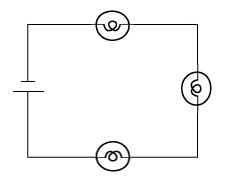
The picture shows an electrical circuit. This circuit is a series circuit because: 
1
It has 3 light bulbs.
2
The same current flows through all three light bulbs.
3
It uses a single battery.
4
The electrical current is divided between the three light bulbs.

19

Slide image

20

Slide image

21

Slide image

22

Multiple Choice

What is Resistance?
1
the degree to which a circuit component opposes the passage of an electric current, causing energy dissipation
2
How hard the energy is pushed
3
The amount of charges that pass by a given point per second
4
None of the above

23

Slide image

24

Multiple Choice

How to you calculate the total resistance in a series circuit?

1

R1 + R2+ R3

2

R1 - R2 - R3

3

1/R1 + 1/R2 + 1/R3

4

R1 = R2 = R3

25

Multiple Choice

Question image

What is the equivalent or total resistance (Re) across this circuit?

1

3 kΩ

2

10 kΩ

3

13 kΩ

4

18 kΩ

26

Slide image

27

Multiple Choice

Question image
The equivalent resistance in this circuit is 
1
100 ohms
2
450 ohms
3
400 ohms
4
30 ohms

28

Slide image

29

Slide image

30

Multiple Choice

Question image

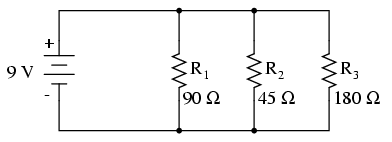
How would the equivalent resistance be determined?

1

1 / Req = (1/5) + (1/8) + (1/3) Ω

2

120 Ω

3

1.5189873 Ω

4

1 / Req = (1/5) * (1/8) * (1/3) Ω

31

Slide image

32

Multiple Choice

How do you calculate total resistance in a parallel circuit?

1

R1 + R2 + R3

2

R1 - R2 - R3

3

1/R1 +1/R2 + 1/R3 = 1/RT

4

R1 = R2 = R3

33

Slide image

34

Slide image

35

Multiple Choice

Which of the following is a material that a magnet would attract?

1

Plastic

2

Aluminum

3

Wood

4

Iron

36

Slide image

37

Multiple Choice

Question image
If you place the North pole of a magnet next to the South pole of another magnet, they will:
1
Attract
2
Repel
3
Do nothing
4
Shatter

38

Slide image

39

Multiple Choice

Question image
What do the lines around this magnet represent?
1
North Pole
2
South Pole
3
Magnetic Declination
4
Magnetic Field

40

Slide image

41

Multiple Choice

As the distance between two magnets increases (they get farther apart), the force between them:
1
Increases
2
Decreases
3
Stays the Same

42

Slide image

43

Multiple Choice

Question image
What will happen when these magnets are brought close together?
1
They will attract each other.
2
They will repel each other.
3
Both magnets will turn to the left
4
Both magnets will turn to the right

44

Slide image

45

Multiple Choice

Question image
The strongest part of a magnet is...
1
the bars.
2
the force field.
3
the poles. 
4
the middle.

46

Slide image

47

Multiple Choice

What two forces are required for generators and electric motors to work?

1

magnetism and thermal

2

electricity and thermal

3

electricity and magnetism

4

magnetism and radiant

Electricity & Magnetism Review

Slide image

Show answer

Auto Play

Slide 1 / 47

SLIDE