Energy revision yr 9
Presentation
•
Science, Physics
•
7th - 9th Grade
•
Medium
Farah Benfedda
Used 3+ times
FREE Resource
10 Slides • 59 Questions
1
Science Block 3
Where does our energy come from?
2
3
Multiple Select
Choose ALL of the nonrenewable energy resources
sun
fossil fuels
nuclear fuel
wind
natural gas
4
Multiple Choice
Nuclear Fuel produce dangerous wastes that remain radioactive for thousands of years
Pro
Con
5
Multiple Choice
Nuclear fuel produces a large amount of energy and does not cause air pollution
Pro
Con
6
Multiple Choice
Fossil Fuels can cause acid rain and smog. Is this a pro or con
Pro
Con
7
Multiple Choice
Fossil Fuels are inexpensive to obtain and use. Is this a pro or con?
Pro
Con
8
Multiple Choice
9
Multiple Choice
10
Multiple Choice
11
12
Multiple Choice
13
Multiple Choice
14
Multiple Choice
15
Multiple Choice
16
Multiple Choice
17
Multiple Choice
18
Multiple Choice
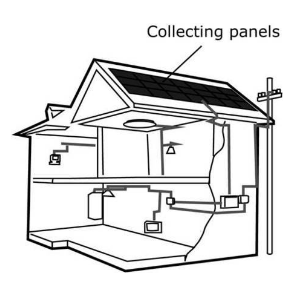
Which alternative energy source does this house use?
19
Multiple Choice
20
Multiple Choice
Renewable energy resources produce less_____________ than fossil fuels.
pollution
energy
wind
light
21
Multiple Choice
22
23
Multiple Choice
What is the unit of energy
Newton (N)
kilogram (kg)
Joule (J)
Watt (W)
24
Multiple Choice
25
Multiple Choice
Every moving object has energy in this energy store
Kinetic
Elastic
Chemical
Nuclear
26
Multiple Choice
Energy stored in the nucleus of an atom
Nuclear
Magnetic
Electrostatic
Chemical
27
Multiple Choice
A stretched rubber band has energy in this energy store
Magnetic
Electrostatic
Elastic
Nuclear
28
Multiple Choice
Food, fuels and batteries have energy in this energy store
Chemical
Thermal
Gravitational Potential
Elastic
29
Multiple Choice
Hot objects have energy in this energy store
Thermal
Elastic Potential
Gravitational Potential
Chemical
30
Multiple Choice
Hot objects have energy in this energy store
Thermal
Elastic Potential
Gravitational Potential
Chemical
31
32
Multiple Choice
Which of these equations is correct?
efficiency = total energy transferreduseful energy transferred
efficiency = useful energy transferredtotal energy transferred
energy = efficiency ×100%
efficiency = total energy tranferredwasted energy transferred
33
Multiple Choice
Total energy = 350J
Useful energy = 70J
Workout the efficiency of this iphoneX.
efficiency = total energy inuseful energy ×100%
100%
80%
40%
20%
34
Multiple Choice
Total energy = 200J
Useful energy = 20J
Workout the efficiency of this lightbulb.
efficiency = total energy inuseful enegy ×100
100%
80%
40%
10%
35
Multiple Choice
36
Multiple Choice
37
Multiple Choice
38
Multiple Choice
39
Multiple Choice
What is the wasted energy here? (we want sound)
electrical
heat
chemical
40
Multiple Choice
What is the wasted energy here? (we want heat and light)
electrical
sound
chemical
41
Multiple Choice
What is the wasted energy here? (we want movement)
heat, light and sound
chemical, electrical and movement
Sound, sound and sound
42
Multiple Choice
What is the wasted energy here? (we want movement)
heat, light and sound
chemical, electrical and movement
Sound, sound and sound
43
44
Multiple Choice
E = 500 Joules
T = 25 seconds
P = ???
0.05 W
20 W
12500 W
2000 W
45
Multiple Choice
46
Multiple Choice
47
48
Multiple Choice
The unit for Electrical Power is
hour
ampere
watt
Volt
49
Multiple Choice
The S.I unit for Electrical Energy is
kwh
KWj
kWh
KWJ
50
Multiple Choice
A 5kW electric slow cooker is used for 4.5 hours to cook. Calculate the cost of electrical energy used if the rate per unit is 12 p.
67p
0.375 p
0.54 p
54 p
51
52
Multiple Choice
Heat transfer by conduction occurs when...
particles collide into each other
large numbers of atoms move from place to place
atoms give off heat in the form of electromagnetic waves
electromagnetic waves travel from place to place through a vacuum
53
Multiple Choice
Heat transfer always moves ...
colder to hotter
east to west
hotter to colder
north to south
54
Multiple Choice
Where do we see conduction in a pot of boiling water on the stove?
The water heats up by touching the hot, metal pot.
The steam from the hot water rises out of the pot.
The heat from the fire can be felt on all sides.
55
Multiple Choice
56
Multiple Choice
Why do metals conduct thermal energy more quickly?
Particles vibrate faster
Due to the presence of bound electrons
Due to the presence of delocalised electrons
Metals are grey
57
58
Multiple Choice
Convection can take place in ____________.
solids only
liquids only
fluids
solids, liquids and gases.
59
Multiple Choice
When air is heated, it's density becomes ___________.
more dense
less dense
remains the same
60
Multiple Choice
When air is heated, its volume ____________.
expands
contracts
remains the same
61
Multiple Choice
In the process of convection, energy is transferred _________.
because of temperature differences in a solid
because of density differences in a liquid
by the diffusion of molecules throughout a fluid
by the vibration of molecules
62
Multiple Choice
The diagram shows a refrigerator. The cooling unit is placed at the top. The cooling unit cools the air near it. What happens to the density of the air as it cools, and how does it move?
The density of air increases. It moves down.
The density of air increases. It moves up.
The density of air decreases. It moves down.
The density of air increases. It moves up.
63
64
Multiple Choice
65
Multiple Choice
66
Multiple Choice
67
Multiple Choice
68
Multiple Choice
Infrared radiation cannot pass through a vacuum (T/F)
True
False
69
Multiple Choice
The three cans were all filled with boiling water they were left for ten minutes and then the temperature of the water was measured again. In which can would the water temperature be the lowest?
A
B
C
There would be no difference.
Science Block 3
Where does our energy come from?
Show answer
Auto Play
Slide 1 / 69
SLIDE

Similar Resources on Wayground
64 questions
Newton's Second Law of Motion
Presentation
•
7th - 8th Grade
62 questions
Plates, Topographic Maps, and Satelite Views Review
Presentation
•
6th - 8th Grade
61 questions
Sound
Presentation
•
6th - 8th Grade
67 questions
Stratigraphy and Dating Rocks
Presentation
•
8th Grade
65 questions
Microorganisms & Viruses
Presentation
•
8th - 10th Grade
67 questions
Sound Review
Presentation
•
6th - 9th Grade
68 questions
Plate Tectonics Review
Presentation
•
6th - 8th Grade
62 questions
Layers of the Earth Guided Lesson
Presentation
•
6th - 8th Grade
Popular Resources on Wayground
20 questions
STAAR Review Quiz #3
Quiz
•
8th Grade
20 questions
Equivalent Fractions
Quiz
•
3rd Grade
6 questions
Marshmallow Farm Quiz
Quiz
•
2nd - 5th Grade
20 questions
Main Idea and Details
Quiz
•
5th Grade
20 questions
Context Clues
Quiz
•
6th Grade
20 questions
Inferences
Quiz
•
4th Grade
19 questions
Classifying Quadrilaterals
Quiz
•
3rd Grade
12 questions
What makes Nebraska's government unique?
Quiz
•
4th - 5th Grade
Discover more resources for Science
8 questions
Amoeba Sister Asexual vs Sexual Reproduction
Interactive video
•
8th Grade
19 questions
Introduction to Properties of Waves
Presentation
•
6th - 8th Grade
16 questions
Interactions within Ecosystems
Presentation
•
6th - 8th Grade
45 questions
Food Webs
Quiz
•
6th - 8th Grade
50 questions
Stars, Galaxies, HR Diagram
Quiz
•
8th Grade
16 questions
Photosynthesis and Cellular Respiration Review
Quiz
•
7th Grade
20 questions
Abiotic & Biotic Factors
Quiz
•
7th Grade
40 questions
Unit F1 Review
Quiz
•
8th Grade