Search Header Logo
CH. 14-A Broken Nation

CH. 14-A Broken Nation

Assessment

Presentation

Social Studies

8th Grade

Hard

Created by

ALLEN KOOCHOF

Used 11+ times

FREE Resource

45 Slides • 16 Questions

1

CH. 14-A Broken Nation

(Prelude to the Civil War)

media

2

THE NORTHERN ECONOMY

The North began to develop more industry and commerce. The growth of industry in the North helped lead to the rapid growth of Northern cities. Much of this population growth came from immigration. In addition, immigrants and Easterners moved west and built farms in the new states formed from the Northwest Territory. Most canals and railroads ran east and west, helping the Eastern and Midwestern states develop strong ties with each other.

3

THE SOUTHERN ECONOMY

The South developed differently than the North. A few wealthy planters controlled Southern society. They made great profits from the labor of their slaves. Much of this profit came from trade. Planters relied on exports, especially cotton. Because these plantations were so profitable, planters invested in slaves instead of industry. As a result, the South developed little industry.

4

media

5

Industry & Agriculture in the North & South (1860)

media

6

media

7

Multiple Choice

By 1860, there were nearly four million enslaved African Americans in the South.

1

true

2

false

8

Territorial Disputes

  • how to deal with slavery in land gained from the War with Mexico?

  • addition of new states threatened balance in Congress between North & South

  • 1850- CA becomes free state

  • slave states would become a minority in the Senate

media

9

Multiple Choice

The ______, was a plan to outlaw slavery in any territory the United States might acquire from the War with Mexico.

1

Compromise of 1850

2

Kansas-Nebraska Act

3

Missouri Compromise

4

Wilmot Proviso

10

Compromise of 1850

  • proposed by Henry Clay

  • CA could not gain statehood without the approval of Congress

  • CA becomes a free state

  • slave trade would be abolished in Washington, D.C.

  • Congress would pass a stronger law to help slaveholders recapture runaway slaves

media

11

12

Multiple Choice

Antislavery Whigs and a few antislavery Democrats joined together to create the _____ Party, which was dedicated to keeping slavery out of the new territories and states.

1

Free-Soil

2

Republican

3

Democratic

4

Anti-Slavery

13

THE FUGITIVE SLAVE ACT

The 1850 law to help slaveholders recapture runaway slaves was called the Fugitive Slave Act. People accused of being fugitives under this law could be held without an arrest warrant. In addition, they had no right to a jury trial. Instead, a federal commissioner ruled on each case. Under this harsh new act, federal marshals, or law enforcers who worked for the U.S. government, could force ordinary citizens to help capture runaway slaves. Anyone who helped a slave escape faced penalties, as did any marshal who failed to enforce the law.

14

15

Multiple Choice

________ wrote Uncle Tom’s Cabin, a novel that portrayed slavery as brutal and immoral; it was published in 1852.

1

Harriet Tubman

2

Harriet Beecher Stowe

3

Frederick Douglas

4

Stephen A. Douglas

16

17

Kansas-Nebraska Act

  • drafted by Stephen A. Douglas, Senator from Illinois

  • Nebraska Territory would be divided into two territories—Nebraska and Kansas

  • angered opponents of slavery, but supported by the South

  • signed into law in May 1854 

media

18

Multiple Choice

If the Kansas-Nebraska Act passed, it would result in getting rid of the ______ by allowing people to vote for slavery in territories where it had banned it.

1

Missouri Compromise

2

Compromise of 1850

3

Wilmot Proviso

4

Louisiana Purchase

19

20

media

21

Multiple Choice

How did the Kansas–Nebraska Act change the amount of territory open to slavery?

1

all answer choices are correct

2

it had no effect

3

it opened new territories to slavery

4

it decreased the amount of territory open to slavery

22

23

"Bleeding Kansas"

  • Kansas became a battleground in the slavery conflict

  • southerners wanted to make Kansas a slave state

  • Missourians crossed the border & voted illegally

  • Sack of Lawrence: pro-slavery mob destroyed buildings & governor's house

media

24

25

26

Multiple Choice

To avenge the Sack of Lawrence, _______ and seven other men went to the cabins of several of his proslavery neighbors and murdered five people. This attack is known as the Pottawatomie Massacre.

1

Robert E. Lee

2

Stephen A. Douglas

3

John Brown

4

Nat Turner

27

28

VIOLENCE IN CONGRESS

In late May, Senator Charles Sumner of Massachusetts delivered a speech attacking the proslavery forces in Kansas. His speech was packed with insults. Sumner even made fun of A. P. Butler, a senator from South Carolina. Preston Brooks, a relative of Butler, heard about Sumner’s speech. To defend Butler and the South, he attacked Sumner, who was sitting at his desk. Brooks hit Sumner over the head with his cane. Sumner tried to defend himself, but his legs were trapped. Brooks hit him 30 times or more, breaking his cane in the assault.

29

30

Multiple Choice

______ is a system where the residents of a state or territory vote to decide an issue, such as slavery.

1

separation of powers

2

checks and balances

3

federalism

4

popular sovereignty

31

Dred Scott

  • was a slave in Missouri

  • taken to live in territories where slavery was illegal by his owners

  • after returning to Missouri, Scott sued claiming he was free because he lived in free territories

  • Dred Scott v. Sandford reached the Supreme Court in 1856.

  • Scott lost his case

media

32

DRED SCOTT V. SANDFORD (1856)

In 1857, the Court ruled against Scott. Chief Justice Roger B.Taney delivered his opinion in the case. In it, he said that Dred Scott was not a U.S. citizen. As a result, he could not sue in U.S. courts. Taney also ruled that Scott was bound by Missouri’s slave code because he lived in Missouri. As a result, Scott’s time in free territory did not matter in his case. In addition, Taney argued that Congress could not ban slavery in the territories. Southerners cheered the Court’s decision, while many Northerners were outraged.

33

34

35

Multiple Choice

The creation of the Republican Party grew out of the problems caused by the Kansas–Nebraska Act of 1854.

1

true

2

false

36

Multiple Select

Which of the following were U.S. president? Click all that apply.

1

Henry Clay

2

James Buchanan

3

Millard Fillmore

4

Stephen A. Douglass

5

Franklin Pierce

37

Multiple Choice

“A house divided against itself cannot stand.” I believe this government cannot endure, permanently half slave and half free. I do not expect the Union to be dissolved—I do not expect the house to fall—but I do expect it will cease to be divided. It will become all one thing, or all the other. "


Who spoke these words?

1

Abraham Lincoln

2

James Buchanan

3

Henry Clay

4

John Brown

38

Harpers Ferry

  • area that became West Virginia

  • October 16, 1859, John Brown & 18 followers captured the Harpers Ferry arsenal

  • killed four people in the raid.

  • hoped to trigger a slave revolt

  • no slaves joined the fight

  • was caught, tried, convicted, & hanged

media

39

RAID ON HARPERS FERRY, VIRGINIA

The U.S. Marines attacked Brown at Harpers Ferry. Some of his men escaped. But Brown and six others were captured, and ten men were killed. Brown was then tried for murder and treason. He was convicted and sentenced to hang. On the day he was hanged, abolitionists tolled bells and fired guns in salute. Southerners were enraged by Brown’s actions. Many northerners refused to condemn Brown. Instead, they viewed him as a hero and a martyr, or a person willing to die for his or her beliefs, to the cause of abolition

40

41

Multiple Choice

Before his execution, John Brown handed his guard a slip of paper that read, “I, John Brown, am now quite certain that the crimes of this guilty land will never be purged away but with _______.”

1

violence

2

slavery

3

war

4

blood

42

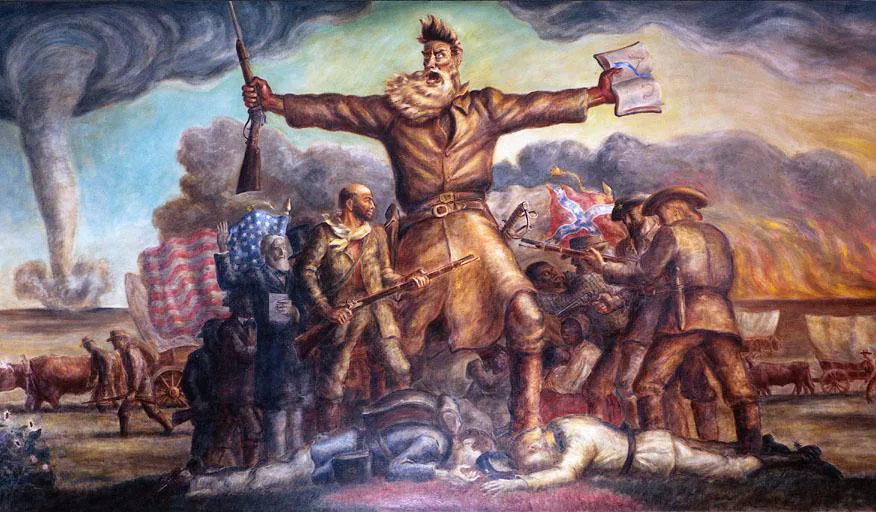
The Bleeding Kansas period of 1854–1860, prelude to or dress rehearsal for the Civil War.

media

43

44

Multiple Choice

What is the name of the painting on the previous slide? It was created by Jon Steuart Curry in 1940.

1

Tragic Prelude

2

Road to the Civil War

3

Bleeding Kansas

4

Border Ruffians

45

Election of 1860

  • Abraham Lincoln-Republican

  • Stephen A. Douglas-Northern Democrat (Illinois)

  • John Breckinridge-Southern Democrat (Kentucky)

  • John Bell-Constitutional Union Party (Tennessee)

  • North had more people than the South, Lincoln from Illinois won

media

46

"A Political Race"-Candidates for the Election of 1860

media

47

48

LINCOLN BECOMES 16TH PRESIDENT

The outcome of the election made it clear that the nation was tired of compromise. Despite Lincoln’s statements that he would do nothing to abolish slavery in the South, white Southerners did not trust him. Many were sure that he and the other Republicans would move to ban slavery. As a result, white Southerners saw the Republican victory as a threat to the Southern way of life.

49

media

50

Multiple Choice

Who was Lincoln's running mate in the Election of 1820? He was a senator from Maine.

1

Jefferson David

2

Henry Clay

3

Andrew Johnson

4

Hannibal Hamlin

51

The Election of 1860

media

52

THE SOUTH DEBATES INDEPENDENCE

The South had reached its breaking point. Abraham Lincoln’s victory in the 1860 election shocked and angered most southerners. They were suddenly faced with a northern president who had not won a single southern state. In fact, his name had not even appeared on the ballot in most of them. After all, Lincoln represented a party founded by people who wanted to keep slavery out of new territories and states. Although Lincoln had not called for the abolition of slavery many proslavery southerners felt certain this was his goal. 

53

Multiple Choice

Supporters of secession based their arguments on the idea of ______. They argued that the states had voluntarily joined the Union. Consequently, they claimed that the states also had the right to leave the Union.

1

confederation

2

constitutionalism

3

popular sovereignty

4

states' rights

54

Southern Secession

  • December 20, 1860, South Carolina secedes from the Union

  • next six weeks, Mississippi, Florida, Alabama, Georgia, Louisiana, & Texas also secede (withdraw)

  • formed the Confederate States of America (CSA)

  • drafted a constitution

  • Montgomery, AL-first capital

media

55

56

Multiple Choice

Who was elected as the president of the Confederacy?

1

Jefferson Davis

2

Robert E. Lee

3

John J. Crittendon

4

John C. Calhoun

57

Jefferson Davis-President of the Confederacy

media

58

EFFORTS AT COMPROMISE

In 1861, John J. Crittenden, a senator from Kentucky, offered a proposal that came to be known as the Crittenden Plan. Under the terms of this compromise plan, the federal government would have no power to abolish slavery in the states where it already existed. Further, the Missouri Compromise line would be reestablished and extended all the way to the Pacific Ocean. Slavery would be prohibited in territories north of the line, but in territories south of it, local residents would decide whether to allow slavery. It was presented to Congress in late February 1861, but it did not pass.

59

Lincoln with His Cabinet and Generals

media

60

KEEPING THE NATION UNITED

In his inaugural address, Lincoln said his first task was to reunite the nation. Secession was illegal, he declared; no state could simply decide on its own to leave the Union. The Union was therefore still intact, and he vowed to use his powers as president to protect places and property belonging to the federal government. He assured the South, however, that he did not intend to interfere with slavery where it already existed, and there would be no invasion or use of force by the government. “We are not enemies, but friends,” Lincoln said. “Though passion may have strained, it must not break our bonds of affection.”

61

THREAT OF WAR

The day after his inaugural address, a message arrived in Washington from Fort Sumter, which lay at the entrance to the harbor in Charleston, South Carolina. The fort was under threat from Confederate forces, and its garrison, or defense force, of about 85 federal soldiers would soon run out of food. Lincoln faced the decision of whether to try to resupply the fort. He wanted to avoid conflict, but a civil war looked more and more likely.

CH. 14-A Broken Nation

(Prelude to the Civil War)

media

Show answer

Auto Play

Slide 1 / 61

SLIDE