

Principles & Washington Review

Presentation
•
Social Studies, History
•
7th - 8th Grade
•
Hard

Kaitlin Harding
Used 2+ times
FREE Resource
23 Slides • 17 Questions
1
Principles & Washington Review
2
3
4
Principle: An important belief
Most of the principles of American government can be found in the U.S. Constitution

5
Consent of the governed
This principle is also called popular sovereignty
Popular sovereignty means that the people are the source of the government's power
This idea was expressed in the Declaration of Independence
This idea is also found in the Preamble to the Constitution when it states "We The People" which means that the people rule in this government

6
Republicanism
The idea that the people have a say in government through elected representatives
You can remember this because it begins with REP just like a representative
A Republic is a type of government, also called Representative Democracy. This is the type of government we have in the U.S.
This term is not the same thing as the political party

7
Separation of Powers
The idea of dividing government powers into three branches: Legislative, Executive and Judicial
The goal of creating three branches with separate powers is to ensure that no member of government can have too much power

8
Checks and Balances
The idea that each branch has certain powers that allow it to limit the power of the other branches of governmento
This ensures that no branch can become to0 powerful

9
Federalism
The idea that power should be divided into two levels of government: state and federal
This principle ensures that neither the federal or state government can become too powerful.

10
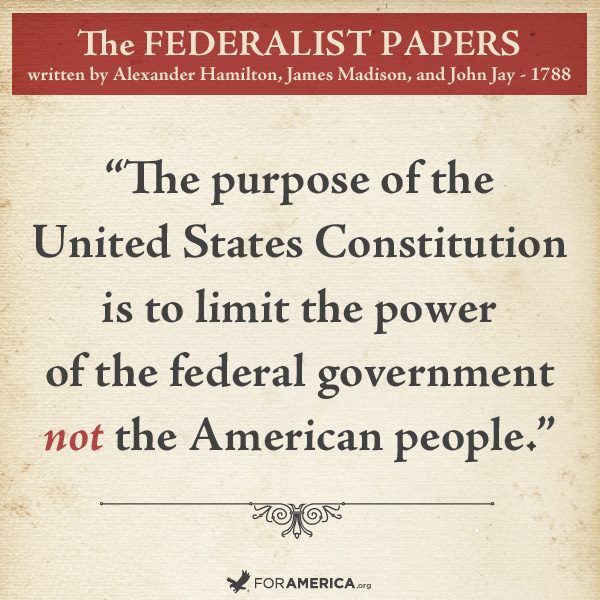
Limited Government
The idea that government powers should be limited to only be allowed to do what is stated in Constitution
Government leaders must follow the law just like citizens
11
Individual Rights
The idea that people have rights that should be protected by the government
This is represented by the Bill of Rights
The arguments of the Anti-Federalists helped to get the protection of individual rights into the U.S. Constitution

12
Theme: limitations on power
There are many ways in which the governments power is limited:
The government is first separated into 2 levels: Federal and State government Within the federal government and state governments there are three branches of government (separation of powers) Those branches have checks and balances on each other

13
Multiple Choice
14
Multiple Choice
15
Multiple Choice
16
Multiple Choice
17
Multiple Choice
18
Multiple Choice
19
20
Multiple Choice

Based on source 1, which statement best explains the U.S Constitutions solution to James Madison’s concern?
21
Multiple Choice

Why does the U.S. Constitution give different branches of the government checks on one another’s power?
22
Multiple Choice
Which power is an example of the U.S. government’s system of checks and balances?
23
Multiple Choice

Based on Source 4, what does Montesquieu believe about the importance of the separation of powers?
24
25
Washington's Presidency
George Washington was the first U.S. President. He was very popular and received 100% of the electoral votes in 1789
He was the general who helped America gain its independence, the President of the Constitutional Convention and was well-respected

26
Multiple Choice
27
Washington's Precedents
As the first President, Washington set many precedents for the role of the President
precedent: example/guide for people in that position in the future
Most presidents that came after Washington followed his precedent

28
Washington's Precedents
Washington made the following precedents:
The President should have a cabinet to give him/her advice
The President should be called Mr. President and not take any titles of nobility
The President should only use the veto power when necessary
29
Washington's Precedents
The President should help the country to stay neutral in foreign affairs
The president should not have a political party
The President should step down after 2 terms (it wasn't a requirement in the Constitution at this time)
30
Multiple Select
31
Hamilton's Economic Plan
Washington appointed Alexander Hamilton as Secretary of the Treasury. Hamilton's job was to strengthen the U.S. economy. Hamilton's financial plan would strengthen the power of the federal government in order to strengthen the economy

32
Hamilton's Economic Plan
Hamilton's Economic Plan included the following:
Creation of a National Bank to pay off federal and STATE debts too!
Creation of tariffs (taxes on imported goods)
Creation of a whiskey tax
33
Multiple Choice
34
Multiple Choice
35
Whiskey Rebellion
Farmers in Pennsylvania were upset on the tax on whiskey because it hurt their business
They rebelled by attacking tax collectors
George Washington marched a large army into Pennsylvania to put down the rebellion. This showed the strength of the Federal government under the Constitution

36
Multiple Choice
37
Washington's Farewell Address
When Washington left office he gave a Farewell Address. The purpose of this speech was to give advice and to help keep the country united as a young nation. Two major ideas stated in the Farewell Address were to:
stay neutral in European Conflicts
to not create political factions/ parties

38
39
Multiple Choice

Using Source 4, which of the following best explains what George Washington meant when he said, “Our true policy is to steer clear of permanent alliances…”?
40
Multiple Choice

What did George Washington claim was the cause for conflict and jealousy among Americans?
Principles & Washington Review
Show answer
Auto Play
Slide 1 / 40
SLIDE


