Search Header Logo
Unit 9 [Kinetics and Equilibrium] Review

Unit 9 [Kinetics and Equilibrium] Review

Assessment

Presentation

Chemistry

9th - 12th Grade

Medium

NGSS
HS-PS1-4, HS-PS1-5, HS-PS1-6

Standards-aligned

Created by

V Pirulli

Used 23+ times

FREE Resource

12 Slides • 12 Questions

1

Unit 9 [Kinetics and Equilibrium] Review

Take out a piece of paper and something to write with! (or be prepared to take screenshots) By the end of this lesson, you will have a nice note sheet to use during Monday's quiz.

Slide image

2

IMPORTANT

  • QUIZ ON MONDAY! Everything you need to know is in this quizziz

  • The "5/6 - Collision Theory and Rates of Reactions" assignment on class kick is due MONDAY

  • Yes, I will post this quizziz for you to study from! 💕

3

Multiple Choice

ΔH value in an endothermic reaction is a positive number.

1

True

2

False

4

Write this down:

+ΔH = ENDOthermic

-ΔH = EXOthermic

5

Multiple Choice

N2 + O2 + 180 kJ → 2 NO


This reaction is

1

ENDOthermic

2

EXOthermic

6

Write this down:

When heat is written IN (not after) the chemical equation...


-Before the arrow (as a reactant) = ENDOthermic


-After the arrow (as a product) = EXOthermic


7

Multiple Choice

Question image

Is this reaction endothermic or exothermic?

1

endothermic

2

exothermic

8

Write this down:

-ENDOthermic: products have more energy than the reactants

-EXOthermic: products have less energy than the reactants

9

Multiple Choice

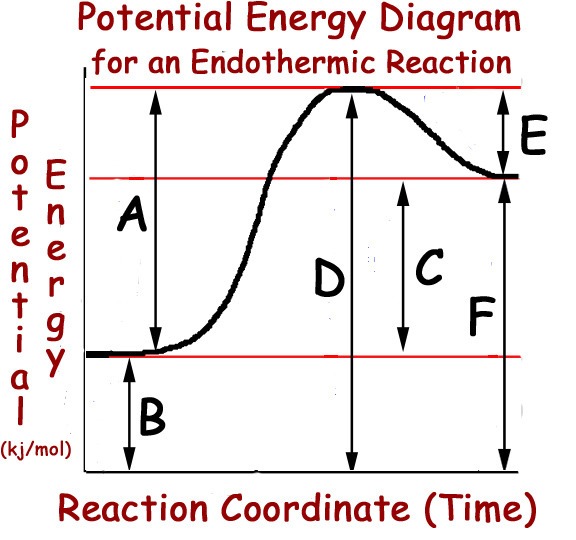
Question image

What letter represents ΔH?

1

A

2

B

3

C

4

D

10

Write this down:

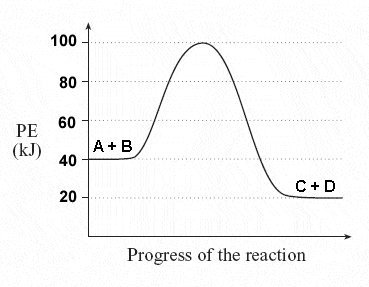
HOW TO CALCULATE 

 ΔH = PEproducts  PEreactants \Delta H\ =\ PE_{products}\ -\ PE_{reac\tan ts\ }  

11

Multiple Choice

Question image

What is the change of the heat of the reaction (ΔH)?

1

-40 kJ

2

-20 kJ

3

20 kJ

4

60 kJ

12

If you got that question wrong... write this down again

 ΔH = PEproducts  PEreactants \Delta H\ =\ PE_{products}\ -\ PE_{reac\tan ts\ }  

13

Multiple Choice

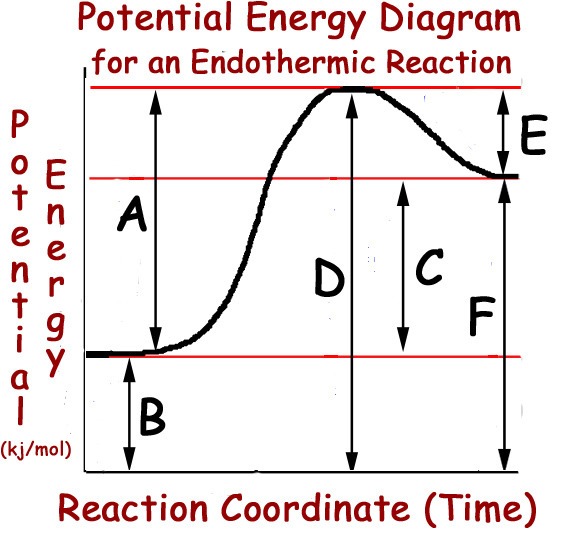
Question image

What letter represents the activation energy of the reverse reaction?

1

A

2

C

3

E

4

F

14

Write this down:

Ea = activation energy

PE = potential energy

  • The Ea for the forward reaction is measured from the PE of the reactants (left side) to the PE of the activated complex (top of graph)

  • The Ea for the reverse reaction is measured from the PE of the products (right side) to the PE of the activated complex (top of graph)

15

Multiple Choice

How does a catalyst work in speeding up a reaction?

1

By lowering the activation energy or reaction

2

by making them more available

3

by giving them more energy

16

Write this down:

A catalyst increases the rate of a reaction (speeds it up) by LOWERING THE ACTIVATION ENERGY

17

Multiple Choice

Question image

The following graph shows two different reaction pathways for the same overall reaction at the same temperature. Which pathway is SLOWER and why?

1

Red, because the activation energy is larger

2

Blue, because the activation energy is lower

3

both reaction progress at the same rate

18

Multiple Choice

What are the two factors that help determine that equilibrium is reached?

1

Forward reaction rate is faster than the reverse and the concentrations are equal

2

Forward and reverse reaction rates are equal and concentrations are equal

3

Forward and reverse reaction rates are equal and concentrations are constant

19

Write this down:

Dynamic Equilibrium:

The forward and reverse reaction rates are equal

and concentrations are constant

20

Multiple Choice

What makes an effective collision?

1

When molecules collide.

2

When molecules collide with the proper orientation.

3

When molecules collide with proper orientation and enough kinetic energy.

4

High Temperature.

21

Multiple Choice

Which of the following is/are the fundamental idea(s) of collision theory?

1

Molecules react by colliding together

2

The effective collisions must occur with certain minimum amounts of energy

3

In a large sample, the greater the number of effective collisions, and the faster the rate of reaction

4

All of the above

22

Write this down:

  • Effective collision: the particles must actually collide with PROPER ENERGY and PROPER ORIENTATION (angle).

  • Collision theory: a reaction is most likely to occur if the particles collide with proper energy and orientation.

23

Multiple Choice

What factors affect rate of reaction?

1

Temperature, Concentration, Pressure and Energy

2

Surface Area, Concentration, Energy and Pressure

3

Temperature, Pressure, Concentration and Surface area

4

Pressure, Surface area, Density and Energy

24

Notes for this question:

SUMMARIZE Slides 11-15 from the "5/6 - Collision theory and rates of reactions" class kick assignment...

WHICH IS DUE ON MONDAY!

Unit 9 [Kinetics and Equilibrium] Review

Take out a piece of paper and something to write with! (or be prepared to take screenshots) By the end of this lesson, you will have a nice note sheet to use during Monday's quiz.

Slide image

Show answer

Auto Play

Slide 1 / 24

SLIDE