
Search Header Logo
Levels of Biological Organization

Levels of Biological Organization

Assessment

Presentation

Science

6th - 10th Grade

Medium

NGSS
MS-LS1-3, MS-LS1-1, MS-LS2-3

+4

Standards-aligned

Created by

Tanisha Boston

Used 68+ times

FREE Resource

19 Slides • 16 Questions

1

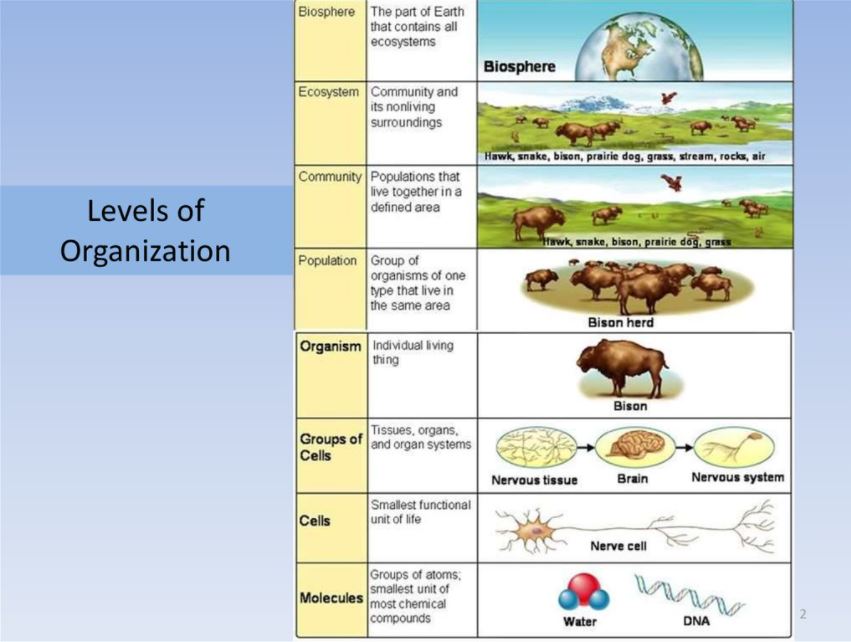
Levels of Organization

Thursday, May 27, 2021

media

2

media

3

media

4

media

5

media

6

media

7

Multiple Choice

Which of the following is the correct order of organization in living things from most basic (simple) to most complex?

1

a. Organism, cell, tissue, organ, organ system

2

a. Organ system, organ, tissue, cell, organism

3

a. Cell, tissue, organ, organ system, organism

4

a. Cell, organ, tissue, organ, organism, organ system

8

media

9

Multiple Choice

The smallest unit of a living thing

1

Cell

2

Tissue

3

organ

4

Organ system

5

Organism

10

media

11

Multiple Choice

A group of similar cells that perform the same function.

1

tissue

2

organelle

3

mass

4

tendon

12

Multiple Choice

What is the difference between a cell and a tissue?

1

cell is basic unit of life; tissue is group of cells that work as one

2

cell is group of tissues; tissue is basic unit of life

3

cell is basic unit of life; tissue is groups of different cells

4

cell is group of organs; tissue is group of different cells

13

media

14

Multiple Choice

Question image

This is a diagram of a heart. The heart is an example of

1

Cell

2

Tissue

3

Organ

4

Organ System

15

media

16

media

17

Multiple Choice

Which is the correct order for levels of organization from simple to complex?

1

cell, organ, tissue, organ system, organism

2

organism, organ system, tissue, cell, organism

3

cell, tissue, organ, organ system, organism

4

organ, tissue, cell, organism, organ system

18

Multiple Choice

3. Organs that work together to perform a related function are called _____________?

1

Cells

2

Organs

3

Organs system

4

Tissues

19

Multiple Choice

1. The _______ is the basic unit of life.

1

Atom

2

Cell

3

Organ

4

Tissue

20

Multiple Choice

Question image

Atom → molecule → organelle → cell→ tissue → organ

→ system → organism

→ population → community

→ ecosystem → biosphere.

1

Taxonomic System

2

Classification system

3

Levels of Organization

4

Periodic Table

21

media

22

Multiple Select

Which of the following factors are needed for all living organisms? Click all that apply

1

Oxygen

2

Living space

3

Energy

4

Carbon Dioxide

5

Evolution

23

media

24

Organism (Individual)

An organism is a single individual animal, plant, fungus, or other living thing. An organism plays a part in each level of the environment.

media

25

Multiple Choice

Question image

What level of ecological organization does the bird represent?

1

Organism

2

Population

3

Community

4

Ecosystem

26

Population

A population is a group of organisms of the same species that live in the same area.

media

27

Multiple Choice

Question image

This school of fish was captured in a fossil

1

Organism

2

Population

3

Community

4

Ecosystem

28

Community

A community is made up of the living components of the ecosystem. In a community, different plants, animals, and other organisms interact with each other.

media

29

Multiple Choice

Question image

What level of ecological organization do the organisms represent?

1

Species

2

Population

3

Community

4

Ecosystem

30

ECOSYSTEM

Within each biome are many ecosystems. Inside an ecosystem, living (biotic) and nonliving (abiotic) factors interact to form a stable system. An ecosystem is smaller than a biome and includes only organisms and their local environment.

media

31

Multiple Choice

Question image

What level of ecological organization does this entire picture represent?

1

Organism

2

Population

3

Community

4

Ecosystem

32

Biome

A biome describes in very general terms the climate and types of organisms that are found in similar places around the world.


Examples of biomes include aquatic, grassland, forest, desert, and tundra. We can divide them into more specific categories such as: freshwater, marine, savanna, tropical rainforest, temperate rainforest, and taiga

media

33

Multiple Choice

The temperate deciduous forest, the tropical rain forest, the desert, and the tundra are all examples of...

1

the biopshere.

2

biomes.

3

ecosystems.

4

communities.

34

media

35

Multiple Choice

Will there be a live science meeting tomorrow, Friday, May 28, 2021?

1

Yes

2

No

Levels of Organization

Thursday, May 27, 2021

media

Show answer

Auto Play

Slide 1 / 35

SLIDE
