

Earth and Space: Lesson 1 SEASONS

Presentation
•
Science
•
4th Grade
•
Practice Problem
•
Easy
Standards-aligned

S P
Used 11+ times
FREE Resource
47 Slides • 13 Questions
1
Earth and Space: Lesson 1 SEASONS
2

p. 302
3
4
Open Ended
5
Open Ended
6
7
**wet season - rainy / monsoon season
** dry season - low rainfall
@ TROPICS/ TROPICAL REGIONS

8
There are only two seasons – an almost six-month long winter night followed by an almost six-month long summer day!
Polar zones/regions (north and south)
9
4 Seasons
Summer
Winter
Fall/ Autumn
Spring

10
Open Ended
11

12

HIGHLIGHT (p.302)
13
Multiple Choice
14
Earth's distance from the Sun is not the cause of the seasons.

15

This just goes to prove that Earth's distance from the Sun is not the cause of the seasons.
16
Multiple Choice
17
Earth is divided into halves called hemispheres.
(HIGHLIGHT) p.302

18

19
Multiple Choice
20
The prime meridian separates the eastern hemisphere from the western hemisphere.
0 degree longitude

21
An equator divides the planet into a Northern Hemisphere and a Southern Hemisphere.
0 degree latitude

22
The Northern
Hemisphere extends from the equator to the North Pole.

23
The Southern Hemisphere extends from the equator to the South
Pole.
24
Multiple Choice
25
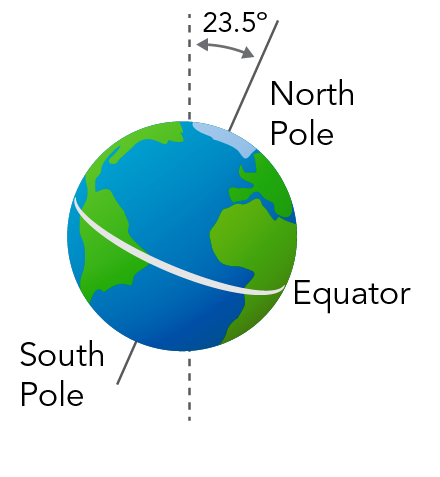
AXIS
Earth's axis is an imaginary pole going right through the center of Earth from "top" to "bottom."
26
Earth has seasons because its axis doesn't stand up straight.

27
Multiple Choice

The axis always points in the same direction.
28
The axis always points in the same direction.
At this time, that direction is more or less toward the star ----Polaris (the North Star)

29
The axis always points in the same direction.
The orientation of Earth's tilt with respect to the sun does change as we orbit the sun.
30
Open Ended
31
Open Ended
32

33

34
35

36
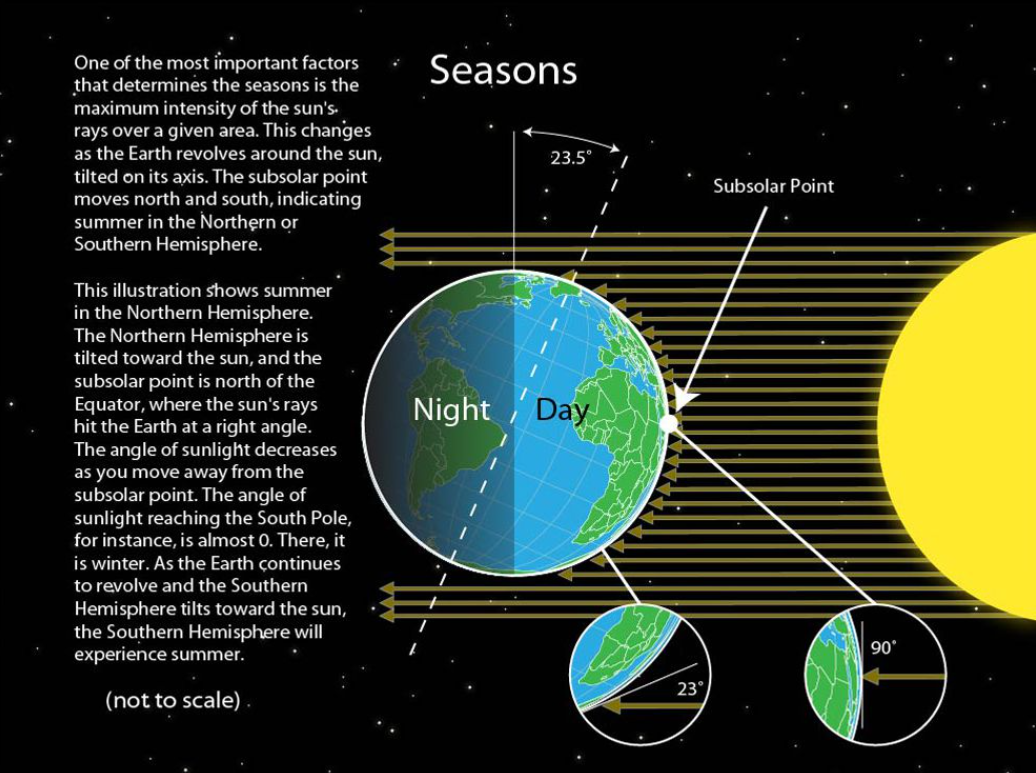
The hemisphere tilted towards the Sun will experience longer hours of sunlight, and more direct sunlight.
SUMMER TIME!!!!

37
During spring and autumn, both hemispheres receive about the same amount of sunlight.

38
39
Throughout the year, this means that either the Northern or Southern Hemisphere is tilted toward the sun and receives the maximum intensity of the sun’s rays.
solstice

40
The only times of the year when the intensity of the sun’s rays is equal.
Equinox

41
Winter solstice (December 21 or 22): shortest day of the year, marking the start of winter.

42
Winter – December, January and February.
NORTHERN HEMISPHERE

43
In winter, the weather is cold and we sometimes get snow and frost.
NORTHERN HEMISPHERE

44
Vernal equinox(about March 21): day and night of equal length, marking the start of spring.
Northern Hemisphere
45
Spring – March, April and May.
NORTHERN HEMISPHERE
46
In spring the weather usually turns warmer, trees begin to grow their leaves, plants start to flower.
NORTHERN HEMISPHERE

47
Summer solstice (June 20 or 21): longest day of the year, marking the start of summer.
Northern Hemisphere
48
Summer – June, July and August
NORTHERN HEMISPHERE
49
In summer the weather is usually hot and trees have full green leaves.
NORTHERN HEMISPHERE

50
Autumnal equinox(about September 23): day and night of equal length, marking the start of autumn.
Northern Hemisphere
51
Autumn – September, October and November
NORTHERN HEMISPHERE

52
In autumn the weather turns colder and often rains. The leaves start to change color and fall off the trees
NORTHERN HEMISPHERE

53

54

55
Multiple Choice
56
Multiple Choice
57
Open Ended
58
59

60

Earth and Space: Lesson 1 SEASONS
Show answer
Auto Play
Slide 1 / 60
SLIDE


