Building Pangea
Presentation
•
Science
•
9th Grade
•
Practice Problem
•
Medium
Standards-aligned
Catherine Val
Used 110+ times
FREE Resource
4 Slides • 11 Questions
1
Building Pangea - Continental Drift
Use your "Building Pangea" document that you completed last class to help you with the following questions. Be sure to read the information on the slides between the questions for the "Big Ideas" you should have learned from this activity.
2
Convection currents
Circulation due to the heating and cooling of rock in the mantle creates currents called "Convection Currents"
These currents are what push and pull the tectonic plates, creating movement at plate boundaries.
The direction of these currents is what determines whether two plates, converge, diverge, or slip past one another.
3
Multiple Choice
The circular arrows inside the Earth's Mantle represent what type of motion, that drives ALL plate movement?
Convergent Boundary
Ocean Currents
Convection Currents
Transform Boundary
4
Multiple Choice
How does heat from the core cause molten rock in these convection currents to move?
Sinks when hot, and rises when cool
Rises when hot, and sinks when cool
Heat from inside the Earth does not cause rocks to move.
5
Multiple Choice
Convection currents beneath the Earth's surface push and pull tectonic plates. Follow the direction of the arrows in the image shown. Imagine the continuous motion of these currents. What type of plate boundary would occur at the surface?
Convergent
Divergent
Transform
6
The Theory of Continental Drift
In 1915, a German scientist named Alfred Wegener (VAY-guh-ner) proposed the theory of continental drift. According to this theory, the landmasses once were joined into a supercontinent called Pangaea. The landmasses then slowly drifted to their current positions.
7
Multiple Choice
Who first proposed the idea of Continental Drift?
Harry Hess
Alfred Wegener
Albert Einstein
Galileo Galilee
8
Multiple Choice
What did Wegener name the large supercontinent where all the continents were joined together?
Wegenerland
Gondwanaland
Laurasia
Pangaea
9
Evidence for the Theory of Continental Drift
Fossils, Rocks, Glaciers, and the shape of coastlines are all pieces of evidence that support the theory of continental drift.
10
Multiple Choice
What does the theory of continental drift state?
The continents were once joined in a super-continent and have moved over time
Continents are stationary and do not move
The Earth is broken into lithospheric plates that move due to convection currents
none of the above
11
Multiple Choice
According to the theory of continental drift, why do the coastlines of Africa and South America appear to fit together so well?
Africa and South America used to be joined together, but split apart long ago.
Africa and South America are drifting towards each other and will soon fit together perfectly.
Ocean currents on either side of the Atlantic have eroded the coastlines into the same shape.
12
Multiple Choice
Lystrosaurus was a slow-moving, plant-eating reptile that lived over 250 million years ago. Fossils of Lystrosaurus have been found in the brown areas shown below. How is this explained by the existence of Pangaea?
Lystrosaurus swam across the oceans from one continent to another.
Lystrosaurus drifted on rafts of vegetation from one continent to another.
Africa, Antarctica, and India used to be joined together into a single landmass.
13
Multiple Choice
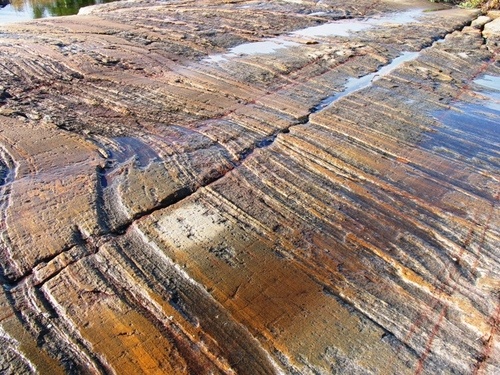
India, Australia, South America, and Africa all have deep grooves or scratches in rocks which is climate evidence of ....
erosion
dinosaurs
glaciers
aliens
14
Multiple Choice
This is a picture of glacial scratches found in Africa. Which of the following statements best explains the presence of these glacial scratches?
Africa has always been near the equator
Africa was once in an area of the Earth that had a very cold climate
The continents have not moved
sea floor spreading
15
Multiple Choice
All of the following were evidence Wegener collect to support his theory of Continental Drift EXCEPT:
Fossils
Roadways
Glaciers
Coastlines that fit like puzzle pieces
Building Pangea - Continental Drift
Use your "Building Pangea" document that you completed last class to help you with the following questions. Be sure to read the information on the slides between the questions for the "Big Ideas" you should have learned from this activity.
Show answer
Auto Play
Slide 1 / 15
SLIDE

Similar Resources on Wayground
14 questions
Chemical/Physical Properties and Changes
Presentation
•
9th Grade
10 questions
DNA Structure Practice
Presentation
•
9th Grade
12 questions
Reviewing Controls & Control Groups
Presentation
•
10th Grade
10 questions
Point Slope Form
Presentation
•
9th Grade
11 questions
Carbon Footprint
Presentation
•
9th Grade
13 questions
Ilmu Pengetahuan Alam
Presentation
•
KG
11 questions
Translation
Presentation
•
9th - 10th Grade
11 questions
Water and Carbon Cycles
Presentation
•
9th Grade
Popular Resources on Wayground
10 questions
Factors 4th grade
Quiz
•
4th Grade
10 questions
Cinco de Mayo Trivia Questions
Interactive video
•
3rd - 5th Grade
13 questions
Cinco de mayo
Interactive video
•
6th - 8th Grade
20 questions
Math Review
Quiz
•
3rd Grade
20 questions
Main Idea and Details
Quiz
•
5th Grade
20 questions
Context Clues
Quiz
•
6th Grade
20 questions
Inferences
Quiz
•
4th Grade
19 questions
Classifying Quadrilaterals
Quiz
•
3rd Grade
Discover more resources for Science
100 questions
Biology EOC Review
Quiz
•
9th - 12th Grade
25 questions
Biology EOC review Quiz
Quiz
•
9th - 12th Grade
20 questions
Human Impact on the Environment Review #2
Quiz
•
9th Grade
20 questions
Balancing Chemical Equations
Quiz
•
9th Grade
9 questions
EOC Domain 4: Evolution
Presentation
•
9th - 10th Grade
14 questions
EOC Domain 2: Genetics
Presentation
•
9th - 10th Grade
10 questions
EOC Domain 3: Taxonomy
Presentation
•
9th - 10th Grade
12 questions
EOC Domain 5: Ecology
Presentation
•
9th - 10th Grade