
Search Header Logo
Dichotomous Keys

Dichotomous Keys

Assessment

Presentation

•

Biology, Science

•

6th - 9th Grade

•

Medium

•
NGSS
MS-LS4-2

Standards-aligned

Created by

Erin Hannan

Used 410+ times

FREE Resource

5 Slides • 11 Questions

1
Dichotomous Keys

Year 7

media

2

What we are going to cover today
  • What is a dichotomous key

  • The different types of dichotomous keys

  • How read and create dichotomous keys

3

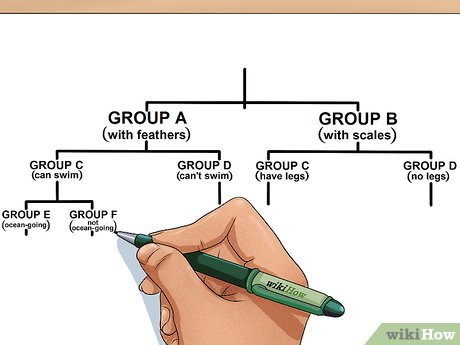
What is a dichotomous key?

A diagram or text that helps us identify and classify an organism after we identify its characteristics.


We generally see them as either branching or tabular.

It presents us with TWO options to choose from - di.

media

4

Multiple Choice

The scientific name of an organism is always its;

1

Genus, species

2

Species, Genus

3

Kingdom, Species

5

Multiple Choice

Question image

What would the scientific name of this animal be?

1

Chelonia mydas

2

Canis lupis

3

Danaus plexippus

4

Vipera aspis

6

Multiple Choice

Question image

What would the scientific name of this animal be?

1

Chelonia mydas

2

Canis lupis

3

Danaus plexippus

4

Vipera aspis

7

Multiple Choice

Question image

What would the scientific name of this animal be?

1

Chelonia mydas

2

Canis lupis

3

Danaus plexippus

4

Halieetus leucocephalus

8

Branching Keys
  • A series of two-part choices

  • Each option should be the opposite of one another - i.e. Has fur and Does not have fur

media

9

Tabular Keys
  • Tabular dichotomous keys display the same information as a branching key, but often are used for large groups of organisms - as it takes up less space

  • It makes them a bit tricky to construct, but easy enough to read

media

10

Multiple Choice

Question image

What would the scientific name of this animal be?

1

Chelonia mydas

2

Canis lupis

3

Danaus plexippus

4

Halieetus leucocephalus

11

Open Ended

Question image

What would be another characteristic you could include INSTEAD of shell or no shell?

12

Multiple Choice

Question image
A dichotomous key for trees is provided. Hikers found a tree that has large brown cones and single sharp needles. What species of tree have the hikers found?
1
Juniper
2
Pine
3
Spruce
4
Fir

13

Multiple Choice

When using a dichotomous key to identify organisms, what do we look at?
1
physical features
2
weather patterns
3
environment
4
diet

14

Multiple Choice

Which of the following characteristics will most likely be helpful in identifying a butterfly using a dichotomous key?
1
Migrates north every spring
2
hangs on branches
3
flutters wings fast on hot days
4
Wings have long extensions

15

Multiple Choice

Question image
Use the dichotomous key above to classify the unknown organism in the picture
1
Kentuckyus
2
Californius
3
WalaWala
4
Beverlus

16

Multiple Choice

Question image
A student discovers an arachnid with a segmented abdomen, long legs, and a tail with no stinger. The student uses the dichotomous key below to identify it. Which arachnid has the student found?
1
Whip Scorpion
2
Wind Scorpion
3
Daddy long legs
4
Scorpion
pattern-tertiary
Dichotomous Keys

Year 7

media

Show answer

Auto Play

Slide 1 / 16

SLIDE
