Extra Lesson EASE 1 preparation_Grade 7
Presentation
•
Physics
•
7th Grade
•
Medium
Irvani Prasanti
Used 19+ times
FREE Resource
30 Slides • 41 Questions
1
Extra Lesson
EASE 1 preparation
Grade 7
by Irvani Prasanti
2
3
4
5
Balance : to measure mass
Spring Balance : to measure weight
6
Multiple Choice
As distance between two objects increase the pull of gravity
Increases
Decreases
Stays the same
7
Multiple Choice
The force of gravity acting on an object is the object's ______.
mass
matter
weight
friction
8
Multiple Choice
Which of the following never changes no matter where in the universe?
weight
force
mass
pounds
9
Multiple Choice
The amount of matter in an object is
pressure
weight
mass
force
10
Multiple Choice
If the mass of an object on Earth is 18 grams, what would the mass of the same object be on the Moon?
18 g
4 g
0 g
32 g
11
Multiple Choice
A child has a mass of 30 Kg on Earth. If the gravity on Moon is one sixth that of the Earth what is the mass of the child on Moon?
30 Kg
180 Kg
5 Kg
0 Kg
12
Multiple Choice
The force of gravity on Jupiter is a little more than 2 times the gravitational force on Earth. If an object has a mass of 50 kg and a weight of 490 N on Earth, what would be the object's approximate mass and weight on Jupiter?
50 kg and 490 N
100 kg and 490 N
50 kg and 980 N
100 kg and 980 N
13
14
15
16
17
18
19
20
21
22
Multiple Choice
A cloud of gas and dust from which bodies in space are formed
photosphere
nebula
solar flare
Sunspot
23
Multiple Choice
The most abundant gases in a nebula are:
Hydrogen & Oxygen
Nitrogen & Oxygen
Hydrogen & Helium
Oxygen & Helium
24
Multiple Choice
A nebula starts to collapse because of:
A nearby star shining it's light
A passing spaceship
A passing comet
Gravity
25
Multiple Choice
How long ago did these nebular processes start?
4.6 years ago
4.6 light years ago
5.6 billion years ago
4.6 billion years ago
26
Multiple Choice
Our solar system began when...
The Big Bang happened
an ancient star exploded around 5 billion years ago
every other solar system began
a huge explosion occurred 15 billion years ago
27
Multiple Choice
What is the fuel for the sun's energy?
The fusion of hydrogen atoms into helium
The gravitational pull on the planets
Solar wind
The nebulae
28
Multiple Choice
What theory describes the formation of our solar system?
The Big Bang theory
The theory of general relativity
The solar nebular theory
The theory of evolution
29
30
31
32
Tidal range is the height difference between high tide and low tide. Tides are the rise and fall of sea levels caused by gravitational forces exerted by the Moon and Sun and the rotation of Earth. Tidal range depends on time and location.
33
34
35
Multiple Choice
The bulge of water on the side of the Earth closest to the moon produces ___________.
high tide
low tide
neap tide
spring tide
36
Multiple Choice
Tides are the cycle of rising and falling ocean water that repeats automatically every
24 hours
12.5 hours
25 hours
6.25 hours
37
Multiple Choice
Tides are caused mainly by the differences in how much gravity from the moon and the sun pulls on different parts of the Earth.
True
False
38
Multiple Choice
Changes in the positions of Earth, the moon, and the sun affect the height of high tides during a month.
True
False
39
Multiple Choice
What type of tides would this arrangement of earth-moon-sun create?
neap tide
spring tide
new moon tide
full moon tide
40
Multiple Choice
Wha type of tide would this arrangement of earth-moon-sun create?
full moon tide
new moon tide
neap tide
spring tide
41
Multiple Choice
What causes tides?
gravity
wind
spring
neap
42
Multiple Choice
Why does the moon's gravitational pull have more of effect on tides than the sun's gravitational pull?
they are the same
the moon is larger than the sun
tides are not caused by the moon
the moon is closer to the Earth than the sun
43
Multiple Choice
High tides and low tides each happen _____ times per day.
4
2
1
24
44
Multiple Choice
Neap tides happen at _________ and _________ phases of the moon.
first quarter and new moon
last quarter and full moon
waxing and waning
1st quarter and 3rd quarter
45
Energy is CONSERVED.
Energy before transformation is EQUAL to energy after transformation.
46
47
48
49
50
51
52
53
54
55
Multiple Choice
The Law of Conservation of Energy states:
Energy can be created or destroyed but not transformed
Energy cannot be created or destroyed, it can only be transformed
Energy can't be created, it can be destroyed and transformed
56
Multiple Choice
Kinetic Energy is the energy of _________
thermal
movement
potential
atoms
57
Multiple Choice
Which type of energy increases when you compress a spring?
elastic potential energy
kinetic energy
radiant energy
sound energy
58
Multiple Choice
What is potential energy?
The energy an object has due to its position or condition.
The energy an object has due to its motion.
The energy an object has due to its chemical composition.
The energy as object has due to its atomic structure.
59
Multiple Choice
What is energy?
The ability to do work and cause change and move an object some distance.
The push and pull exerted on an object.
The relationship between matter and substances..
The feeling you get after drinking a Monster or Red Bull
60
Multiple Choice
At what point does the roller coaster have the highest amount of potential energy?
At the bottom of the first hill.
At the top of the third hill.
At the end of the ride.
At the top of the first hill.
61
Multiple Choice
At what point of the ride have the highest kinetic energy?
At the lowest point of the ride.
At the highest point in the ride.
On the middle hill of the ride.
Roller coasters do not exhibit kinetic energy.
62
Multiple Choice
If the speed of an object increases, what also increases?
potential energy
solar energy
static energy
kinetic energy
63
Multiple Choice
What is chemical energy?
A form of potential energy that is stored in chemical bonds between atoms.
The potential energy an object has because of the movement of its molecules
Kinetic and potential energy that is stored and produced by an electrical field.
Energy sent out in the form of electromagnetic waves.
64
Multiple Choice
What is an example of Electric Energy
Apple
Rubber Bands
Car Battery
Table
65
Multiple Choice
Which 2 types of energy does the object in the image use?
Electric and Thermal
Nuclear and Elastic
Chemical and Mechanical
Sound and Elastic
66
Multiple Choice
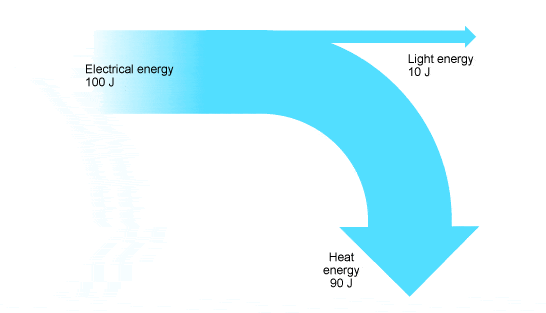
Where does most of the energy go in this transformation.
Electrical energy
Light
Heat
other
67
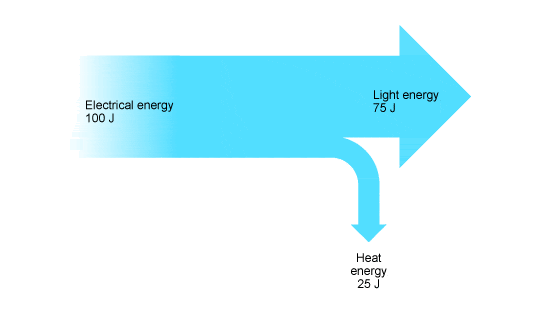
Multiple Choice
What is this diagram called?
Stankey Diagram
Sankey Diagram
Sankay Diagram
Samkay Diagram
68
Multiple Choice
A kettle uses 100J of electrical energy to produce 7J of sound energy and 93J of thermal energy. How efficient is the kettle?
100%
7%
93%
95%
69
Multiple Choice
A washing machine uses 250J of electrical energy to produce 125J of useful energy. How efficient is it?
5%
50%
55%
100%
70
Multiple Choice
An iPhone charger coverts 75J of electricty in to 50J of charge and 25J of thermal energy. How efficient is the charger?
10%
100%
33%
67%
71
Multiple Choice
Which of these equations is correct?
efficiency = total energy transferreduseful energy transferred
efficiency = useful energy transferredtotal energy transferred
energy = efficiency ×100%
efficiency = total energy tranferredwasted energy transferred
Extra Lesson
EASE 1 preparation
Grade 7
by Irvani Prasanti
Show answer
Auto Play
Slide 1 / 71
SLIDE

Similar Resources on Wayground
64 questions
Europe Geography
Lesson
•
7th Grade
65 questions
Famous Artists
Lesson
•
7th Grade
67 questions
Life in Ancient Egypt 2 / Mummificationa and Pyramids
Lesson
•
7th Grade
66 questions
Measuring Angles
Lesson
•
7th Grade
65 questions
G7 - Final Test Review
Lesson
•
7th Grade
67 questions
Mastery Test Review (Yay!)
Lesson
•
7th Grade
64 questions
CHAPTER 5 SCIENCE FROM 1
Lesson
•
7th Grade
64 questions
ENG7 Term 3 Pronoun-Antecedent Agreement Review and Continuation
Lesson
•
7th Grade
Popular Resources on Wayground
10 questions
5.P.1.3 Distance/Time Graphs
Quiz
•
5th Grade
10 questions
Fire Drill
Quiz
•
2nd - 5th Grade
20 questions
Equivalent Fractions
Quiz
•
3rd Grade
15 questions
Hargrett House Quiz: Community & Service
Quiz
•
5th Grade
20 questions
Main Idea and Details
Quiz
•
5th Grade
20 questions
Context Clues
Quiz
•
6th Grade
20 questions
Inferences
Quiz
•
4th Grade
15 questions
Equivalent Fractions
Quiz
•
4th Grade