Plants and water
Presentation
•
Biology
•
8th Grade
•
Medium
Lkhagvajargal Sanjsuren
Used 5+ times
FREE Resource
11 Slides • 19 Questions
1
Previous lesson
Testing a leaf for starch
2
Photosynthesis
​
3
Destarch a plant
4
Multiple Choice
What are the products of photosynthesis?
Glucose & Oxygen
Water & Oxygen
Carbon dioxide & Water
Glucose & Carbon dioxide
5
Multiple Choice
a. add iodine to the leaf b. boil leaf in water c. boil leaf in alcohol d. rinse leaf in water The correct sequence used to test a leaf for starch from the steps above is:
a b c d
b c d a
c d a b
d c a b
6
Multiple Choice
When testing a leaf for starch why is it necessary to boil it in ethanol first?
To break open the plant cells
To release the starch form the cells
To kill the plant cells
To remove the green chlorophyll from the leaf
7
Multiple Choice
The diagram shows the apparatus used in an investigation to measure the rate of oxygen production during photosynthesis. The investigation was repeated several times and the average amount of gas collected was calculated.
Which two factors must be kept constant during this investigation?
the amount of water in the beaker and the height of the measuring cylinder
the size of aquatic plant and the amount of gas in the measuring cylinder
the size of aquatic plant and the duration of exposure to light
the size of the beaker and the funnel
8
Multiple Choice
In the presence of starch Iodine changes colour...
from red/orange to blue/black
from blue/black to red/orange
from pink to yellow
from yellow to green
from green to white
9
Multiple Choice
How do we destarch a plant?
Place a plant in a dark space for at least 24 hours
Place a plant in the sunlight for a few hours
Leave a houseplant outside overnight
Do not water the plant for a week
10
Multiple Choice
the root of plant take up nitrogen in the form of nitrate from the soil.
What are the nitrates used to make?
fat
glucose
protein
starch
11
Plants and water
Grade 8 by Lkhagvajargal
12
Everyone knows that plants need water.
If you grow plants in pots, you need to water them regularly.
13
Water for support
Plants need water – it helps them to stand upright. Plant cells contain a lot of water, especially inside their vacuoles. A plant cell that has plenty of water is strong and firm. When all the cells in a plant are like this, they press out against each other and make the whole plant firm and well-supported. When a plant cell doesn’t contain enough water, it becomes soft and floppy. When all the cells in a plant are like this, the plant collapses. We say that it has wilted.
14
Water for transport
Plants contain long tubes, called xylem, which transport water from the roots up to the leaves.
There are mineral salts dissolved in the water, and this is how they are transported around the plant.
15
16
Water for cooling
When the water in the xylem gets into the leaves, it spreads out through each leaf. Some of it evaporates into the air spaces inside the leaf.
When water evaporates, it absorbs heat energy. This cools down the surroundings.
The water evaporating inside a plant leaf helps to keep the plant cool. This is really important for plants that live in very hot environments.
17
Water for photosynthesis
Water is one of the reactants in photosynthesis. Water combines with carbon dioxide, inside chloroplasts, to make glucose and oxygen.
In fact, only a very small proportion of the water taken up by a plant’s roots is used in photosynthesis.
18
Homework
COURSEBOOK - Activity 1.3 & Question 1-3 on page 11
WORKBOOK - Exercise 1.3 How temperature affects water loss
19
Multiple Choice
What happens to the rate of transpiration as humidity increases?
Decreases
Increases
Reaches equilibrium
Nothing
20
Multiple Choice
How will water leave through a leaf?
As water
As ice
As water vapor
It won't leave
21
Multiple Choice
What features do root hair cells have that animal cells do not have?
Nucleus and cytoplasm
Cell wall and vacuole
Chloroplasts and cell membrane
Chloroplasts and no vacuole
22
Multiple Choice
How does most of the water needed by the plant get into its leaves?
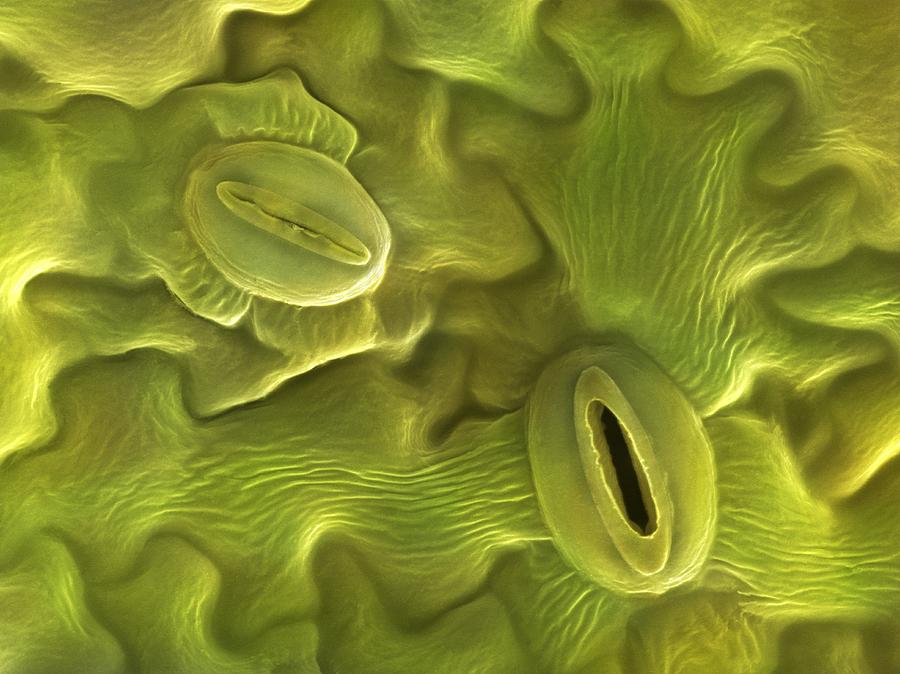
It enters through the stomata
The roots absorb it and then it travels up the xylem
It's made during a chemical reaction in the stem
The flowers capture water and deliver it to the leaves
23
Multiple Choice
Roots absorb water into the __.
Xylem
Phloem
24
Multiple Choice
Both the xylem and phloem are considered-
Stomata
Leaves
Roots
Vascular tissue
25
Multiple Choice
Opening that allows gas exchange
Stomata
Leaves
Roots
Vascular tissue
26
Multiple Choice
Water exits the leaf through the __.
Stomata
Flower
Roots
Phloem
27
Multiple Choice
In what plant cell part/structure is water stored?
chloroplast
cell wall
vacuole
cytoplasm
28
Multiple Choice
What is transpiration?
The evaporation and diffusion of water from inside leaves
The uptake of water through root hair cells
The loss of water from leaves by osmosis
The uptake of water through stem cells
29
Multiple Choice
What happens to the transpiration rate as light intensity increases?
It changes
It stays the same
It decreases
It increases
30
Multiple Choice
How well did you understand the "plant and water"?
I GOT IT
I ALMOST GOT IT
I NEED HELP
Previous lesson
Testing a leaf for starch
Show answer
Auto Play
Slide 1 / 30
SLIDE

Similar Resources on Wayground
23 questions
Westward Expansion
Presentation
•
8th Grade
23 questions
Electromagnetic Spectrum Review
Presentation
•
8th Grade
24 questions
Atoms
Presentation
•
8th Grade
24 questions
Teamwork & Professionalism
Presentation
•
8th Grade
23 questions
Types of Reproduction
Presentation
•
7th Grade
22 questions
Osmosis & Tonicity
Presentation
•
9th Grade
25 questions
Biology EOC Review 3- DNA & Mutations
Presentation
•
9th Grade
19 questions
Periodic Table
Presentation
•
8th Grade
Popular Resources on Wayground
10 questions
5.P.1.3 Distance/Time Graphs
Quiz
•
5th Grade
10 questions
Fire Drill
Quiz
•
2nd - 5th Grade
20 questions
Equivalent Fractions
Quiz
•
3rd Grade
22 questions
School Wide Vocab Group 1 Master
Quiz
•
6th - 8th Grade
20 questions
Main Idea and Details
Quiz
•
5th Grade
20 questions
Context Clues
Quiz
•
6th Grade
20 questions
Inferences
Quiz
•
4th Grade
12 questions
What makes Nebraska's government unique?
Quiz
•
4th - 5th Grade
Discover more resources for Biology
20 questions
Food Chains and Food Webs
Quiz
•
7th - 12th Grade
20 questions
Natural Selection
Quiz
•
8th Grade
5 questions
Human Impacts: How Do People Disrupt Ecosystems?
Interactive video
•
4th Grade - University
10 questions
Exploring Evidence of Evolution
Interactive video
•
6th - 10th Grade
10 questions
Exploring Food Webs and Energy Pyramids
Interactive video
•
6th - 10th Grade
15 questions
Pedigrees
Quiz
•
7th - 12th Grade
10 questions
Comparing Mitosis and Meiosis: Key Differences and Stages
Interactive video
•
6th - 10th Grade
21 questions
Levels Of Organization in Living Things
Quiz
•
6th - 8th Grade