Projectile Motion- an Introduction
Presentation
•
Physics, Science
•
6th - 12th Grade
•
Medium
Doctor Doctor
Used 11+ times
FREE Resource
9 Slides • 25 Questions
1
Projectile Motion- an Introduction
by SciDept Twenty Twenty-One
2
Objectives
describe the horizontal and vertical motions of a projectile
2. investigate the relationship between the angle of release and the height and range of the projectile
3. to take the mandatory screen breaks
3
Hello, students!
Projectile motion entails knowledge about force, motion, the three laws of motion, free fall, and uniform circular motion. Would you please take the mandatory screen breaks to ensure that you can understand the lessons and stay healthy?
4
5
Multiple Choice
What is the acceleration of a ball that is dropped off the side of a cliff after 1,2,3,4,5 seconds? (assume g is rounded to 10 m/s2)
5,10,15, 20, 25 m/s2
10, 20, 30, 40, 50 m/s2
5, 20, 45, 80, 125 m/s2
10,10,10,10,10 m/s2
6
Multiple Choice
When an object falls in physics world, what happens?
It accelerates at a constant rate until it hits the ground
It accelerates at a non-constant rate until it hits the ground
It accelerates at a constant rate until it reaches terminal velocity
It accelerates at a non-constant rate until it reaches terminal velocity
7
Multiple Choice
Which would hit the ground first if dropped from the same height in a vacuum—a feather or a metal bolt?
the feather
the metal bolt
They would hit the ground at the same time.
They would be suspended in a vacuum.
8
9
10
Please take a mandatory 3-minute screen break.
​
11
Multiple Choice
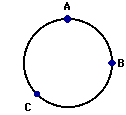
What is the direction of the velocity at point B, if the ball is revolving clockwise?
up
right
down
left
12
Multiple Choice
What is the direction of the acceleration at point A, if the ball is revolving clockwise?
up
right
down
left
13
Multiple Choice
The velocity is always _____ to the line of a circle.
outwards
towards the center
tangent
faster
14
Multiple Choice
Which statement is true about an object that is traveling in uniform circular motion?
The speed of the object varies.
The net force on the object is directed toward the center of the circular path.
The direction of the object's velocity is constant.
The net force on the object is directed away from the center of the circular path.
15
Multiple Choice
Centripetal acceleration is ...
Acceleration toward the center of a curved or circular path
Acceleration toward the outside of a circle
Vertical motion instead of horizontal motion
16
17
Please take a mandatory 3-minute screen break.
​
18
Multiple Choice
The x and y component of a projectile are independent of one another.
True
False
19
Multiple Choice
Without gravity, you can toss anything into the air and it will follow a straight-line path.
True
False
20
Multiple Choice
If the velocity of a tossed rock (or anything really) is great enough, it can become a satellite.
True
False
21
Multiple Choice
If you throw a baseball straight up, what is its acceleration at the highest point?
9.8 m/s2
9.8 m/s
0 m/s2
0 m/s
22
Multiple Choice
In a projectile motion we always have...
1 component (x)
3 components (x,y, and z)
2 components (x and y)
0 components
23
Multiple Choice
What is the vertical acceleration of a projectile?(neglect air resistance)
0 m/s2
9.8 m/s2
24
Multiple Choice
What is the direction of the acceleration for any projectile?
The direction the projectile is traveling.
Down
Up
Sideways
25
Multiple Choice
If you throw a baseball straight up, what is its acceleration at the highest point?
9.8 m/s2
9.8 m/s
0 m/s2
0 m/s
26
Multiple Choice
What is the horizontal acceleration of a projectile?
0 m/s2
9.8 m/s2
27
Multiple Choice
The shape of the path a projectile follows...
circular
linear
wavy
parabolic
28
Multiple Choice
What is the vertical acceleration of a projectile?(neglect air resistance)
0 m/s2
9.8 m/s2
29
Multiple Choice
In a projectile motion we always have...
1 component (x)
3 components (x,y, and z)
2 components (x and y)
0 components
30
Multiple Choice
What is the direction of the acceleration for any projectile?
The direction the projectile is traveling.
Down
Up
Sideways
31
Multiple Choice
A ball is thrown and follows the parabolic path shown above. Air friction is negligible. Point Q is the highest point on the path. Points P and R are the same height above the ground. Which of the following diagrams best shows the direction of the acceleration of the ball at point P?
32
Multiple Choice
The more mass an object has, the faster it will fall.
True
False
33
Multiple Choice
As an object travels through the air, its vertical velocity
changes continuously
remains the same
34
Multiple Choice
What force acts in the y direction that causes an object to travel in a parabolic arc?
Friction
Gravity
Tension
No force acting.
Projectile Motion- an Introduction
by SciDept Twenty Twenty-One
Show answer
Auto Play
Slide 1 / 34
SLIDE

Similar Resources on Wayground
31 questions
The Water Cycle
Presentation
•
6th Grade - University
29 questions
Mendelian Genetics: Part 2
Presentation
•
7th - 11th Grade
26 questions
Mass and Kinetic Energy
Presentation
•
6th - 12th Grade
26 questions
Kinetic Energy, Mass and Speed
Presentation
•
6th - 12th Grade
27 questions
Math-Science MoD Foundation Course Orientation + Quiz
Presentation
•
KG - University
23 questions
Earth Quake Faults
Presentation
•
7th - 12th Grade
25 questions
Deep Sea Currents
Presentation
•
KG - University
27 questions
MS-LS1-6: Photosynthesis and Energy Flow
Presentation
•
7th Grade - University
Popular Resources on Wayground
20 questions
STAAR Review Quiz #3
Quiz
•
8th Grade
20 questions
Equivalent Fractions
Quiz
•
3rd Grade
6 questions
Marshmallow Farm Quiz
Quiz
•
2nd - 5th Grade
20 questions
Main Idea and Details
Quiz
•
5th Grade
20 questions
Context Clues
Quiz
•
6th Grade
20 questions
Inferences
Quiz
•
4th Grade
19 questions
Classifying Quadrilaterals
Quiz
•
3rd Grade
12 questions
What makes Nebraska's government unique?
Quiz
•
4th - 5th Grade
Discover more resources for Physics
10 questions
Genetics Vocabulary Pre-Test (2026 Version)
Quiz
•
8th Grade
15 questions
Absorption, Reflection, Refraction
Quiz
•
4th - 6th Grade
20 questions
Ohm's Law
Quiz
•
9th - 12th Grade
10 questions
Types of Chemical Reactions
Quiz
•
10th Grade
12 questions
Speed - Distance - Time
Quiz
•
12th Grade
23 questions
Acap Physical Science Review
Quiz
•
8th Grade
10 questions
Digital vs Analog
Quiz
•
8th Grade
20 questions
Waves Quizizz
Quiz
•
9th Grade