Search Header Logo
3.2 Proving Figures are Congruent Using Rigid Motions (Revised)

3.2 Proving Figures are Congruent Using Rigid Motions (Revised)

Assessment

Presentation

Mathematics

10th Grade

Medium

CCSS
HSG.CO.B.6, 8.G.A.3, HSG.CO.A.2

+2

Standards-aligned

Created by

Larry Cooper

Used 35+ times

FREE Resource

6 Slides • 15 Questions

1

3.2 Prov. Figures are Congruent Using Rigid Motions

"Push harder than yesterday if you want a different tomorrow."

-Unknown

media

2

3

media

4

media

5

media

6

media

7

Multiple Select

SELECT ALL the rigid transformations :

1

Translation

2

Dilation

3

Rotation

4

Reflection

8

Multiple Choice

Question image

ΔABC \Delta ABC\  is translated 7 units right and 2 units up.  AC\overline{AC}\cong  _____ ? 

1

PI\overline{PI}  

2

IE\overline{IE}  

3

PE\overline{PE}  

9

Multiple Choice

Question image

Select the transformation that, when applied to ΔABC, shows that ΔABC and ΔDEF are congruent.

1

Rotation 90°90\degree about the origin

2

Translation

3

Reflection across the line x = -1

4

Vertical stretch with scale factor 7

10

Multiple Choice

Question image

Determine if the two figures are congruent, if so, how do you know? #4

1

Yes, translation 4 units left and 3 units up

2

Yes, rotation 90o CW/ 270o CCW

3

Yes, reflection over the y-aixs

4

Not Congruent

11

Multiple Select

Question image

What transformation occurred from the blue triangle to the red triangle to prove that the blue triangle is congruent to the red triangle(Select all that apply). #6

1

rotation of 90 degrees clockwise

2

rotation of 180 degrees clockwise

3

rotation of 270 counterclockwise

4

reflection over the y-axis

12

Multiple Choice

Question image

Analyze the two triangles shown. Determine the transformation used to prove that triangle WCT is congruent to triangle PMK. #10

1

rotation 90clockwise

2

rotation 180counterclockwise

3

rotation 90counterclockwise

4

rotation 180clockwise

13

Multiple Choice

Question image

Trapezoid PQRS is rotated 180° about the origin to form trapezoid P'Q'R'S'. Which statement is true? #14

1

The sum of the angle measures of trapezoid PQRS is 180° less than the sum of the angle measures of trapezoid P'Q'R'S'.

2

Trapezoid PQRS is not congruent to trapezoid P'Q'R'S'.

3

The area of trapezoid PQRS is less than the area of trapezoid P'Q'R'S'.

4

The angle measures of trapezoid PQRS are equal to corresponding angle measures of trapezoid P'Q'R'S'.

14

Multiple Choice

Question image

Figure ABCD is shown below. Which statement is true about the shape ABCD if it was reflected across the y-axis to create shape A’B’C’D’? #16

1

Shape A’B’C’D’ will not preserve congruency to shape ABCD.

2

Shape A’B’C’D’ will preserve orientation to shape ABCD.

3

Shape A’B’C’D’ will preserve congruency to shape ABCD.

15

Multiple Choice

Question image

Triangle ABC is shown on the coordinate grid. Which statement about the 180° rotation of triangle ABC about the origin is true? #22

1

The side lengths and angles of triangle A’B’C’ will be more than the side lengths and angles of triangle ABC.

2

The side lengths and angles of triangle A’B’C’ will be less than the side lengths and angles of triangle ABC.

3

The side lengths and angles of triangle A’B’C’ will be congruent to the side lengths and angles of triangle ABC.

4

Triangle A’B’C’ will have the same orientation as triangle A, B, C.

16

Multiple Choice

Question image

Describe a congruence transformation that maps

ΔABC to ΔABC\Delta ABC\ to\ \Delta A'B'C'   (Notice the increments on the graph.) #26

1

Translation 8 units right and 2 units up.

2

Translation 2 units right and 9 units up

3

Translation 8 units left and 2 units down.

4

Translation 4 units right and 1 unit up.

17

Multiple Choice

Question image

Figure X is translated down 5 and then reflected over the y-axis, forming figure Y.

Which sequence of transformations results in the same transformation?

1

a translation left 5 units and then a reflection over the x-axis

2

a translation left 5 units and then a translation down 5 units

3

a 180 degree rotation using the origin as the center of rotation

4

a reflection over the y-axis and then a translation down 5 units

18

Multiple Choice

Question image

In the figure below, △ ABC ≅△ A'B'C'. Which transformation maps △ ABC onto △ A'B'C'?

1

Reflect △ ABC in the x-axis.

2

Translate △ ABC 3 units left and 6 units down.

3

Reflect △ ABC in the y-axis, then rotate it 90° counterclockwise about the origin.

4

Rotate △ ABC 180° counterclockwise about the origin.

19

Multiple Choice

Question image

Which best explains whether or not ΔABC ≅ ΔLMN?

1

The figures are congruent because a 270° rotation about the origin and then a reflection over the x-axis will map ΔABC onto ΔLMN.

2

The figures are congruent because a 180 rotation about the origin and then a reflection over the x-axis will map ΔABC onto ΔLMN.

3

The figures are not congruent because point B corresponds with point N and point C corresponds with point M.

4

The figures are not congruent because there is no rigid transformation or combination of rigid transformations that will map ΔABC onto ΔLMN.

20

Multiple Choice

Question image

Given the triangles shown at the right. Which rigid motion will verify that ΔABC is congruent to ΔDEF? #40

1

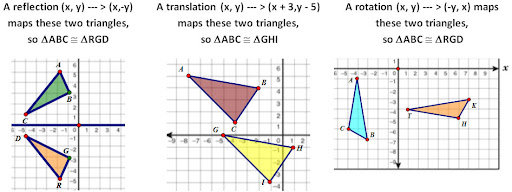
translation (x, y)→(x + 3, y - 5)

2

reflection over the y-axis

3

rotation of 90º about origin

4

translation (x, y)→(x + 1,y - 3)

21

Multiple Choice

Question image

Use rigid motions to explain why ∆ABC∆XZY. #42

1

If ∆ABC is rotated around the origin 180 degrees, it will map to ∆XYZ. Since Rotations preserve shape and size, the triangles are congruent.

2

If ∆ABC is translated, it will map to ∆XYZ. Since Rotations preserve shape and size, the triangles are congruent.

3

If ∆ABC is reflected across the y-axis, it will map to ∆XYZ. Since Rotations preserve shape and size, the triangles are congruent.

4

If ∆ABC is rotated around the origin 90 degrees, it will map to ∆XYZ. Since Rotations preserve shape and size, the triangles are congruent.

3.2 Prov. Figures are Congruent Using Rigid Motions

"Push harder than yesterday if you want a different tomorrow."

-Unknown

media

Show answer

Auto Play

Slide 1 / 21

SLIDE