Search Header Logo
Plate Tectonics

Plate Tectonics

Assessment

Presentation

•

Science

•

8th Grade

•

Medium

•
NGSS
MS-ESS2-3, MS-ESS2-2, HS-ESS1-5

+3

Standards-aligned

Created by

Ciara West

Used 20+ times

FREE Resource

6 Slides • 42 Questions

1

Plate Tectonics

by Miss West

2

​You need to know why we think the plates move and how...

​Alfred Wegner discovered 3 things:

​Continents look like puzzles

​Fossils and Rocks match across continents

​Glacier evidence is found in tropical continents

media
media
media
media
media

Harry Hess discovered 2 things

​The seafloor was spreading out at mid ocean ridges

​Plates move by CONVECTION in the mantle

3

Multiple Choice

Scientists recently discovered that rocks collected from the Franklin Mountains in West Tests and rocks collected from mountains in eastern Antarctica were exactly the same age. Further research showed that the rocks were chemically and geologically the same and came from the same magma source. This discovery provides evidence of--

1

coastal erosion

2

plate tectonics

3

ocean currents

4

glacial melting

4

Multiple Choice

Question image

Fossil records indicate that the continents were once connected. How do fossil records support this claim?

1

We have been able to transport the same types of fossils from one continent to another.

2

Fossils of the same organism have been found on continents that are now separated by oceans.

3

Some continents contain fossils of many different types of organisms.

5

Multiple Choice

Question image

One piece of evidence for Plate Tectonics is that--

1

some continents appear to fit together like a puzzle.

2

we have video footage of the plates actually moving.

3

all continents have formed from volcanic eruptions.

4

the continents are no longer moving.

6

Multiple Choice

Which of the following causes Earth's tectonic plates to move?
1
Energy from the Sun
2
Magnetic Pole Reversal
3
Convection currents in the mantle
4
Faults in Mountain Ranges

7

Multiple Choice

Question image

Younger crust being found near mid-ocean ridges supports the idea of Plate Tectonics because---

1

this indicates that new crust is being formed over time, pushing old crust outward.

2

this indicates that volcanoes are able to take place in different places on the Earth.

3

this indicates that new crust is never formed.

4

this indicates that the continents are stationary.

8

Multiple Choice

Which of the following is NOT evidence to support the theory of plate tectonics?

1

Fossils

2

Continental fit

3

Glaciers

4

Sand Erosion

9

Multiple Choice

Question image

Which of the following occurs because of convection currents?

1

Pressure in the crust decreases.

2

The mantle increases in size.

3

Pressure in the crust increases.

4

Pieces of the crust, known as tectonic plates, move.

10

​You need to know what is made at the 3 plate boundaries...

​Convergent=Collide

media

​When 2 pieces of dry land crust collides, you get MOUNTAINS only.

​

media

When 1 wet oceanic crust collides with 1 dry land crust, you get Sinking ocean crust (subduction), Trenches, and Volcanoes.

media

When 2 wet oceanic crusts collide, you get Sinking ocean crust (subduction), Trenches, and Volcanoes that make Islands

11

​You need to know what is made at the 3 plate boundaries...

​Divergent= Divide=RIPS in the earth's crust

​When 2 pieces of dry, land crust divide, a Rift Valley. I think of it as a RIPPED Valley because it's being pulled apart!

​

When 2 wet oceanic crusts divide, you get seafloor spreading at a Mid Ocean Ridge. MOR land is made at the MID OCEAN RIDGE.

media
media
media

12

​You need to know what is made at the 3 plate boundaries...

​Transform Tectonic Plates= Slide

​When 2 pieces of crust slide past each other, we get earthquakes that occur at a fault.​

media

13

Multiple Choice

A plate boundary where two plates move away from each other is called
1
Divergent Boundary
2
Convergent Boundary
3
Transform Boundary
4
Subduction

14

Multiple Choice

A Plate Boundary where two plates move toward each other is called
1
Convergent Boundary
2
Divergent Boundary
3
Transform Boundary
4
Subduction

15

Multiple Choice

Convergent Plate Movement can create
1
Rifts
2
Mountains
3
Ocean Ridges
4
Radiation

16

Multiple Choice

Divergent Plate movement can create
1
Convection Currents
2
Conduction
3
Mountains
4
Rifts and ocean ridges

17

Multiple Choice

Plates slide past each other at _________________ boundaries.

1

divergent

2

convergent

3

transform

4

universal

18

Multiple Choice

A __________ forms where plates diverge on land.

1

rift valley

2

mid-ocean ridge

3

mountain

4

trench

19

Multiple Choice

________________ currents drive Earth's plate movement.

1

ocean

2

atmosphere

3

wind

4

convection

20

Multiple Choice

The San Andreas fault is an example of which type of boundary?

1

transform

2

divergent

3

convergent

4

universal

21

Multiple Choice

Question image

What type of landform is at C?

1

mid-ocean ridge

2

continental crust

3

deep ocean trench

4

sea floor spread

22

Multiple Choice

Question image

Identify the landform labeled A

1

mid-ocean ridge

2

deep ocean trench

3

sea floor spread

23

Multiple Choice

Question image

The process by which the ocean floor sinks beneath a deep-ocean trench and back into the mantle is known as _______

1

convection.

2

continental drift.

3

subduction.

4

conduction.

24

Multiple Choice

Question image
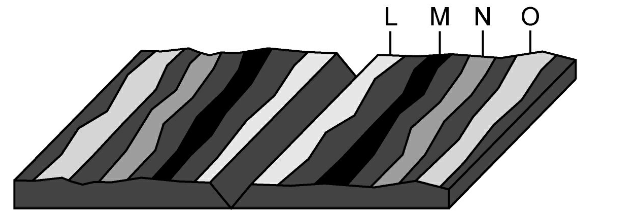
Where would the oldest rock be found?
1
L
2
M
3
N
4
O

25

Multiple Choice

The Himalayas in Asia are an example of what type of plate boundary?
1
divergent
2
continent-to-continent convergent
3
ocean-to-continent convergent
4
transform

26

Multiple Choice

Question image
What type of crustal feature will form at this boundary?
1
mid-ocean ridge
2
volcanic island arc
3
mountains
4
fault

27

Multiple Choice

Question image

This volcanic island arc pictured mostly formed at what type of boundary?

1

Convergent

2

Divergent

3

Transform

28

Multiple Choice

Question image
What type of boundary is located between Nazca and Pacific Plate?
1
convergent
2
divergent
3
transform

29

Multiple Choice

Question image
Which crustal feature would result from this boundary?
1
mountains
2
rift valley
3
fault

30

Multiple Choice

Earthquakes and volcanoes are most likely found in which locations? 
1
at plate boundaries
2
in oceans
3
in the middle of continents
4
in the middle of plates

31

Multiple Choice

When an oceanic plate and a continental plate collide, which one will subduct?

1

oceanic

2

continental

3

neither

4

both

32

Multiple Choice

A collision between two pieces of continental crust at a converging boundary produces a

1

mid-ocean ridge

2

deep ocean trench

3

volcanic mountain range

4

folded mountain range

33

Multiple Choice

What land form is created when an oceanic plate is subducted beneath a continental plate?

1

mid-ocean ridge

2

rift valley

3

trench

4

volcanic island arc

34

Multiple Choice

Question image
What geologic feature is shown in the picture below?
1
Rift Valley
2
Volcanic Mountains
3
Trench

35

Multiple Choice

Question image

What geologic feature is shown in the picture below?

1

Mid-ocean ridge

2

Subduction Zone

3

Volcanic Islands

4

Seafloor spreading

36

​STAAR Questions

37

Multiple Choice

Question image

Which table represents a land feature or geologic process that occurs at each type of boundary pictured? (8.9B)

1
2
3
4

38

Multiple Choice

What would you be most likely to find at a divergent boundary between two pieces of oceanic crust?
1
Rift
2
Mid-Ocean Ridge
3
Island Arc
4
Flat land

39

Multiple Choice

What would you be most likely to find at a convergent boundary between two pieces of continental crust?
1
Volcano
2
Folded Mountain
3
Rift Valley
4
Subduction Zone

40

Multiple Choice

Question image
What type of crustal feature will form at this boundary?
1
mid-ocean ridge
2
volcanic island arc
3
mountains
4
fault

41

Multiple Choice

Question image

The information regarding the movement of the seafloor helped geologists form the theory of-

1

continental drift

2

sea floor spreading

3

glacial impact

4

global warming

42

Multiple Choice

The San Andreas Fault in California stretches over 800 miles and is responsible for many of the earthquakes that happen in California. What kind of a plate boundary is the San Andreas Fault?

1

Transform

2

Subduction

3

Convergent

4

Divergent

43

Multiple Choice

Question image

The above table shows land features and the boundary type that has formed those features. Choose the best choice to complete the boundary types for both oceanic ridges and terrestrial mountain ranges.

1

Oceanic ridge: Divergent Boundary

Mountain Range on Land: Divergent Boundary

2

Oceanic ridge: Convergent Boundary

Mountain Range on Land: Divergent Boundary

3

Oceanic ridge: Convergent Boundary

Mountain Range on Land : Transform Boundary

4

Oceanic ridge: Divergent Boundary

Mountain Range on Land: Convergent Boundary

44

Fill in the Blank

Question image

Which of the following is the correct type of boundary that is represented in the diagram, and what is the resulting feature at this boundary?

45

Multiple Choice

Question image
1

Student 1

2

Student 2

3

Student 3

4

Student 4

46

Multiple Choice

Question image
What is B?
1
ocean trench
2
mid-ocean ridge
3
rift valley
4
volcano

47

Multiple Choice

Question image
What is A?
1
ocean trench
2
mid-ocean ridge
3
volcano
4
rift valley

48

Multiple Choice

Question image

Which of the following is an accurate description of the movement of the tectonic plates in the diagram?

1

Plate A is sliding past plate B.

2

Plate A and plate B are diverging.

3

Plate A and plate B are of equal density and are colliding.

4

Plate A is denser than plate B, which results in subduction.

Plate Tectonics

by Miss West

Show answer

Auto Play

Slide 1 / 48

SLIDE