

Cells Theory, Microscopes, and Types of Cells

Presentation
•
Biology, Science
•
10th Grade
•
Medium
Standards-aligned

Kara Simpson
Used 187+ times
FREE Resource
15 Slides • 13 Questions
1
by Kara Simpson
2
Who: Robert Hooke
When: 1665
How: Looked at cork through a microscope
Significance: First to see and name cells


3
Who: Anton van Leeuwvenhoek
When: 1683
What: microorganisms in pond water
Significance: Cells are alive

4
Contributors:
Matthias Schleiden --> all plants are made up of cells
Theodor Schwann --> all animals are made up of cells
Rudolph Virchow --> cells only come from other cells

5
Multiple Choice
Which statement is NOT a part of the Cell Theory?
All cells come from pre-existing cells
All living things are made of cells
All cells form from spontaneous generations
Cells are the basic unit of structure & function of living organisms
6
Multiple Select
Check all that applies to the Cell Theory:
Plants
Animals
Bacteria
Water
7
Multiple Choice
How can we see cells?
Light Microscopes
Electron Microscopes
Both
8
Multiple Choice
9

10
Basic tool of biology
Creates an enlarged image of an object
Terms to know:
magnification --> Power to increase an objects apparent size
resolution --> Power to show detail clearly

11
Compound Light Microscope
Uses a series of lenses to magnify images
Use stains and dyes to see cells better
Electron Microscope
Create an image with a beam of electrons
Transmission Electron Microscope
Scanning Electron Microscope
Scanning Tunneling Microscope

12
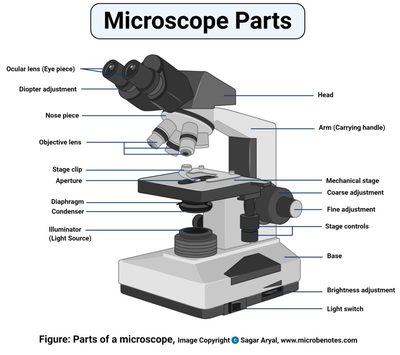
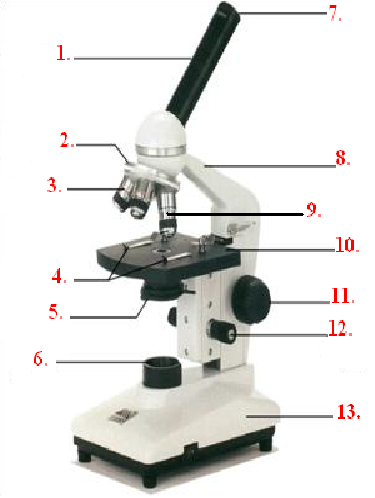
Objective Lens = Lens closest to the specimen; directs light to the ocular.
Ocular = Eyepiece; Lens in eye piece
Revolving Nosepiece = Holds the objective lenses; allows for adjustment of objective lenses to higher or lower magnification.
13
4. Stage = holds the specimen to be viewed
5. Stage Clips = keeps the microscope slide in place
6. Diaphragm = adjusts the amount of light that passes through the specimen
7. Light source = source of light on the microscope
8. Arm = holds the ocular and revolving nosepiece; carry using the arm
14
9. Coarse Adjustment knob = allows for focus of the specimen at low magnification; only use on low magnification
10. Fine adjustment knob = used to focus specimen at high magnification
11. Base = the bottom of the microscope; put one hand under the base to carry
15
Multiple Choice
Where do you place the slide?
eyepiece lens
Objective lens
Stage
lamp
16
Multiple Choice
What are the lenses above the stage called?
eyepiece lens
Objective lens
Stage
lamp
17
Multiple Choice

18
Multiple Choice
19
Multiple Choice

20

21
Cells that have a nucleus: EUKARYOTIC
Cells that do not have a nucleus: PROKARYOTIC

22
A cell membrane
Cytoplasm
DNA
Ribosomes
Ability to generate energy

23
are bacteria
are small
are old
are missing a nucleus and organelles

24
Plants, animals, fungi or protists
Have a nucleus and organelles
DNA is found in the nucleus
Single or multicellular organisms
generally large and complex

25
Multiple Choice
The two types of cells are
Youkaryotic and Prokaryotic
Eukaryotic and Prokaryotic
Plant and Animal
26
Multiple Select
What do all cells have:
nucleus
cytoplasm
cell wall
cell membrane
RER
27
Multiple Choice
Prokaryotic cells are missing:
cytoplasm
ribosomes
a nucleus
a cell membrane
DNA
28
Multiple Choice
A nucleus is found in
Eukaryotic Cells
Bacteria
Prokaryotic Cells
by Kara Simpson
Show answer
Auto Play
Slide 1 / 28
SLIDE
Similar Resources on Wayground

20 questions
Rush Day 1 Cells
Presentation
•
10th Grade
19 questions
The study of cells using the Microscope
Presentation
•
10th Grade
22 questions
Cell Cycle and Cancer Review
Presentation
•
9th - 10th Grade
20 questions
Cell Cycle & Cancer
Presentation
•
9th - 10th Grade
19 questions
Transport
Presentation
•
10th Grade
19 questions
DNA Replication
Presentation
•
9th - 10th Grade
23 questions
Cell Cycle, Mitosis & Meiosis Review
Presentation
•
9th Grade
25 questions
Mutations
Presentation
•
9th - 10th Grade
Popular Resources on Wayground
21 questions
Continents and Oceans

Quiz
•
6th Grade
20 questions
Parts of Speech
Quiz
•
5th Grade
16 questions
Subject & Predicate
Quiz
•
5th Grade
25 questions
Multiplication Facts
Quiz
•
5th Grade
12 questions
Map Skills
Quiz
•
3rd Grade
22 questions
Continents and Oceans
Quiz
•
5th Grade
15 questions
Rounding Decimals
Quiz
•
5th Grade
20 questions
Brand Labels
Quiz
•
5th - 12th Grade
Discover more resources for Biology
10 questions
Exploring the 4 Major Macromolecules and Their Functions

Interactive video
•
9th - 12th Grade
20 questions
Cell organelles and functions
Quiz
•
10th Grade
20 questions
Cell Transport
Quiz
•
9th - 12th Grade
20 questions
Macromolecules
Quiz
•
10th Grade
20 questions
BIOLOGY-CELL MEMBRANE AND CELL TRANSPORT
Quiz
•
9th - 10th Grade
18 questions
FAKE IT 'TILL YOU MAKE IT: Mitosis vs. Meiosis
Quiz
•
10th Grade
16 questions
AP Biology: Unit 2 Review (CED)
Quiz
•
9th - 12th Grade
16 questions
AP Biology: Unit 1 Review (CED)
Quiz
•
9th - 12th Grade