SSA Space Review
Presentation
•
Science
•
7th - 9th Grade
•
Easy
+9
Standards-aligned
Katherine Heter
Used 31+ times
FREE Resource
20 Slides • 28 Questions
1
SSA Space Review
by Katie Heter
2
3
4
5
Multiple Choice
In the diagram, which circle would contain the planet Earth and its moon?
Sun
Solar System
Galaxy
Universe
6
Multiple Choice
Object X is made of layers of solid and liquid rock and metals. Its outermost layer is a water ice shell. It is larger than the smallest planet, but does not orbit the Sun. Which type of object is it?
a moon
an asteroid
an inner planet
an outer planet
7
Multiple Choice
Hierarchical relationships are typically based on levels. The subordinate or lower-level objects are then all contained in the next category in the hierarchy. Which of the following correctly organizes astronomical bodies from largest to smallest?
stars, solar systems, galaxies, planets
universe, planets, solar systems, stars
galaxy, planets, comets, stars
universe, galaxy, solar system, stars
8
Multiple Choice
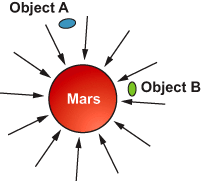
Here is a model of the gravitational force of Mars. Objects A and B have the same mass but are different distances from Mars. Which statement explains how the gravitational force affects the two objects?
Object A and B will be affected equally by the gravitational force.
Object B will be more affected by the gravitational force because it is closer to Mars than Object A.
Object A will be more affected by the gravitational force because it is farther from Mars than Object B.
9
Multiple Choice
increase because gravitational force increases
decrease because gravitational force decreases
decrease because gravitational force increases
increase because gravitational force decreases
10
11
Apparent vs Absolute
12
13
Multiple Choice
Hydrogen
Helium
Lithium
Heavy Elements
14
Multiple Choice
Scientists have determined that the star on the left is actually much brighter than the star on the right. What may best explain this difference between observation and reality?
Iota Canis Majoris must be much smaller than Sirius
Sirius is much closer to Earth than Iota Canis Majoris
Iota Canis Majoris must have been dimmer in the past
Sirius must create a lot more visible light compared to Iota Canis Majoris
15
Multiple Choice
Iota Canis Majoris has an apparent brightness of 4.36, while Sirius has an apparent brightness of -1.46. Even so, Sirius seems much brighter because it is much closer to Earth. If Sirius and Iota Canis Majoris were the same distance from Earth, which of the following statements would be true
Iota Canis Majoris would appear to be smaller than Sirius
Iota Canis Majoris would appear to be much brighter than Sirius
Sirius would appear to be brighter than Iota Canis Majoris
Sirius would appear to be hotter than Iota Canis Majoris
16
Multiple Choice
Based on the diagram, which star is brighter than our Sun but has a lower temperature?
Sirius A
Aldebaran
Sirius B
Alpha Centauri B
17
Multiple Choice
What is the difference between absolute brightness and apparent magnitude?
Absolute brightness is the total amount of light emitted by the star and apparent magnitude is what color it appears
Absolute magnitude is how brightly stars are shining, while apparent magnitude is how bright they look from Earth
Absolute brightness is the core temperature and apparent magnitude is how bright it looks from Earth
Absolute brightness is the star’s color and apparent magnitude is how bright it looks from Earth
18
Multiple Choice
A
B
C
D
19
20
Multiple Choice
high, low
high, high
low, high
low, low
21
Multiple Choice
Gamma Rays
Radio Waves
Visible Light
Infrared rays
22
Multiple Choice
5. Which of the following colors of the Visible Light Spectrum has the lowest amount of energy?
yellow
green
blue
orange
23
Multiple Choice
11. In which wavelength would you expect the hottest stars to emit most of their energy?
gamma rays
microwaves
radio waves
visible light
24
Multiple Choice
8. Within the visible spectrum of light, there are many colors: red, orange, yellow, green, blue, indigo, and violet. What characteristic of each of these colors makes this spectrum of light visible to the human eye?
Each color has a different wavelength.
Each color travels at a different speed.
Each color must travel a different distance to our eyes.
Each color has a different level of intensity.
25
26
27
Multiple Choice
What is transported by a wave?
air
energy
matter
particles
28
Multiple Choice
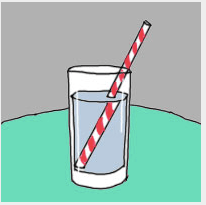
Why does the straw appear to be bent?
light is reflected
light is absorbed
light is turned
light is refracted
29
Multiple Choice
Sound waves cannot travel through _________.
paper
milk
hydrogen
empty space
30
31
32
33
34
35
36
Multiple Choice
It is summer.
It is spring.
It is winter.
It is fall.
37
Multiple Choice
distance from the sun
rotation of the earth
change in solar output
tilt of the earth's axis
38
Multiple Choice
Because it is closest to the sun.
Because it receives the most direct sunlight
Because no clouds form here.
Because it is far from the sun
39
40
41
42
Spring Tide- especially high tides caused by the Sun and the Moon working together
Neap Tides- small high tides caused by the Sun and the Moon working against each other
43
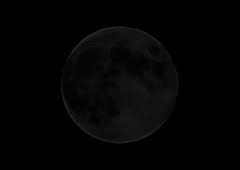
Multiple Choice
First Quarter
Last Quarter
New Moon
Full Moon
44
Multiple Choice
Which special type of tide is this?
spring tide
neap tide
tide pods
low tide
45
Multiple Choice
Full moon
New moon
Waxing moon
46
Multiple Choice
Lunar eclipse
Solar eclipse
Partial eclipse
47
Multiple Choice
Sun
Saturn
Moon
Venus
48
Multiple Choice
Wha type of tide would this arrangement of earth-moon-sun create?
full moon tide
new moon tide
neap tide
spring tide
SSA Space Review
by Katie Heter
Show answer
Auto Play
Slide 1 / 48
SLIDE

Similar Resources on Wayground
39 questions
LIght technology
Presentation
•
8th Grade
47 questions
Understanding Plate Tectonics
Presentation
•
6th - 8th Grade
45 questions
Chemistry Test Review
Presentation
•
7th - 9th Grade
44 questions
Symbiosis Lesson
Presentation
•
6th - 10th Grade
46 questions
Force and Motion
Presentation
•
7th - 8th Grade
40 questions
Math 1 Unit 6 Statistics Day 2
Presentation
•
7th - 9th Grade
43 questions
Newton's 3rd Law
Presentation
•
6th - 8th Grade
47 questions
Chemical reactions and equations
Presentation
•
8th Grade
Popular Resources on Wayground
20 questions
"What is the question asking??" Grades 3-5
Quiz
•
1st - 5th Grade
20 questions
“What is the question asking??” Grades 6-8
Quiz
•
6th - 8th Grade
10 questions
Fire Safety Quiz
Quiz
•
12th Grade
20 questions
Equivalent Fractions
Quiz
•
3rd Grade
34 questions
STAAR Review 6th - 8th grade Reading Part 1
Quiz
•
6th - 8th Grade
20 questions
“What is the question asking??” English I-II
Quiz
•
9th - 12th Grade
20 questions
Main Idea and Details
Quiz
•
5th Grade
47 questions
8th Grade Reading STAAR Ultimate Review!
Quiz
•
8th Grade
Discover more resources for Science
20 questions
8th Grade Science STAAR Review
Quiz
•
8th Grade
8 questions
Amoeba Sister Asexual vs Sexual Reproduction
Interactive video
•
8th Grade
19 questions
Introduction to Properties of Waves
Presentation
•
6th - 8th Grade
16 questions
Interactions within Ecosystems
Presentation
•
6th - 8th Grade
20 questions
genetics, punnett squares, heredity
Quiz
•
7th Grade
16 questions
Photosynthesis and Cellular Respiration Review
Quiz
•
7th Grade
20 questions
Abiotic & Biotic Factors
Quiz
•
7th Grade
18 questions
Conduction Convection Radiation
Quiz
•
7th Grade