

Down in the Deep

Presentation
•
Science
•
10th Grade
•
Medium
+7
Standards-aligned

Stephanie Vivas
Used 331+ times
FREE Resource
13 Slides • 11 Questions
1
by Stephanie Vivas
2
Organisms that can make food are very important in the ecosystem. They can produce food for themselves, and the others that eat them.

3
Multiple Choice
What is another term for a producer?
Autotroph
Heterotroph
Herbivore
Carnivore
4
Fill in the Blanks
Provide an example of a producer:
Type answer...
5
Plant cells have a unique organelle called a chloroplast. Chloroplasts contain a pigment called chlorophyll, which is what absorbs solar energy so the plant can use it to make food.

6
Draw
Circle the part of the plant that does photosynthesis.
7
Photosynthesis is an example of a chemical reaction.
Reactants are the original molecules that go into the reaction. They are rearranged and used to make products, which is what comes out of the reaction.

8
Multiple Select
Select the reactants of photosynthesis
Carbon Dioxide
Oxygen
Water
Glucose
Solar Energy
9
Multiple Select
Select the products of photosynthesis
Carbon Dioxide
Oxygen
Water
Glucose
Solar Energy
10
This is my mom, Flor. Her name means "flower" in Spanish- and she really does love flowers!
She talks and sings to her plants as she waters them, and she insists it helps them grow better.

11
Poll
Do you think you talking and singing to plants a lot helps them grow?
I think so
No, I don't think so
12

Some people say talking to plants helps them grow because you are giving them more CO2 as you exhale more around them!
13
Multiple Choice
True or False:
Photosynthesis can not take place if there is no sunlight
True
False
14
There are organisms like animals found all over the planet, even in the deep ocean and they need oxygen to survive.
Examine the information on the following slide. It is a chart that examines the relationship between the depth of the ocean and the amount of oxygen available.

15

Examine the chart- what seems to be happening to the amount of oxygen the deeper you go into the ocean?
16
Open Ended

Examine the chart- what seems to be happening to the amount of oxygen the deeper you go into the ocean?
17
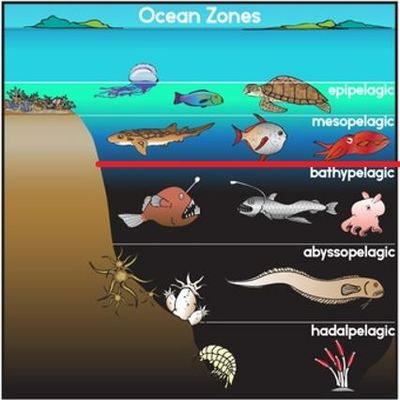
The word "photo" means light.
Like in photosynthesis, where plants can use light to create sugar.
If we say there is an aphotic zone in the oceans, what do you think this means?
18
Dropdown
19
Multiple Choice

True or False: Plants can survive in the aphotic zones of the ocean
True
False
20

21
There is no sunlight, so there are no plants and no photosynthesis in the deep ocean zones.
For a long time, scientists thought this means there was no life in the deep oceans.
Until 1977- enter Robert Ballard and his expedition to the ocean floor.

22

In 1977, Robert Ballard was the first scientist to discover there was life on the ocean floor. BUT- there are very different kinds of producers living in the deep ocean.
23
Multiple Choice
Do you think deep ocean producers can do photosynthesis?
Yes they can
No they can't
24
There is no sunlight, so there are no plants or photosynthesis in the deep ocean.
The main kinds of producers are bacteria that do chemosynthesis, where they use chemicals released from the Earth to help them create sugar.

by Stephanie Vivas
Show answer
Auto Play
Slide 1 / 24
SLIDE
Similar Resources on Wayground

17 questions
Origin Of Life
Presentation
•
9th - 11th Grade
19 questions
INDUS RIVER VALLEY CIVILIZATION
Presentation
•
10th Grade
19 questions
CORRELATIVE CONJUNCTION
Presentation
•
10th Grade
21 questions
Q3 MODULE 4 DNA REPLICATION
Presentation
•
10th Grade
19 questions
Calculating Speed, Acceleration and Force Review
Presentation
•
9th - 10th Grade
19 questions
Tides
Presentation
•
9th Grade
16 questions
Cell Membrane
Presentation
•
9th - 10th Grade
20 questions
Effects of Electric Current
Presentation
•
10th Grade
Popular Resources on Wayground
10 questions
How much do you know about our Portrait of an Eagle?

Quiz
•
10th Grade
10 questions
Fast Food Slogans
Quiz
•
6th - 8th Grade
21 questions
Continents and Oceans
Quiz
•
6th Grade
20 questions
Parts of Speech
Quiz
•
5th Grade
16 questions
Subject & Predicate
Quiz
•
5th Grade
25 questions
Multiplication Facts
Quiz
•
5th Grade
12 questions
Map Skills
Quiz
•
3rd Grade
22 questions
Continents and Oceans
Quiz
•
5th Grade
Discover more resources for Science
10 questions
Exploring Chemical and Physical Changes

Interactive video
•
6th - 10th Grade
10 questions
Decoding the Periodic Table of Elements
Interactive video
•
6th - 10th Grade
10 questions
Exploring the Periodic Table
Interactive video
•
6th - 10th Grade
14 questions
Physical and Chemical Changes
Quiz
•
10th Grade
22 questions
Periodic Table Review
Quiz
•
9th - 12th Grade
10 questions
Exploring the States of Matter
Interactive video
•
6th - 10th Grade
10 questions
Exploring Physical and Chemical Changes
Interactive video
•
6th - 10th Grade
21 questions
Macromolecules and Enzymes Study Guide
Quiz
•
9th - 10th Grade