Search Header Logo
9.3 PRINCIPLE OF EXPANSION AND CONTRACTION OF MATTER

9.3 PRINCIPLE OF EXPANSION AND CONTRACTION OF MATTER

Assessment

Presentation

Science

2nd Grade

Easy

NGSS
MS-PS1-4, MS-ETS1-1, MS-PS3-4

+5

Standards-aligned

Created by

KASMAWATI Moe

Used 5+ times

FREE Resource

18 Slides • 35 Questions

1

9.3 PRINCIPLE OF EXPANSION AND CONTRACTION OF MATTER

by KASMAWATI Moe

2

media

3

media

4

5

media

6

7

media

8

media

9

10

media

11

media

12

13

media

14

15

media

16

17

media

18

media

19

Multiple Choice

What are the three states of matter?
1
solid, volume, mass
2
density, volume, mass
3
solid, liquid, gas
4
density, gas, volume

20

Multiple Choice

Adding HEAT to matter causes its particles to:
1
move faster and farther apart
2
Move slower and farther apart
3
Move faster and closer together
4
Move slower and closer together

21

Multiple Choice

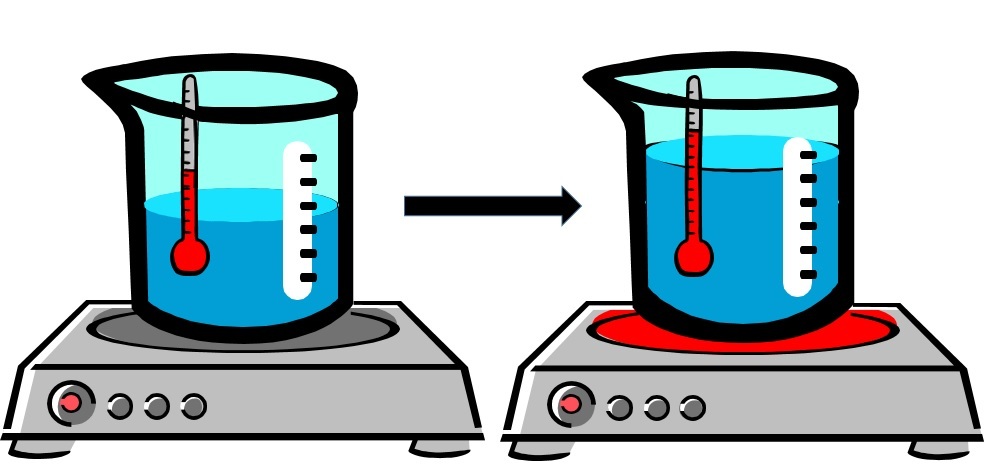
Question image

When temperature increases (gets "hotter"), the volume of matter increases (gets bigger).

1

Dissolving

2

Compression

3

Thermal Expansion

4

Diffusion

22

Multiple Choice

When the temperature of matter decreases the particles ...
1
speed up and move farther apart
2
speed up and move closer together
3
slow down and move farther apart
4
slow down and move closer together

23

Multiple Choice

Railroad tracks have gaps between rails so they don't buckle in hot weather because
1
thermal conductivity
2
specific heat
3
thermal expansion
4
thermal insulation

24

Multiple Choice

When air in a hot air balloon is heated the air inside the baloon...
1
expands
2
contracts
3
evaporates
4
condenses

25

Multiple Choice

Question image

When thermal energy is added to a substance, the substance's particles move:

1

More rapidly at an increased distance from each other.

2

More rapidly with less distance between each other.

3

More slowly with a greater distance between each other.

4

More slowly with a reduced distance between each other.

26

Multiple Choice

Question image
Thermal energy always moves:
1
From a high temperature object to a lower temperature object.
2
From a lower temperature object to a higher temperature object.
3
From an object with lower kinetic energy to an object with higher kinetic energy.
4
From an object of higher mass to an object of lower mass.

27

Multiple Choice

If an object has particles that are moving very slowly, the object's temperature is probably ______.
1
hot
2
small
3
cold
4
big

28

Multiple Choice

If an object has particles that are moving very quickly, the object 's temperature is probably _____.
1
cold
2
slow
3
big
4
hot

29

Multiple Choice

Question image

If the movement of the atoms increases, you can assume the temperature was _________.

1

Increased

2

Decreased

3

Not Changes

30

Multiple Choice

Which is NOT a part of the particle kinetic theory of matter?

1

All atoms are in motion

2

The faster atoms move, the more energy they have.

3

All matter is made of atoms

4

The atoms in a solid are not moving.

31

Multiple Choice

When objects absorb heat, the particles...
1
gain energy and vibrate at fixed position.
2
gain energy and increase in size.
3
gain energy and move slower.
4
gain energy and move faster.

32

Multiple Choice

When objects contract upon cooling...
1
volume increases and density increases.
2
volume increases and density decreases.
3
volume decreases and density decreases.
4
volume decreases and density increases.

33

Multiple Choice

As particles are exposed to warmer temperatures they __________

1

speed up

2

slow down

3

stay the same

4

vibrate at fixed positions

34

Multiple Choice

As particles are exposed to colder temperatures they _____
1
speed up
2
slow down
3
stay the same
4
become ions

35

Multiple Choice

Which characteristic is included in the particle theory of matter?

1

All matter is made up of tiny particles

2

All particles in a pure substance are the same

3

Particles are always moving

4

All of the above

36

Multiple Choice

3. If the atoms of an object are moving or vibrating fast, the temperature would be...
1
Hot
2
Cold
3
Unknown

37

Multiple Choice

What is Thermal Contraction 
1
A Potato
2
A decrease in a materials  volume when its temperature decreases 
3
The movement of fluids in a cycle because of convection 
4
A material through which  thermal energy does not flow easily.

38

Multiple Choice

Thermal expansion occurs when particles of matter move farther apart as temperature increase.

1

True

2

False

39

Multiple Choice

Question image

What is happening to the fluid inside the thermometer in this image?

1

thermal expansion

2

thermal contraction

3

vaporization

4

boiling

40

Multiple Choice

Question image

When water in the flask was heated, the water level rose because ______________.

1

the water gained heat and expanded

2

the water lost heat and expanded

3

the water gained heat and contracted

4

the water lost heat and contracted

41

Multiple Choice

Question image

When water in the flask was cooled down, the water level dropped because ______________.

1

the water gained heat and expanded

2

the water lost heat and expanded

3

the water gained heat and contracted

4

the water lost heat and contracted

42

Multiple Choice

Question image

A bottle of air is connected to a balloon. When the bottle is placed in cold water, ______________.

1

the air in the balloon gained heat and the balloon expanded

2

the air in the balloon lost heat and the balloon expanded

3

the air in the balloon gained heat and the balloon contracted

4

the air in the balloon lost heat and the balloon contracted

43

Multiple Choice

Question image

A bottle of air is connected to a balloon. When the bottle is placed in hot water, ______________.

1

the air in the balloon gained heat and the balloon expanded

2

the air in the balloon lost heat and the balloon expanded

3

the air in the balloon gained heat and the balloon contracted

4

the air in the balloon lost heat and the balloon contracted

44

Multiple Choice

Question image

When the metal ball is placed in fire, ______________.

1

the metal ball gained heat and expanded

2

the metal ball gained heat and contracted

3

the metal ball lost heat and contracted

4

the metal ball lost heat and expanded

45

Multiple Choice

Question image

When the metal ball is placed in a bowl of ice, ______________.

1

the metal ball gained heat and expanded

2

the metal ball gained heat and contracted

3

the metal ball lost heat and contracted

4

the metal ball lost heat and expanded

46

Multiple Choice

Question image

The metal plate ______________(lost / gained) heat to the ice cube and _____________ (contracted / expanded).

1

gained, expanded

2

gained, contracted

3

lost, expanded

4

lost, contracted

47

Multiple Choice

Question image

The metal plate ______________(lost / gained) heat from the heat source and _____________ (contracted / expanded).

1

gained, expanded

2

gained, contracted

3

lost, expanded

4

lost, contracted

48

Multiple Choice

Question image

Which statement is correct?

1

Block P gained heat and expanded.

2

Block P gained heat and contracted.

3

Block P lost heat and expanded.

4

Block P lost heat and contracted.

49

Multiple Choice

Question image

When the round-bottomed flask is placed in a basin of hot water, what will happen to the liquid level in the thin tube?

1

The liquid level in the thin tube will stay at the same level.

2

The liquid level in the thin tube will rise.

3

The liquid level in the thin tube will drop.

50

Multiple Choice

Question image

Why did the train tracks become crooked?

1

The train tracks gained heat, expanded and increased in length.

2

The train tracks lost heat, contracted and decreased in length.

51

Multiple Select

Question image

What can be done to ensure that the tracks do not become crooked like this? You may choose more than one answer.

1

Expansion gap should be included between adjacent tracks.

2

A shorter track should be used.

3

A longer track should be used.

4

Each track should be made up of many shorter tracks, placed adjacent to one another.

52

Multiple Choice

Question image

What causes the balloon to be inflated?

1

Air in the bottle increases in mass when heated.

2

Air in the bottle increases in volume when heated.

3

The balloon increases in size when heated.

4

The balloon increases in volume when heated.

53

Multiple Choice

Question image

The diagram shows a bimetallic strip made of two metals, brass and iron. Which metal, brass or iron, bends more when heated?

1

Brass

2

Iron

9.3 PRINCIPLE OF EXPANSION AND CONTRACTION OF MATTER

by KASMAWATI Moe

Show answer

Auto Play

Slide 1 / 53

SLIDE