

Heat, Pressure and Wind

Presentation
•
Science
•
7th Grade
•
Medium
Standards-aligned

Restie Carullo
Used 6+ times
FREE Resource
11 Slides • 4 Questions
1
By Restie Carullo
2
High Pressure
=cold air, denser
Low Pressure
=warm air, less dense
Air moving horizontally is called WIND. Air moves due to differences in air pressure.
Air Pressure is affected by temperature.

3
Multiple Choice
Why do warm air rise and cold air sink?
Warm air is less dense than cold air.
Warm air has less mass
than cold air.
Warm air exerts less pressure than cold air.
The average kinetic energy of the molecules in warm air is less.
4
Local Winds: Sea Breeze

Winds are named after where they come from.

5
Multiple Choice
Land Breeze and Sea Breeze are local winds.
True
False
6
Local Winds: Land Breeze
Winds are named after where they come from.
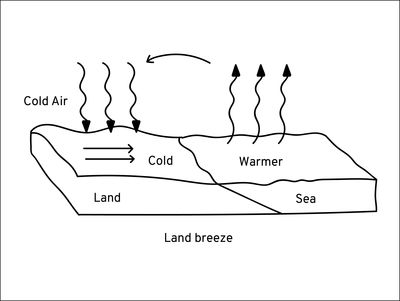

7
Multiple Choice
The movement of air during daytime differs from its movement during nighttime.
True
False
8
Sun=Day Time
LaNd Breeze vs. Sea Breeze
Nighttime

9
Global Wind System

10

11
Principles:
Air moves from High Pressure to Low Pressure
Alternating High Pressure and Low Pressure due to uneven heating of the sun
Due to Earth's rotation wind does not move in straight line, but curves to the right in the Northern Hemisphere and curves to the left in the Southern Hemisphere
12
13
Multiple Choice
Which of the following is NOT a global wind?
Trade Winds
Westerlies
Easterlies
Sea Breeze
14


15
Let's Practice!
Principles:
Air moves from High Pressure to Low Pressure
Alternating High Pressure and Low Pressure due to uneven heating of the sun
Due to Earth's rotation wind does not move in straight line, but curves to the right in the Northern Hemisphere and curves to the left in the Southern Hemisphere
By Restie Carullo
Show answer
Auto Play
Slide 1 / 15
SLIDE
Similar Resources on Wayground

10 questions
Metabolism
Presentation
•
6th Grade
11 questions
Nonrenewable and Renewable energy
Presentation
•
6th Grade
11 questions
Atmosphere Data Interpretation
Presentation
•
6th Grade
10 questions
untitled
Presentation
•
KG
13 questions
Unit 6: Rock cycle
Presentation
•
6th Grade
10 questions
Massa Jenis
Presentation
•
7th Grade
12 questions
Respiration in Organisms
Presentation
•
7th Grade
12 questions
Unit 6 Cells Pre-Assessment
Presentation
•
7th Grade
Popular Resources on Wayground
10 questions
Safety Day 2026 – Student Review

Quiz
•
9th Grade
21 questions
Continents and Oceans
Quiz
•
6th Grade
20 questions
Parts of Speech
Quiz
•
5th Grade
16 questions
Subject & Predicate
Quiz
•
5th Grade
25 questions
Multiplication Facts
Quiz
•
5th Grade
12 questions
Map Skills
Quiz
•
3rd Grade
22 questions
Continents and Oceans
Quiz
•
5th Grade
15 questions
Rounding Decimals
Quiz
•
5th Grade
Discover more resources for Science
10 questions
Exploring Chemical and Physical Changes

Interactive video
•
6th - 10th Grade
14 questions
Week 1 Falcon Flex Fast and Curious
Quiz
•
7th Grade
42 questions
Explore Plate Tectonics and Boundaries
Quiz
•
7th Grade
21 questions
Waves and Wave Properties
Quiz
•
6th - 8th Grade
16 questions
Photosynthesis and Cellular Respiration Review
Quiz
•
7th Grade
20 questions
Food Webs + Energy Pyramids
Quiz
•
7th Grade
9 questions
Biology: Cell Structure
Interactive video
•
7th Grade
8 questions
Diffusion and Osmosis Review
Presentation
•
6th - 8th Grade