

Changes of Matter (feat. Law of Conservation)

Presentation
•
Science, Chemistry
•
6th - 8th Grade
•
Easy
Standards-aligned

Jawara Senghor
Used 144+ times
FREE Resource
8 Slides • 13 Questions
1
By J Senghor
2
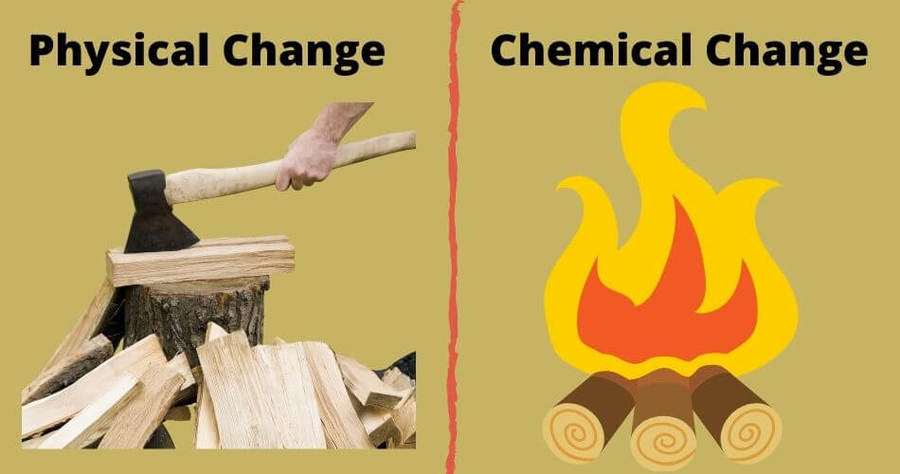
There are two types of changes in matter; physical change and chemical change. As the names suggest, a physical change affects a substance’s physical properties and a chemical change affects its chemical properties.
3

occur when there is a change to one or more physical properties
does not result in a change in chemical identity
are reversible in many cases
4

occur when one substance changes into another after a chemical reaction
"ingredients" are called reactants and end results are called products
irreversible
5

6
Multiple Choice
A physical change...
changes the physical properties of an object, but does not create a new substance.
creates a new substance and cannot be undone.
7
Multiple Choice
A chemical change
changes the physical properties of an object, but does not create a new substance.
creates a new substance and cannot be undone.
8

Production of gas/bubbles
Production of odor
Change in color
Formation of precipitate
Exothermic/Endothermic reaction
Release of light
Identifying chemical changes
Signs of a chemical change
9
Chemical reactions tend to happen more quickly at higher temperatures. When temperatures are higher, atoms and molecules have more kinetic energy which enable them to move around and rearrange more quickly and easily.

10

This law states that mass cannot be created or destroyed during a physical or chemical change. The mass you have before the change is always equal to the mass after the change. For example, a chemical reaction between 93g of mercury and 7g of oxygen will produce 100g of mercuric oxide.
11
Multiple Choice
What kind of change occurs if matter changes in amount, size, or shape?
substance change
chemical change
physical change
elemental change
12
Multiple Choice
Which of the following is NOT an example of a physical change?
Smashing a soda can
Wood breaking apart
Salt dissolving in water
Iron rusting
13
Multiple Choice
14
Multiple Choice
15
Multiple Choice
16
Multiple Choice

17
Multiple Choice
18
Multiple Choice
19
Multiple Choice
20
Multiple Choice
According to the Law of Conservation of Mass, what happens to the wood and oxygen when it is burned?
The wood disappears.
It stays the same chemically.
The atoms in the wood and oxygen rearrange and form smoke and ash.
Nothing.
21
Poll
Which level best describes where you are at the end of this lesson?
Level 1 - I need help to differentiate between physical and chemical changes
Level 2 - I am able to differentiate between physical and chemical changes; as well as give examples on my own
Level 3 - In addition to performing tasks at level 2, I can also describe how temperature affects chemical changes
Level 4 - Not only can I perform level 3 tasks, I can also demonstrate that mass is conserved when substances undergo physical and chemical changes.
By J Senghor
Show answer
Auto Play
Slide 1 / 21
SLIDE
Similar Resources on Wayground

14 questions
Cell Structure and Function
Presentation
•
6th - 8th Grade
18 questions
Newton's Third Law
Presentation
•
6th - 8th Grade
14 questions
The Greenhouse Effect
Presentation
•
6th - 8th Grade
19 questions
Abiotic and Biotic Factors/ Components of an Ecosystem
Presentation
•
6th - 8th Grade
13 questions
Heat Transfer
Presentation
•
6th - 8th Grade
17 questions
Distance Time Graph Lesson
Presentation
•
6th - 8th Grade
15 questions
HR Diagram
Presentation
•
6th - 8th Grade
15 questions
Physical and Chemical Properties
Presentation
•
6th - 8th Grade
Popular Resources on Wayground
10 questions
Safety Day 2026 – Student Review

Quiz
•
9th Grade
21 questions
Continents and Oceans
Quiz
•
6th Grade
20 questions
Parts of Speech
Quiz
•
5th Grade
16 questions
Subject & Predicate
Quiz
•
5th Grade
25 questions
Multiplication Facts
Quiz
•
5th Grade
12 questions
Map Skills
Quiz
•
3rd Grade
22 questions
Continents and Oceans
Quiz
•
5th Grade
15 questions
Rounding Decimals
Quiz
•
5th Grade
Discover more resources for Science
20 questions
Newton's Laws of Motion
Quiz
•
8th Grade
20 questions
Elements, compounds, and mixtures
Quiz
•
6th Grade
10 questions
6.6D - Relative Density Review
Quiz
•
6th Grade
15 questions
potential and kinetic energy
Quiz
•
8th Grade
21 questions
Newton's Laws of Motion
Quiz
•
8th Grade
20 questions
Elements, Compounds and Mixtures
Quiz
•
8th Grade
10 questions
Exploring Chemical and Physical Changes

Interactive video
•
6th - 10th Grade
20 questions
CONDUCTION,CONVECTION AND RADIATION
Quiz
•
6th Grade