

Spanish 2: 6.2

Presentation
•
World Languages
•
10th Grade
•
Practice Problem
•
Medium

Danielle Banks
Used 17+ times
FREE Resource
12 Slides • 10 Questions
1
5.9.23
By Danielle Banks
2
We have concluded unit 5; please check unit 5 work and make a plan to submit any outstanding unit 5 work! Please come to Study Hall Monday from 3-4 with any questions you may have or help you may need!
6.1 work: 6.1.3, 6.1.6, 6.1.8 discussion, and 6.1.9 were due yesterday, 5/8. We went over these on last Thursday's class if you'd like an overview of the assignments.
6.2.4, 6.2.8 and 6.2.9 practice are due Thursday 5/11.
3
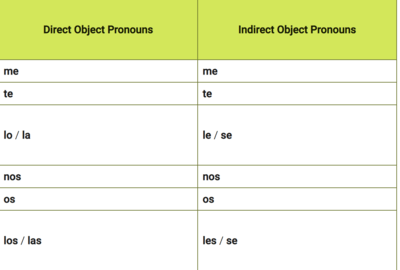
Review direct/indirect objects from 6.1 Study
Review study 6.2: informal commands
4
5
Remember..
Direct objects are the direct recipient of the verb. It usually answers the question of 'what' as a recipient of the action of the verb.
I ate the cookies. / I ate them.
Remember...
Indirect objects are the indirect receiver of the verb's action. I gave the cookies to Jessica.
I gave the cookies to her.
Cookies would be the direct object and 'her' or Jessica is the 'who' or indirect recipient of the verb's action.
6
Remember..
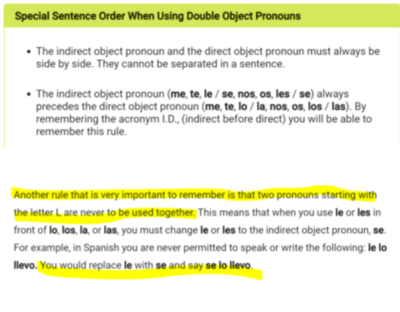
Direct and indirect objects MUST come together in a sentence. They cannot be separated.
The indirect object comes BEFORE the direct object in a sentence.
When the indirect object and the direct object start with the letter L .. the indirect must become 'se' and not le/les
I gave it to him would be: Lelo doy. But with this rule it would be: se lo doy
7
Multiple Choice
Ellos le dan los platos al camarero.
se los dan
le los dan
8
Multiple Choice
Nosotros le pasamos la sal a mi hermana.
se la pasamos
le la pasamos
9
Multiple Choice
Direct and indirect objects must come side by side in a sentence.
True
False
10
Multiple Choice
Two pronouns starting with the letter L are never used together. What must you do if you have the pronouns le or les in front of lo, los, la, or las?
change le/les to the pronoun lo
change le/les to the pronoun se
11
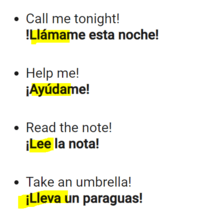
Affirmative just means that there isn't a 'no' used with the command.
Affirmative tú commands are called familiar commands and are used between friends and classmates, when parents or other adults are speaking to children, and when there is a familiar relationship between two people.
12
The tú commands are formed using the same endings as for the present tense usted, él, or ella forms.
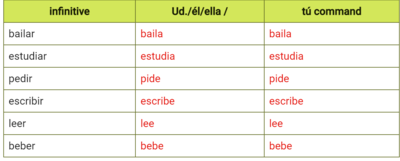
notice the command is the same as the usted/él/ella form of the verb.
13
The tú commands are formed using the same endings as for the present tense usted, él, or ella forms.
notice the command is the same as the usted/él/ella form of the verb.
One irregular that does not
use the el/ella/usted form:
hacer in the command would
be "haz" and not hace.
14
Multiple Choice
Juanito's room is very dirty. Tell him what to do. (limpiar)
limpia
limpie
15
Multiple Choice
Juanito won't eat his broccoli. Tell him what to do. (comer)
coma
come
16
Multiple Choice
Juanito won't watch TV. Tell him what to do. (ver)
va
vee
ve
17
Multiple Choice
Juanito won't share his cookies. Tell him what to do. (compartir)
comparte
comparta
18
Multiple Choice
Juanito won't do his homework. Tell him to do the homework. (hacer)
hace
haz
19
*Spoken assignment *
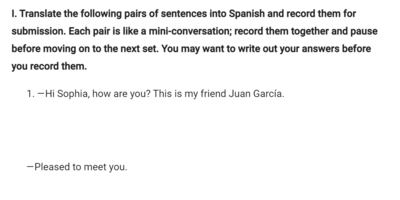
Please be sure to include the number to the question in your response!
You must translate BOTH parts!
20
*Spoken assignment *
You MUST use both a direct AND an indirect object in the blanks! There should ONLY be object pronouns in the blanks!

21
*Spoken assignment *
Please review today's lesson on forming commands! Each of these MUST be in the command form!

22
Open Ended
Exit slide:
Me llamo:
On a scale of 1-10, I am feeling (insert number) about my progress and work in Spanish class.
5.9.23
By Danielle Banks
Show answer
Auto Play
Slide 1 / 22
SLIDE
Similar Resources on Wayground

17 questions
Genetics Review Part 2 (Practice)
Presentation
•
6th - 9th Grade
18 questions
El Tiempo y Las Estaciones
Presentation
•
9th Grade
16 questions
6/1: Evolution: Gene Variation
Presentation
•
10th Grade
18 questions
Perfect Verb Tenses
Presentation
•
KG
16 questions
Ten Steps of the AVID Tutorial
Presentation
•
10th Grade
16 questions
Acid-Base Summary
Presentation
•
10th Grade
16 questions
Adjectives agreement - French
Presentation
•
10th Grade
17 questions
Corresponding Angles
Presentation
•
10th Grade
Popular Resources on Wayground
10 questions
Safety Day 2026 – Student Review

Quiz
•
9th Grade
21 questions
Continents and Oceans
Quiz
•
6th Grade
20 questions
Parts of Speech
Quiz
•
5th Grade
16 questions
Subject & Predicate
Quiz
•
5th Grade
25 questions
Multiplication Facts
Quiz
•
5th Grade
12 questions
Map Skills
Quiz
•
3rd Grade
22 questions
Continents and Oceans
Quiz
•
5th Grade
15 questions
Rounding Decimals
Quiz
•
5th Grade
Discover more resources for World Languages
20 questions
Preterite vs. Imperfect
Quiz
•
10th Grade
20 questions
Ser vs. Estar
Quiz
•
10th Grade
10 questions
Spanish Greetings and Goodbyes!
Presentation
•
6th Grade - University
25 questions
Preterito regular
Quiz
•
10th - 12th Grade
28 questions
Ser vs estar
Quiz
•
9th - 12th Grade
18 questions
Subject Pronouns in Spanish
Quiz
•
9th - 12th Grade
20 questions
Preterite vs Imperfect usage
Quiz
•
9th - 12th Grade
16 questions
Subject pronouns in Spanish
Quiz
•
9th - 12th Grade