Summer School BIO STAAR review: Genetics
Presentation
•
Biology
•
9th - 10th Grade
•
Medium
Samantha Berry
Used 5+ times
FREE Resource
39 Slides • 52 Questions
1
By Samantha Knowles
2
3
DNA molecules consist of small units called nucleotides.
Several Million nucleotides make up one strand of DNA.
DNA is what carried our genes
Our genes cannot be translated until mRNA leaves the nucleus, goes to the ribosome, and makes proteins
DNA's purpose is to make proteins
But it has to go through multiple steps before it can do that
DNA stays in the nucleus (it cannot leave), which is the purpose of mRNA, it is able to leave the nucleus
4
Codes for proteins
keratin- hair protein
insulin- glucose regulation
hGH- growth hormone
antigens- blood type
5
Order determines Genetic traits
Made of nitrogenous base, phosphate and sugar
6
Phosphate group + sugar + nitrogen base = one nucleotide
7
Multiple Choice
Blood types such as A, B, AB, and O are a physical characteristic of anantigen located on an individuals red blood cell. This is possible because DNA codes for a specific _______
phosphate
protein
nucleotide
thymine
8
9
10
All living things MUST have
DNA
Ribosomes
Cell membrane
11
Multiple Choice
What base joins with A?
C
G
T
12
Multiple Choice
What base joins with G
A
T
C
13
Multiple Choice
Dolphins and Humpback whales both are able to use echolocation to locate prey in murky/dark waters due to a common mutation of their cochlear nerve . Based on this information what is the probable conclusion?
Dolphins and Humpback share common genes
Dolphins and Humpbacks eat the same prey
Dolphins are evolving into Humpbacks
Dolphins and Humpbacks are found in the same regions
14
DNA is the blueprints
mRNA makes a copy
substituting Thymine with Uracil
DNA code ATC CGA CAA
mRNA code UAG GCU GUU
15
Occurs in the nucleus
an inner protected membrane
16
Multiple Choice
During protein synthesis, an RNA strand is transcribed from one strand of DNA (GCG TTA CCT) What is the complementary RNA strand?
CGC UUT CCT
CGC AAU GGA
GCG UUA CCU
CGC AAT GGA
17
mRNA attaches to the ribosome
tRNA transports the correct amino acids to bind
rRNA helps bind amino acids together
a protein is made
18
Occurs in the ribosome
19
Multiple Choice
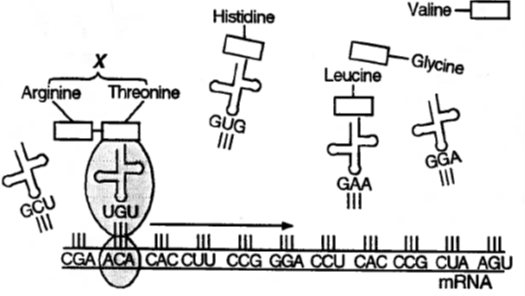
WHAT IS #3 (ITS CARRYING AND AMINO ACID)
T RNA
M RNA
R RNA
20
​
21
Multiple Choice
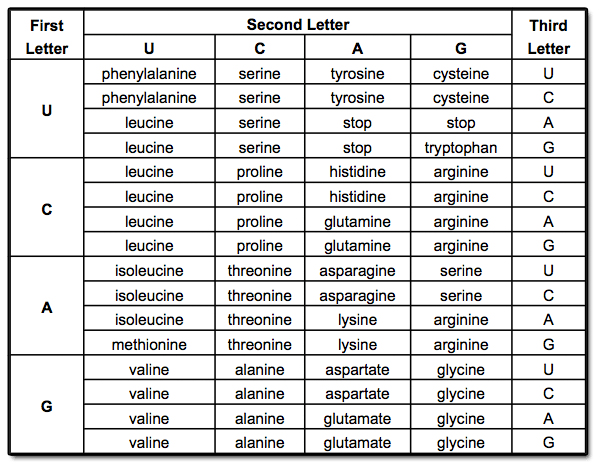
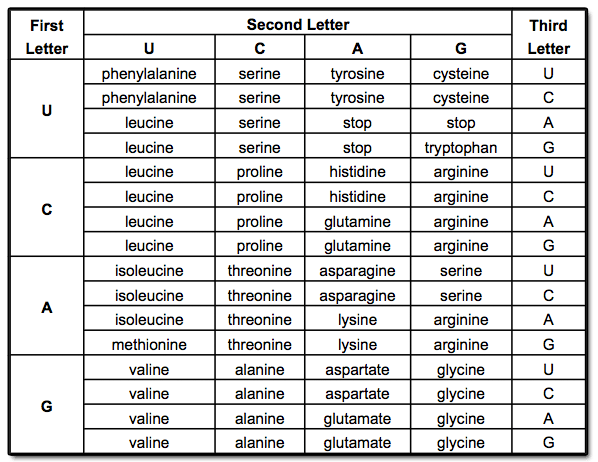
mRNA codon AAA codes for which amino acid
ASPARAGINE
LYSINE
SERINE
ARGININE
22
23
DNA to RNA to Protein
DNA to mRNA
mRNA read by rRNA
tRNA bring amino acids
Amino acids bind making proteins
24
Multiple Choice
What is the central dogma?
DNA to RNA to Amino Acid
DNA to RNA to Protein
RNA to DNA to Protein
RNA to DNA to Amino Acid
25
Single strand
Uracil instead of thymine
3 types
26
Multiple Choice
In RNA, what base replaces Thymine?
Cytosine
Adenine
Uracil
Guanine
27
Multiple Choice
Determine the RNA sequence that compliments the DNA stranded:
TACGGT
TACGGT
AUGCCA
ATGCCA
UACGGU
28
Multiple Choice
When using your codon chart, what sequence can you use to find the correct amino acid?
DNA
mRNA
tRNA
Any of these will do
29
Multiple Choice
What organelle reads the mRNA and finds the correct amino acid?
DNA
Nucleus
Ribosome
Chloroplast
30
Multiple Choice
31
Multiple Choice
32
You are definitely a mutant!!!
33
Open Ended
A friend makes the following statement: "Mutations are all bad, right?" How do you respond?
34
35
36
37
Multiple Choice
Which statement correctly describes a way that mutations increase the likelihood that a species will survive in a changing environment?
Mutations are a source of variation in the species
Mutations are the cause of disease in the species
Mutations are not harmful when they occur in somatic cells
Mutations are always passed on to subsequent generations
38
Multiple Choice
A parent that has a mutation to their skin cells caused by the environment can pass this mutation to their offspring
True
False
39
Multiple Choice
40
Multiple Choice
41
Multiple Choice
42
Multiple Choice
Original DNA: CAT GAT CCA
New DNA: CAT TGA TCC A
What mutation occurred?
deletion
substitution
tranverse
insertion
43
Multiple Choice
What organelle reads the mRNA and finds the correct amino acid?
DNA
Nucleus
Ribosome
Chloroplast
44
Multiple Choice
How many nucleotides make up a codon?
1
3
5
15
45
Multiple Choice
How many codons: AAU GCG AUG
9
1
3
15
46
Multiple Choice
How many nucleotides? AAU GCG AUG
9
3
1
15
47
Multiple Choice
48
Take C-Notes on the Video and the following 4 slides. Pay particular attention to the steps of meiosis, especially what happens in Prophase 1. Make sure you understand what "Crossing Over" is.

49
50
Study this picture. Notice how a cell with four chromosomes turns into four different cells, each containing two chromosomes.
51
Remember, the steps of Meiosis are similar to the steps to Mitosis. The major differences is that "Crossing Over" of the DNA occurs in Meiosis.
During Prophase 1 and Metaphase 1 of Meiosis, the DNA next to each other can SWITCH chromosomes, making a completely new strand of DNA.
52
Each new sperm or egg cell has a different set of DNA, which is why you are different than your siblings.
53
Multiple Choice
How many chromosomes does a human somatic (body) cell have?
2
14
23
46
54
Multiple Choice
Why do sexually reproducing organisms need meiosis?
To double the number of chromosomes in a new organism
So that gametes have half the number of chromosomes of the organism
So that offspring are identical
So that human sperm and egg cells will each have 46 chromosomes.
55
Multiple Choice
What process, and which types of cells are represented by the diagram?
Mitosis, somatic cells
Mitosis, gametes
Meiosis, somatic cells
Meiosis, gametes
56
Multiple Choice
This image shows chromosomes during Prophase 1. Which of the following correctly describes the process shown?
segregation of sister chromatids
mutation in which the DNA content of the gene is altered
condensation and segregation of alleles
crossing - over in which alleles are exchanged
57
58
59
60
Multiple Choice
Crossing over occurs in what phase of Meiosis?
Prophase I
Prophase II
Metaphase I
Interphase
61
62
Multiple Choice
63
Multiple Choice
64
Multiple Choice
DURING WHICH PHASE OF MEIOSIS DOES GENETIC VARIATION INCREASE
PROPHASE II
PROPHASE I
ANAPHASE I
ANAPHASE II
65
Multiple Choice
WHAT TYPE OF CELLS STORE THE GENETIC INFORMATION THAT IS PASSED TO OFF-SPRING
BODY CELLS
MITOSIS
EGG
SPERM
EGG AND SPERM
66
Essential Question: Why do different individuals show different traits?
67
Characteristics that make an individual unique
These traits are passed from parent to offspring during reproduction
68
69
150 years ago no one knew about "genes" or "chromosomes"
Mendel studied peas to determine how traits are passed from parent to offspring. "Why do we look similar?"
70
Seed shape ( round or wrinkled)
Seed color (yellow or green)
Flower color (purple or white)
Plant height (tall or short)
71
Yes! We can look at their parents genes to determine outcomes
Dominant genes are written as CAPITAL letters
Recessive genes are written as lower case letters.
72
Dominant: The stronger of the 2 genes
Recessive: The weaker of the two genes
73
Punnett square is the standard way of working out possible offspring outcome of 2 parents
Father has 2 sets of alleles from his parent
Mother has 2 sets of alleles from her parents
74
The observable characteristic of an individual
If an individual gets ONE dominant gene, the individual will show the dominant phenotype (BB, or Bb)
an individual must have 2 pairs of the recessive gene to show that phenotype. (bb)
75
Multiple Choice
How do we write DOMINANT alleles?
Capital letters
Lower case
76
Multiple Choice
What is a trait?
Your DNA
The things that make an individual unique
Common characteristics in a species
Chromosomes
77
Multiple Choice
a ___________ is a letter combination of an allele
phenotype
genotype
dominant
recessive
78
Multiple Choice
This image is called a ____________
triangle
punnett square
square
rectangle
79
Multiple Choice
Who is considered the "father" of modern genetics?
Einstein
Mendel
Disney
Washington
80
Poll
A
B
C
D
81
Poll
A
B
C
D
82
Multiple Choice
83
Multiple Choice
84
Poll
A
B
C
D
85
Multiple Choice
86
Multiple Select
Which of the following increase genetic diversity in organisms? There may be more than one correct answer.
Mitosis
Meiosis
Mutations
Crossing over
87
Poll
A
B
C
D
88
Poll
Answer choices A, B, C and D are shown in the answer choices area. Due to having to make all of these with screen shots there are other words in a couple and they look kind of weird. Please ask for help if the answer choices dont make since to you.
89
Poll
Don't forget, you may need to use a punnett square for this problem.
A
B
C
D
90
Poll
A
B
C
D
91
Poll
A
B
C
D
By Samantha Knowles
Show answer
Auto Play
Slide 1 / 91
SLIDE

Similar Resources on Wayground
87 questions
Chapter 12 The History of Life
Presentation
•
10th Grade
86 questions
AG_4 Chapter 08 PPTX
Presentation
•
10th Grade
82 questions
Climate and Climate Change Lesson
Presentation
•
9th - 12th Grade
89 questions
PLATE BOUNDARIES
Presentation
•
10th Grade
83 questions
9G (2.10) Operation with Exponents
Presentation
•
10th Grade
83 questions
Solve Quadratics Using Square Root Method
Presentation
•
10th Grade
83 questions
Solving Quadratics with Square Roots
Presentation
•
10th Grade
89 questions
SAVVAS K Objects Experience 1
Presentation
•
KG
Popular Resources on Wayground
10 questions
Safety Day 2026 – Student Review
Quiz
•
9th Grade
21 questions
Continents and Oceans
Quiz
•
6th Grade
20 questions
Parts of Speech
Quiz
•
5th Grade
16 questions
Subject & Predicate
Quiz
•
5th Grade
25 questions
Multiplication Facts
Quiz
•
5th Grade
12 questions
Map Skills
Quiz
•
3rd Grade
22 questions
Continents and Oceans
Quiz
•
5th Grade
15 questions
Rounding Decimals
Quiz
•
5th Grade
Discover more resources for Biology
20 questions
Cell organelles and functions
Quiz
•
10th Grade
20 questions
Cell Transport
Quiz
•
9th - 12th Grade
25 questions
photosynthesis and cellular respiration
Quiz
•
9th Grade
20 questions
Cell Cycle
Quiz
•
9th Grade
8 questions
DNA vs. RNA
Presentation
•
9th - 12th Grade
14 questions
Ecological Succession: Primary and Secondary
Quiz
•
9th Grade
20 questions
Macromolecules
Quiz
•
10th Grade
20 questions
Characteristics of Life
Quiz
•
9th - 10th Grade