

Scientific Method, Laws, and Theories

Presentation
•
Chemistry
•
9th - 12th Grade
•
Practice Problem
•
Medium
Standards-aligned

Michaela Bratsch
Used 144+ times
FREE Resource
12 Slides • 9 Questions
1
2

3

4
Multiple Choice
5
Multiple Choice
6

7
8

9

10
11
Multiple Choice
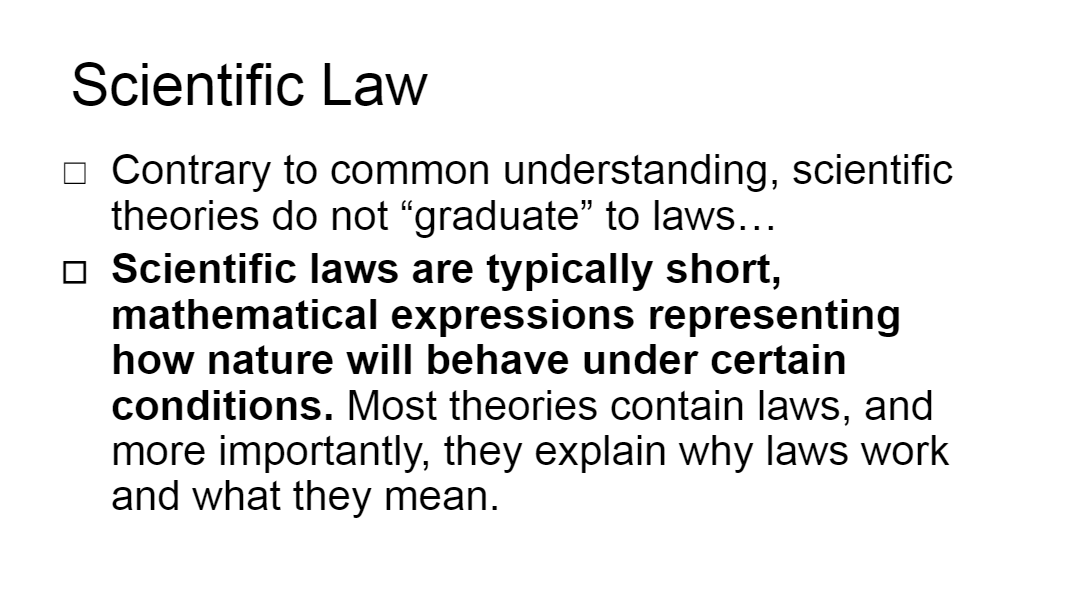
Scientists create both scientific theories and scientific laws as they make observations and conduct experiments about the natural world. Which of the following statements most accurately compares the difference between scientific theories and scientific laws?
Scientific laws are based on evidence, while scientific theories are not.
Scientific theories involve only biology, while laws involve all types of science.
Scientific theories involve mathematical equations, while scientific laws are based on observations.
Scientific theories are ideas that explain natural events, while scientific laws more reliably predict natural events.
12
Multiple Choice
Which of the following ways describe how scientific theories and scientific laws are alike?
Both scientific theories and scientific laws explain why events occur in nature.
Both scientific theories and scientific laws can be modified if new evidence is discovered.
Both scientific theories and scientific laws are accepted by only the minority of scientists in their field.
Scientific theories and scientific laws are not alike in any ways.
13
Multiple Choice
Which of the following is supported by lots of evidence?
Theory
Law
Both
Neither
14
Multiple Choice
Which of the following tells what happens every time under certain conditions?
Theory
Law
Both
Neither
15

16

17

18

19
Multiple Choice
Research Question: Does the type of gasoline put in a car effect how fast the car can drive?
What is the independent variable?
20
Multiple Choice

What is the DEPENDENT variable (effect) in this experiment?
"Does eating breakfast improve test scores?"
eating breakfast or not
the grade you got on the test
what time you get up in the morning
how tasty the breakfast is
21
Multiple Choice
What is the variable called that is used for comparison (does not change)?
Changed
Show answer
Auto Play
Slide 1 / 21
SLIDE
Similar Resources on Wayground

17 questions
Acids & Bases - Molarity & Dilutions
Presentation
•
9th - 12th Grade
18 questions
Water Properties
Presentation
•
9th - 12th Grade
15 questions
New Electron Models
Presentation
•
9th - 12th Grade
14 questions
Moles - Empirical & Molecular Formula
Presentation
•
9th - 12th Grade
12 questions
Types of Chemical Equations
Presentation
•
9th - 12th Grade
19 questions
Reviewing Atoms, Ions, the Periodic Table, and Lewis dots
Presentation
•
10th - 12th Grade
19 questions
Periodic Trends
Presentation
•
10th - 12th Grade
15 questions
Physical and Chemical Changes
Presentation
•
9th - 12th Grade
Popular Resources on Wayground
21 questions
Continents and Oceans

Quiz
•
6th Grade
20 questions
Parts of Speech
Quiz
•
5th Grade
16 questions
Subject & Predicate
Quiz
•
5th Grade
25 questions
Multiplication Facts
Quiz
•
5th Grade
12 questions
Map Skills
Quiz
•
3rd Grade
22 questions
Continents and Oceans
Quiz
•
5th Grade
15 questions
Rounding Decimals
Quiz
•
5th Grade
20 questions
Brand Labels
Quiz
•
5th - 12th Grade
Discover more resources for Chemistry
20 questions
Metric Conversions
Quiz
•
11th Grade
20 questions
electron configurations and orbital notation
Quiz
•
9th - 12th Grade
20 questions
Periodic Table Trends
Quiz
•
11th Grade
20 questions
COUNTING ATOMS
Quiz
•
10th Grade
20 questions
Practice: E-Con, Orbital Notation, Noble Gas Notation
Quiz
•
10th Grade
11 questions
Balancing Chemical Equations
Presentation
•
9th Grade
50 questions
Unit 3: Atomic Assault Summative Review
Quiz
•
11th Grade
15 questions
Heating and Cooling Curves
Quiz
•
9th - 12th Grade