


Reinforcement seventh 2nd and 3rd
Presentation
•
Science, Biology
•
2nd - 7th Grade
•
Medium
Daniel Cuellar
Used 19+ times
FREE Resource
11 Slides • 66 Questions
1
Reinforcement 2nd and 3rd term
Goal: to recall the key information of the 2nd and 3rd terms
2
The circulatory system consists of:
a system of tubes (arteries, capillaries and veins)
a pump (the heart)
valves to ensure a one-way flow of blood
Arteries and veins
Arteries carry blood away from the heart towards an organ, while veins carry blood from an organ towards the heart.
3
Double circulation:
Makes reference to the entrance of blood twice in the heart for a complete cycle.
Pulmonary circulation:
After blood has enter into the heart through the vena cava, it moves into the right side of it and goes to the lungs through the pulmonary artery
Systemic circulation:
Blood rich on oxygen enters into the heart through the pulmonary vein and moves through the left side of the heart to get expulsed towards the body through the aorta
4
5
Multiple Choice
What is blood made of?
oxygen and plasma
red blood cells and white blood cells
plasma, red blood cells, white blood cells, and platelets.
plasma and platelets
6
Multiple Choice
What makes up around 55% of the blood?
plasma
red blood cell
white blood cells
platelets
7
Multiple Choice
What is the function (job) of the red blood cells?
To transport oxygen around the body and to the muscles.
To fight infections.
To carry nutrients and sugars around the body.
8
Multiple Choice
What is the function (job) of the white blood cells?
To transport oxygen around the body.
To carry dissolved sugars.
To clot and cover wounds like cuts.
To fight infections.
9
Multiple Choice
What is the function (job) of the platelets?
To form clots (i.e. scabs) when you have cuts.
To transport oxygen to the muscles.
To carry dissolved sugars.
To produce antibodies.
10
Multiple Choice
11
Multiple Choice
12
Multiple Choice
13
Multiple Choice
14
Multiple Choice
15
Multiple Choice
16
Multiple Choice
17
Multiple Choice
Which of the following brings blood back to the heart from the lungs?
C
D and K
E
B
18
Multiple Choice
19
Multiple Choice
Which of the following carries blood TO the lungs?
pulmonary veins
pulmonary arteries
aorta
superior vena cava
20
Multiple Choice
What is the arrow pointing to?
right atrium
left atrium
right ventricle
left ventricle
21
Multiple Choice
Transports blood with oxygen from the heart to the body.
Superior and inferior vena cava
Pulmonary vein
Pulmonary artery
Aorta
22
Excretion
Excretion is the removal of the following substances:
toxic materials
waste products of metabolism
excess substances from organisms
Excretion is not the same as egestion - which is the passing out of undigested food through the anus as faeces.
23
Blood is brought to the kidney in the renal artery. The kidneys filter the blood and then reabsorb useful materials such as glucose. After it has been purified, the blood returns to the circulation through the renal vein.
Urine is taken from the kidneys to the bladder by the ureters. The bladder stores the urine until it is convenient to expel it from the body.
24
The inner part of the kidney is called the medulla and the outer part is the cortex.
A renal artery carries blood to the kidney and a renal vein carries it away. The ureter carries urine from the kidney to the bladder.
The kidney
25
Multiple Select
Which of these organs excretes waste?
Skin
Lungs
Kidneys
26
Multiple Choice
Urine is a solution of ............... and other substances in water.
acids
bile
amino acid
urea
27
Multiple Choice
Carbon dioxide is excreted through the.............
liver
kidney
urethra
lungs
28
Multiple Choice
29
Multiple Choice
30
Multiple Choice
The correct labeling is:
A- Kidneys
B- Ureters
C- Urinary bladder
D- Urethra
A- Ureters
B- Kidneys
C- Urinary bladder
D- Urethra
A- Ureters
B- Urinary bladder
C- Kidneys
D- Urethra
A- Ureters
B- Urinary bladder
C- Urethra
D- Kidneys
31
Multiple Choice
….................... are the structural and functional units of kidneys.
Neurons
Nephrons
Bowman's capsule
Cortex
32
Multiple Choice
What is the term for the process by which organisms maintain their internal stability?
Proteostasis
Homeostasis
stabilization
interostasis
33
Multiple Choice
What is the tissue region labelled B called?
pelvis
cortex
medulla
capsule
34
Multiple Choice
Recall what structure carries urine from the bladder out of the body.
Ureter
Urethra
Distal convoluted tubule
Proximal convoluted tubule
35
Soil is a mixture of tiny particles of rock, dead plants and animals, air and water. Different soils have different properties depending on their composition.
Sandy soil is pale coloured and has large particles. These create lots of small air gaps. Water drains through them easily so it usually feels dry.
Clay soil is usually sticky and has small particles. They contain very few air gaps and water does not drain through it easily.
Chalky soil is a light brown soil. Water drains through it quickly.
Peat does not contain any rock particles. It's made from very old decayed plants and is dark, crumbly and rich in nutrients.
36
Evaporation
Transpiration
Condensation
Precipitation
THE WATER CYCLE
37
Photosynthesis
Feeding
Respiration
Fossilization
Combustion
THE CARBON CYCLE
38
Multiple Choice
The major nutrients that plants need are..
Nitrogen, Potassium, Calcium
Nitrogen, Carbon dioxide, Oxygen
Nitrogen, Potassium, Phosphorus
Phosphorus, Titanium, Nitrogen
39
Feeding
Ammonification
Nitrification
Assimilation
Denitrification
Nitrogen Fixation (lightning or bacteria)
THE NITROGEN CYCLE
40
Multiple Choice
decayed matter (broken down remains of plants and animals) that gives soil the dark brown or black color
weathering
humus
clay
loam
41
Multiple Choice
three types of soil are...
humus, sand, pebbles
water, humus, grass
clay, sand, loam
weathering, erosion, humus
42
Multiple Choice
a type of soil that has the smallest particles, holds water well, and is sticky when wet
clay
sand
loam
43
Multiple Choice
the type of soil with the largest particles, it does not hold water well, and has a light color
clay
sand
loam
44
Multiple Choice
the type of soil that is a mixture of sand and clay
clay
sand
loam
45
Multiple Choice
the process by which organic matter breaks down to become part of the soil
decomposition
humus
weathering
loam
46
Multiple Choice
What is the name of the process that fixes Nitrogen into Ammonia?
Nitrification
Denitrification
Nitrogen Fixation
Ammonia Fixation
47
Multiple Choice
Which of the following describes condensation?
Ice becoming water when placed into a warm liquid.
Water becoming ice in a freezer
Liquid water being heated until it turns into steam.
Steam from a teapot turning into liquid water.
48
Multiple Choice
What is precipitation?
Sweat from our bodies on hot days
Warm rain but not cold snow or sleet
Gas that we use in furnaces or ovens
Any form of water that falls from the sky
49
Multiple Choice
The process when plants release water vapor from their leaves is called _____________.
precipitation
evaporation
transpiration
condensation
50
Multiple Choice
51
Multiple Choice
52
Multiple Choice
What is it called when water sticks to water?
Cohesion
Adhesion
Capillary Action
Xylem
53
Multiple Choice
54
Multiple Choice
55
Multiple Choice
plant
fungi
56
Multiple Choice
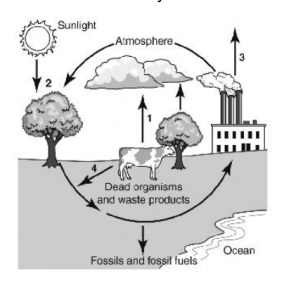
If the plant population decreased, the amount of carbon in the atmosphere would _________.
Stay the same
Increase
Decrease
57
Multiple Choice
58
Multiple Choice
59
Multiple Choice
60
Multiple Choice
Where can you find carbon?
Only in the Earth's atmosphere.
Inside all water molecules.
Inside the sun.
Inside every living thing on Earth.
61
Multiple Choice
62
Multiple Choice
63
Multiple Choice
Which nitrogen cycle process is occurring when bacteria convert ammonium to nitrite and then into nitrate?
nitrogen fixation
nitrification
denitrification
ammonification
assimilation
64
Multiple Choice
Nitrogen makes up..
78% of the atmosphere.
90% of the atmosphere.
71% of the atmosphere.
53% of the atmosphere.
65
Multiple Choice
Which of these nitrogen cycle processes converts atmospheric nitrogen to a soil form of nitrogen that is usable by plants?
nitrogen fixation
nitrification
denitrification
ammonification
assimilation
66
Multiple Choice
What is the main source of Nitrogen?
Ocean
Organisms
Atmosphere
Soil
67
Multiple Choice
68
Multiple Choice
69
Multiple Choice
How do animals get the nitrogen they need?
From the air they breathe
From the water they drink
From the food they eat
From the sun
70
Multiple Select
Choose the plants that are examples of legumes. You will need to select more than one correct answer.
peas
wheat
corn
clover
beans
71
Multiple Choice
How can Nitrogen gas (N2) be fixed into a usable form for plants?
Through the action of bacteria only
Through lightning only
Through the action of bacteria and lightning
72
Multiple Choice
How do humans influence the carbon cycle?
Burning fossil fuels
Farting
Crash bandicoot nitrocart
Gex
73
Multiple Choice
74
Multiple Select
Select all of the following biological molecules that contain nitrogen (more than one)
amino acids
DNA and RNA
ATP
starch
75
Multiple Choice
Which bacteria convert nitrate into nitrogen gas?
nitrogen fixing bacteria
nitrifying bacteria
denitrifying bacteria
76
Multiple Choice
When organisms are broken down by decomposers, what process release their nitrogen containing molecules?
ammonification
nitrogen fixation
nitrification
denitrification
77
Multiple Choice
What types of organism convert nitrogen containing compounds into different forms in the nitrogen cycle?
bacteria
fungi
viruses
plants
Reinforcement 2nd and 3rd term
Goal: to recall the key information of the 2nd and 3rd terms
Show answer
Auto Play
Slide 1 / 77
SLIDE

Similar Resources on Wayground
73 questions
Air and Aerodynamics
Presentation
•
5th - 7th Grade
74 questions
Air and Aerodynamics
Presentation
•
5th - 7th Grade
64 questions
Week 10- Tuesday
Presentation
•
3rd - 7th Grade
68 questions
Adjectives
Presentation
•
KG
71 questions
critical thinking
Presentation
•
KG
77 questions
Level K Sight Words
Presentation
•
KG
67 questions
Comparison of adjectives (stopniowanie przymiotników)
Presentation
•
2nd - 6th Grade
74 questions
Air & Aerodynamics Review
Presentation
•
5th - 7th Grade
Popular Resources on Wayground
10 questions
HCS SCI 03 Summer School Review 4
Quiz
•
3rd Grade
11 questions
HSMS - Standard Response Protocol
Quiz
•
6th - 8th Grade
16 questions
1.1-1.2 Quiz Review
Quiz
•
9th - 12th Grade
12 questions
Exponent Expressions
Quiz
•
6th Grade
20 questions
Adding and Subtracting Integers
Quiz
•
6th - 7th Grade
11 questions
Northeast States
Quiz
•
3rd - 4th Grade
10 questions
Characterization
Quiz
•
3rd - 7th Grade
10 questions
Common Denominators
Quiz
•
5th Grade