Solid, Liquid and Gas
Presentation
•
Science
•
5th Grade
•
Easy
Standards-aligned
gilson granil
Used 298+ times
FREE Resource
5 Slides • 8 Questions
1
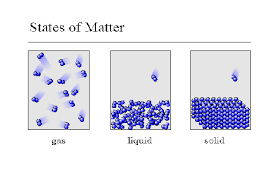
All objects are made up of small particles.
Can you describe the particles in each state of matter?
WILF: I can identify the effects of energy changes in the state of matter.
CHANGING STATES OF MATTER
2
Multiple Choice
All objects are made up of tiny _______ that are in motion.
particles
rocks
minerals
3
Multiple Choice
Which state of matter has its particles tightly packed and vibrate in place?
solid
liquid
gas
4
The average movement of particles in an object is determined by the amount of energy in the object.
Temperature is the measurement of this movement.
WILF: I can identify the effects of energy changes in the state of matter.
CHANGING STATES OF MATTER
5
Multiple Choice
At higher temperatures, particles in an object move ________.
slower
faster
the same
6
Add Energy: the particles will start to move quickly.
Remove Energy: the particles will slow down and move closer together.
WILF: I can identify the effects of energy changes in the state of matter.
CHANGING STATES OF MATTER
7
Multiple Choice
What causes a change in the state of matter?
removing energy
adding energy
both are correct
8
What happens when energy is INCREASED (or added)?
WILF: I can identify the effects of energy changes in the state of matter.
CHANGING STATES OF MATTER
1. Melting: Solid turns to Liquid
Evaporating: Liquid turns to Gas
9
What happens when energy is DECREASED (or removed)?
WILF: I can identify the effects of energy changes in the state of matter.
CHANGING STATES OF MATTER
1. Condensing: Gas turns to liquid
Freezing: Liquid turns to Solid
10
Multiple Choice
Which of the following is an example of melting?
11
Multiple Choice
Which scenario would melt a crayon faster?
In a classroom
In a freezer
Under a lamp light
12
Multiple Choice
How would you describe a liquid changing to a solid?
melting
boiling
freezing
13
Poll
How do I feel about the lesson today?
All objects are made up of small particles.
Can you describe the particles in each state of matter?
WILF: I can identify the effects of energy changes in the state of matter.
CHANGING STATES OF MATTER
Show answer
Auto Play
Slide 1 / 13
SLIDE

Similar Resources on Wayground
11 questions
5th grade review
Lesson
•
5th Grade
9 questions
L.5.3a.2-Photosynthesis-Odd Environments
Lesson
•
5th Grade
12 questions
Microorganisms Are Harmful
Lesson
•
5th Grade
12 questions
Seasons
Lesson
•
5th Grade
12 questions
Modeling Matter Review
Lesson
•
5th Grade
10 questions
WATER CYCLE
Lesson
•
5th Grade
10 questions
Forms of Precipitation
Lesson
•
5th Grade
10 questions
Rotation and Revolution
Lesson
•
5th Grade
Popular Resources on Wayground
10 questions
5.P.1.3 Distance/Time Graphs
Quiz
•
5th Grade
10 questions
Fire Drill
Quiz
•
2nd - 5th Grade
20 questions
Equivalent Fractions
Quiz
•
3rd Grade
15 questions
Hargrett House Quiz: Community & Service
Quiz
•
5th Grade
20 questions
Main Idea and Details
Quiz
•
5th Grade
20 questions
Context Clues
Quiz
•
6th Grade
20 questions
Inferences
Quiz
•
4th Grade
15 questions
Equivalent Fractions
Quiz
•
4th Grade
Discover more resources for Science
10 questions
5.P.1.3 Distance/Time Graphs
Quiz
•
5th Grade
15 questions
Force and Motion
Lesson
•
5th Grade
20 questions
Food Chains and Food Webs Review
Quiz
•
5th Grade
23 questions
Comparing and Ordering Decimals
Quiz
•
5th Grade
20 questions
Food Webs
Quiz
•
5th Grade
20 questions
The Water Cycle
Quiz
•
4th - 5th Grade
20 questions
The Water Cycle
Quiz
•
5th Grade
21 questions
Photosynthesis Review
Quiz
•
5th Grade