K1 & K2
Presentation
•
Science
•
9th - 12th Grade
•
Easy
Standards-aligned
Catherine Val
Used 35+ times
FREE Resource
7 Slides • 14 Questions
1
Kepler's 1st and 2nd Laws
2
Orbits are NOT perfect circles
Orbits are Elliptical
One focus point in a planet's orbit is always the sun.
The second focus point is a mathematically calculated spot in space.
Kepler's 1st Law
3
Eccentricity is the measure of how elliptical an orbit is.
Always a value between 0-1
0 = perfect circle
1 = flat line
Calculating Eccentricity Equation:
Calculating Eccentricity
4
You will need a calculator for a few questions in this next section!
5
Multiple Choice
6
Multiple Choice
7
Multiple Choice
8
Multiple Choice
9
Multiple Choice
10
Multiple Choice
Which diagram in the image shows a planet with the LEAST eccentric orbit?
A
B
C
D
11
Multiple Choice
Which diagram in the image shows a planet with the MOST eccentric orbit?
A
B
C
D
12
Fill in the Blank
The distance between foci is 6.0. The length of major axis is 10.5. What is the eccentricity to the nearest thousandth?
13
Fill in the Blank
The distance between foci is 2.0. The length of major axis is 10.0. What is the eccentricity to the nearest thousandth?
14
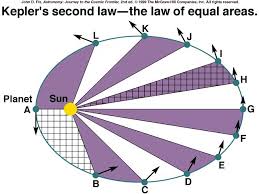
Observe the velocity of this planet in orbit. What do you notice?
Some text here about the topic of discussion
15
States that a planet speeds up as it gets closer to the Sun, and slows down as it moves farther away.
This is due to the gravitational attraction increasing as the planet approaches the sun
This causes velocity to also increase.
Kepler's Second Law
16
Multiple Choice
17
Multiple Choice
Kepler's second law states that _________.
a planet moves faster when closer to the Sun
planets close to the Sun have shorter periods than those farther away
the Sun is at the center of planetary orbits
slowly moving planets are close to the Sun
18
Multiple Choice
19
Multiple Choice
20
Multiple Choice
A planet moves fastest during its orbit around the Sun when...
it is closest to the sun and gravity has a stronger pull
it is farthest from the sun and gravity has a stronger pull
it is closest to the sun and gravity has a weak pull
it is farthest from the sun and gravity has a weak pull
21
There is one more law of Planetary Motion!
Kepler's 1st and 2nd Laws
Show answer
Auto Play
Slide 1 / 21
SLIDE

Similar Resources on Wayground
17 questions
Water Pollution
Lesson
•
9th - 12th Grade
17 questions
Composition and Physiology of Blood
Lesson
•
9th - 12th Grade
18 questions
Blood Spatter
Lesson
•
9th - 12th Grade
18 questions
Disease District Assessment Review 25/26
Lesson
•
9th - 12th Grade
18 questions
Plants
Lesson
•
6th - 8th Grade
16 questions
ACT Science Mastery Lesson 13
Lesson
•
9th - 12th Grade
19 questions
Balanced & Unbalanced Forces
Lesson
•
9th - 12th Grade
16 questions
Translation
Lesson
•
9th - 12th Grade
Popular Resources on Wayground
10 questions
5.P.1.3 Distance/Time Graphs
Quiz
•
5th Grade
10 questions
Fire Drill
Quiz
•
2nd - 5th Grade
20 questions
Equivalent Fractions
Quiz
•
3rd Grade
15 questions
Hargrett House Quiz: Community & Service
Quiz
•
5th Grade
20 questions
Main Idea and Details
Quiz
•
5th Grade
20 questions
Context Clues
Quiz
•
6th Grade
20 questions
Inferences
Quiz
•
4th Grade
15 questions
Equivalent Fractions
Quiz
•
4th Grade
Discover more resources for Science
10 questions
Exploring the Layers of the Earth
Interactive video
•
6th - 10th Grade
25 questions
Naming Ionic and Covalent Compounds
Quiz
•
9th Grade
20 questions
Balancing Chemical Equations
Quiz
•
9th Grade
35 questions
DNA Structure and Replication
Quiz
•
10th Grade
20 questions
Non-Mendelian Genetics
Quiz
•
9th Grade
10 questions
Exploring the Dynamics of Ocean Currents
Interactive video
•
6th - 10th Grade
20 questions
The Cell Cycle and Mitosis
Quiz
•
9th Grade
15 questions
Genetics- Punnett Squares
Quiz
•
9th Grade