

8.26 Jefferson vs. Hamilton

Presentation
•
History
•
8th Grade
•
Medium

Lindsay Hill
Used 81+ times
FREE Resource
10 Slides • 8 Questions
1

Essential Questions:
How did political parties emerge in America?
TN State Standard- 8.26 Explain how conflicts between Thomas Jefferson
and Alexander Hamilton resulted in the emergence of two political parties
by analyzing their views on foreign policy, economic policy, a national bank,
and strict versus loose interpretation of the Constitution
JEFFERSON VS. HAMILTON
THE EMERGENCE OF POLITICAL PARTIES
2
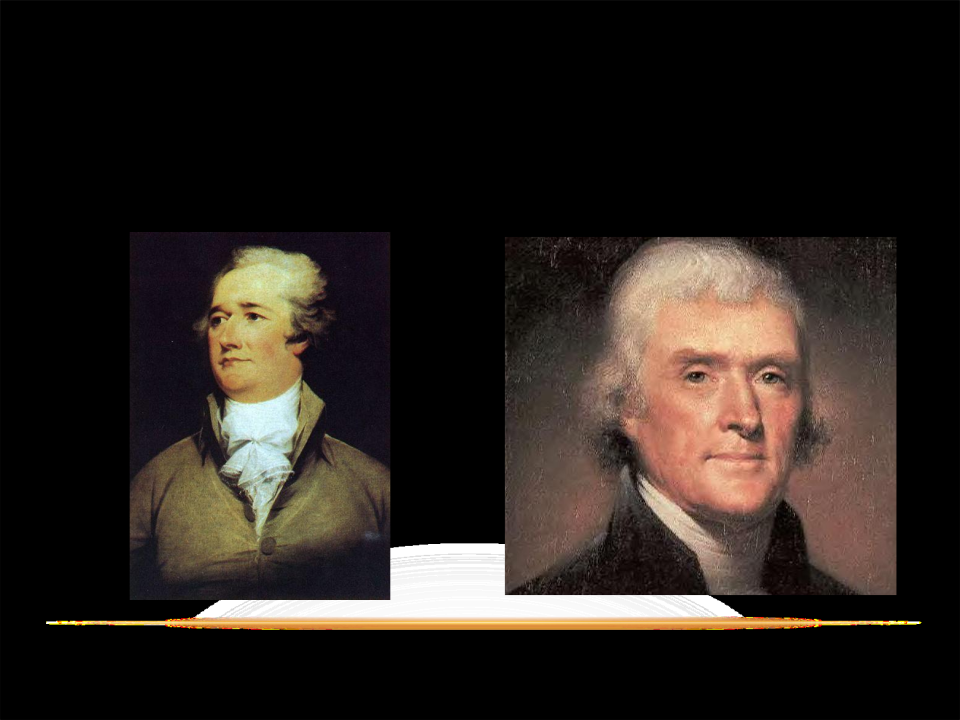
POLITICAL PARTIES EMERGE
Federalists- Led by Alexander Hamilton
Democratic-Republicans- Led by Thomas
Jefferson
3
Open Ended
What are the two political parties that have emerged during Washington's Presidency?
4

Alexander Hamilton & Thomas Jefferson were on opposite sides on how the federal government should be run.
Both even wrote separate letters to President Washington about the issue.
All was not calm in the early years of the new nation.
5

•Appealed to the common man-
farmers, Southerners/Westerners
•Appealed to the wealthy, educated,
and those living in big cities
WHO SUPPORTED THESE PARTIES?
Federalists- Led by Alexander Hamilton
Democratic-Republicans- Led by Thomas
Jefferson
6
Multiple Choice
While Alexander Hamilton supported merchants, Thomas Jefferson was more sympathetic toward the needs of...
farmers
aristocrats
financiers
shopkeepers
7
Multiple Choice
Who was the leader of the Federalist Party?
John Adams
Thomas Jefferson
Alexander Hamilton
George Washington
8

•Rejected IMPLIED POWERS
•“That government is best which
governs least”
•The Constitution should be interpreted
EXACTLY as it is written
•Supported the STATES over the
Federal government
•The Constitution has IMPLIED
POWERS (not specifically listed)
•This allowed the government to take a
greater role in shaping events
•The Constitution has lots of room for
interpretation
•Supported the FEDERAL
GOVERNMENT over the states
LOOSE VS. STRICT INTERPRETATION OF THE
CONSTITUTION
Federalists- LOOSE Interpretation
Democratic-Republicans- STRICT
Interpretation
9
Multiple Choice
One of the issues facing the early nation was how to interpret the Constitution. Alexander Hamilton said that the Constitution gave Congress the power "to make all laws necessary and proper." Which statement best describes Hamilton's views on how the Constitution should be interpreted?
He favored a strict interpretation of the Constitution.
He favored a broad interpretation of the Constitution.
He favored an inconsistent interpretation of the Constitution.
He favored a partisan interpretation of the Constitution.
10

•Supported the French Revolution
•Wanted to have alliances with the
British
VIEWS ON FOREIGN POLICY
Federalists
Democratic-Republicans
11

•Against the National Bank
•Against the excise tax
•Believed the national debt was bad for
the country
•States should pay their own debts
•Tariffs should be low
•Supported the National Bank
•Supported an excise tax
•Believed the national debt was good
for the country
•National government should pay state
debts
•Tariffs should be high
VIEWS ON ECONOMICS
Federalists
Democratic-Republicans
12
Multiple Choice
In 1790, Alexander Hamilton proposed the creation of a national bank. Which of the following is one of the reasons that people like Thomas Jefferson opposed the creation of a national bank?
The bank was not necessary because the federal government did not have any money.
The bank would cause high inflation, and it would harm the economy.
There was a high probability that the bank would fail.
The Constitution did not specifically grant the government the power to create the bank.
13
Believed democracy & liberty would be safe only if ordinary people took part fully in the government.
Democratic-Republicans
Supported representative government-elected officials ruled in the people's name.
Did not believe it wise to let the public become too involved in politics.
Wealthier, educated should hold public office.
Federalists
Some text here about the topic of discussion
14
Multiple Choice
• favored a limited national government
• opposed a national bank
• was supported primarily by farmers, artisans and skilled workers
The information in the list best describes which political party that was formed in the United States in the 1790s?
Populist
Whig
Democratic-Republican
Federalist
15
Multiple Choice
1. favored a strong national government
2. favored a national bank
3. was supported by bankers, merchants and other businessmen
The text in the box best describes which political party that was formed in the United States in the 1790s?
Whig
Democratic-Republican
Populist
Federalist
16

These growing differences troubled President Washington.
He tried to get the two sides to work together, but ultimately failed.
The split was so strong that Jefferson left the cabinet & his position as Secretary of State.
Some text here about the topic of discussion.
Washington's Reaction
17
Multiple Choice
Who expressed their concern that political parties were a threat to the ability of people in government to work together?
Thomas Jefferson
George Washington
Alexander Hamilton
John Adams
18
Go to your Quizizz Class to find your assigned Exit Ticket.
Remember this is a Quiz Grade!

Essential Questions:
How did political parties emerge in America?
TN State Standard- 8.26 Explain how conflicts between Thomas Jefferson
and Alexander Hamilton resulted in the emergence of two political parties
by analyzing their views on foreign policy, economic policy, a national bank,
and strict versus loose interpretation of the Constitution
JEFFERSON VS. HAMILTON
THE EMERGENCE OF POLITICAL PARTIES
Show answer
Auto Play
Slide 1 / 18
SLIDE
Similar Resources on Wayground

12 questions
History
Presentation
•
7th Grade
14 questions
Cuban Missile Crisis
Presentation
•
7th Grade
11 questions
SS8H7b. Analyze how rights were denied to African Americans
Presentation
•
8th Grade
14 questions
Ancient Greece Democracy
Presentation
•
8th Grade
13 questions
Lesson 2.5.2 - Life During the Civil War
Presentation
•
8th - 9th Grade
10 questions
Yorktown and Treaty of Paris of 1783
Presentation
•
8th Grade
12 questions
Life in Medieval Europe: An Intro
Presentation
•
7th Grade
Popular Resources on Wayground
21 questions
Continents and Oceans

Quiz
•
6th Grade
20 questions
Parts of Speech
Quiz
•
5th Grade
16 questions
Subject & Predicate
Quiz
•
5th Grade
25 questions
Multiplication Facts
Quiz
•
5th Grade
12 questions
Map Skills
Quiz
•
3rd Grade
22 questions
Continents and Oceans
Quiz
•
5th Grade
15 questions
Rounding Decimals
Quiz
•
5th Grade
20 questions
Brand Labels
Quiz
•
5th - 12th Grade
Discover more resources for History
31 questions
Foundations of GA's Gov't
Quiz
•
8th Grade
15 questions
Unit 3 - Part 1 Road to Revolution
Quiz
•
8th Grade
10 questions
Exploring the Causes of the American Revolution

Interactive video
•
6th - 10th Grade
20 questions
The Early Colonies
Quiz
•
7th - 11th Grade
25 questions
The American Revolution
Quiz
•
7th - 10th Grade
10 questions
Recap on Mesopotamia: Key Concepts and Facts
Interactive video
•
6th - 10th Grade
16 questions
Government Unit 2
Quiz
•
7th - 11th Grade
34 questions
Judicial Branch and Juvenile Justice
Quiz
•
8th Grade