Physical Earth Lesson
Presentation
•
Science
•
7th - 8th Grade
•
Hard
+3
Standards-aligned
Robert Johnson
Used 6+ times
FREE Resource
3 Slides • 30 Questions
1
2
Multiple Choice
3
Multiple Choice
What is the thickest layer?
the core
the mantle
the crust
the uppermantle
4
Multiple Choice
5
Multiple Choice
6
7
Multiple Choice
8
Multiple Choice
9
Multiple Choice
What is the name of layer R?
lithosphere
inner core
outer core
asthenosphere
mesosphere
10
Multiple Choice
What is the name of layer Q?
lithosphere
inner core
outer core
asthenosphere
mesosphere
11
Multiple Choice
What is the name of layer Z?
crust
mantle
outer core
inner core
core
12
Multiple Choice
What is the name of layer Y?
crust
mantle
outer core
inner core
core
13
Multiple Choice
Where is heat and pressure the greatest in the Earth?
crust
mantle
outer core
inner core
14
Multiple Choice
How have scientists been able to infer the internal structure of Earth without being able to directly observe inside the Earth?
Scientists analyze how earthquake waves move throught Earth's interior.
Scientists use satellite radar and sonar technologies to map Earth's internal layers.
Scientists make educated guesses about Earth's internal structure based on previous hypothesis.
Scientists study different types of rocks from many different locations on Earth's surface.
15
Multiple Choice
16
17
Multiple Choice
Forms where plates are moving away from each other
Divergent-
Convergent-
Transform-
18
Multiple Choice
Formed where two sections of Earth’s crust are colliding
Divergent-
Convergent-
Transform-
19
Multiple Choice
The land mass where all of the continents were once together in one large continent is called ________________.
Laurasia.
Pangaea.
Eurasia.
Gondwana.
20
Multiple Choice
Tectonic plates consist of
continental crust.
mesosphere.
both continental and oceanic crust.
oceanic crust.
21
Multiple Choice
The movement of the tectonic plates is caused by
the rotation of the Earth.
convection currents in the Asthenosphere
the gravity of the iron-nickel core.
the Moho discontinuity.
22
Multiple Choice
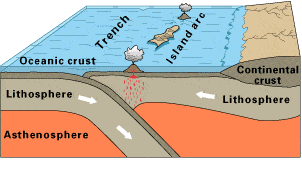
Observe this diagram of a plate boundary. One statement BEST describes what is happening. It is that
the oceanic crust is melting.
the denser ceanic crust is subducting under the less dense oceanic crust
volcanic islands are forming.
the tectonic plates are moving away from each other.
23
Multiple Choice
Most geologists think that the movement of Earth’s plates is caused by _______
convection.
continental drift.
subduction.
conduction.
24
Multiple Select
______ a hypothesis that new sea floor is created at mid-ocean ridges and that in the process the continents are pushed apart from each other.
PLATE TECTONIC
FAULTS
SEA-FLOOR SPREADING
SEISMOMETER
25
Multiple Choice
The three types of plate boundaries are
Convergent, divergent, change
Divergent, allegiant, insurgent
Convergent, divergent, transform
Push, pull, slide
26
Multiple Choice
What is common at convergent boundaries?
Valleys
Canyons
Mountains
Rivers
27
Multiple Choice
What happens often at transform boundaries?
Rain
Hurricanes
Volcanic activity
Earthquakes
28
Multiple Choice
divergent boundary
convergent boundary
transform boundary
29
Multiple Choice
divergent boundary
convergent boundary
transform boundary
30
Multiple Choice
New crust is formed at this type of boundary
divergent
convergent
transform
31
Multiple Choice
This type of boundary creates folded mountains.
transform
divergent
continental-continental convergent
continental-oceanic convergent
32
Multiple Choice
This feature can be found along a divergent boundary
mid-ocean ridge
folded mountains
deep sea trench
33
Multiple Choice
Which feature is formed when two oceanic plates collide?
mid-ocean ridge
volcanic island arc
folded mountains
Show answer
Auto Play
Slide 1 / 33
SLIDE

Similar Resources on Wayground
23 questions
Earthquakes
Presentation
•
7th Grade
23 questions
The Solar System
Presentation
•
6th - 8th Grade
23 questions
Geologic Time Scale
Presentation
•
8th Grade
25 questions
Weather Day 7 - Factors Affecting Climate
Presentation
•
6th - 8th Grade
30 questions
Earth Spheres and Interactions
Presentation
•
6th - 8th Grade
23 questions
Exploring the Strength of Magnetic Force
Presentation
•
8th Grade
26 questions
Sound - Hearing
Presentation
•
7th - 8th Grade
25 questions
The Sun
Presentation
•
7th - 8th Grade
Popular Resources on Wayground
19 questions
Naming Polygons
Quiz
•
3rd Grade
10 questions
Prime Factorization
Quiz
•
6th Grade
20 questions
Math Review
Quiz
•
3rd Grade
15 questions
Fast food
Quiz
•
7th Grade
20 questions
Main Idea and Details
Quiz
•
5th Grade
20 questions
Context Clues
Quiz
•
6th Grade
20 questions
Inferences
Quiz
•
4th Grade
19 questions
Classifying Quadrilaterals
Quiz
•
3rd Grade
Discover more resources for Science
16 questions
Interactions within Ecosystems
Presentation
•
6th - 8th Grade
12 questions
PS.8.1.2, PS.8.1.3, PS.8.1.5 Review
Quiz
•
8th Grade
20 questions
Moon Phases and Eclipses
Quiz
•
6th - 8th Grade
16 questions
Photosynthesis and Cellular Respiration Review
Quiz
•
7th Grade
22 questions
6th & 8th Grade Science Material SOL Review
Quiz
•
6th - 8th Grade
20 questions
genetics, punnett squares, heredity
Quiz
•
7th Grade
49 questions
NC Released EOG 8 Science (2024)
Quiz
•
8th Grade
48 questions
8th Grade NC Science EOG Review 2
Quiz
•
8th Grade