

Experience Chemistry Lesson 12.1-Rates of Reaction

Presentation
•
Chemistry, Science
•
10th - 12th Grade
•
Medium
Standards-aligned

Abby Fancsali
Used 7+ times
FREE Resource
11 Slides • 6 Questions
1

2
Expressing Rates of Change
Rate: The ratio between two related quantities expressed in different units
Many describe how much something changes over time (ex: Speed is distance/time)
Reaction Rate: The rate at which the reactants of a chemical reaction form the product
Written in terms of a concentration [X]/t
Rate can be negative for a reactant or positive for a product
Experience Chemistry | Lesson 12.1
3
Expressing Rates of Change
Experience Chemistry | Lesson 12.1

4
Expressing Rates of Change
To keep things simple, chemists use a single rate of reaction that is always positive based on the stoichiometry of the reaction
Take a typical reaction with reactants A & B and Product C
xA + yB → zC
Experience Chemistry | Lesson 12.1
5
Calculating Reaction Rates
Hydrogen and Iodine gas react to form hydrogen iodide, as shown in the equation H2 + I2 → 2HI. Suppose you are given a time interval from t1=10 sec and t2=20 sec where the change in H2 concentration from 0.210 mol/L to 0.185 mol/L. Calculate the average reaction rate in that period
Step 1: Identify your knonws
[H1] =
[H2] =
t1=
t2=
x=, y=, z=
Experience Chemistry | Lesson 12.1
6
Calculating Reaction Rates
Hydrogen and Iodine gas react to form hydrogen iodide, as shown in the equation H2 + I2 → 2HI. Suppose you are given a time interval from t1=10 sec and t2=20 sec where the change in H2 concentration from 0.210 mol/L to 0.185 mol/L. Calculate the average reaction rate in that period
Step 1: Identify your knonws
[H1] =0.210 mol/L
[H2] =0.185 mol/L
t1=10
t2=20
x=1, y=1, z=2
Experience Chemistry | Lesson 12.1
7
Calculating Reaction Rates
Hydrogen and Iodine gas react to form hydrogen iodide, as shown in the equation H2 + I2 → 2HI. Suppose you are given a time interval from t1=10 sec and t2=20 sec where the change in H2 concentration from 0.210 mol/L to 0.185 mol/L. Calculate the average reaction rate in that period.
Step 2: Substitute your knowns into the equation
ΔH=0.185-0.210=-0.025
Δt=20-10=10
x=1, y=1, z=2
Experience Chemistry | Lesson 12.1
8
Fill in the Blanks
Hydrogen and Iodine gas react to form hydrogen iodide, as shown in the equation H2 + I2 → 2HI. Suppose you are given a time interval from t1=10 sec and t2=20 sec where the change in H2 concentration from 0.210 mol/L to 0.185 mol/L. Calculate the average reaction rate in that period.
Type answer...
9
Calculating Reaction Rates
For the same reaction H2 + I2 → 2HI. You are given a product concentration of 0.180 mol/L at a time of 15 seconds and a concentration of 0.205 mol/L at a time of 20 seconds. Calculate the average reaction rate for the time interval.
Step 1: Identify your knowns
[HI1] =
[HI2] =
t1=
t2=
x=, y=, z=
Experience Chemistry | Lesson 12.1
10
Calculating Reaction Rates
For the same reaction H2 + I2 → 2HI. You are given a product concentration of 0.180 mol/L at a time of 15 seconds and a concentration of 0.205 mol/L at a time of 20 seconds. Calculate the average reaction rate for the time interval.
Step 2: Substitute your knowns into the equation
ΔHI=0.205-0.0180= 0.025
Δt=20-15=5
x=1, y=1, z=2
Experience Chemistry | Lesson 12.1
11
Fill in the Blanks
For the same reaction H2 + I2 → 2HI. You are given a product concentration of 0.180 mol/L at a time of 15 seconds and a concentration of 0.205 mol/L at a time of 20 seconds. Calculate the average reaction rate for the time interval.
Type answer...
12
Collision Theory and Reaction Rates
Collision Theory states that a reaction only takes place if reactants combine with enough energy at the right orientation
As reaction takes place, less reactants are available to collide
Experience Chemistry | Lesson 12.1

13
Concentration, Temperature, Particle and Reaction Rates
The higher the concentration, the more molecules to collide and react
High Concentration= faster rate
The higher the temperature, the more faster molecules move, and the more likely they are to collide
High temperature= faster rate
A larger particle size, the longer the reaction will take place
Smaller Particles have more surface area
More Surface area = Faster rate
Experience Chemistry | Lesson 12.1
14
Multiple Choice
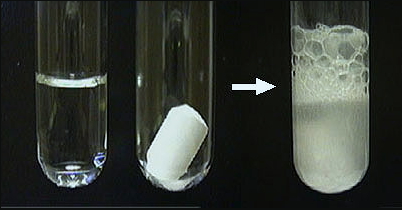
How could we make this reaction happen more quickly?
Decrease the concentration of the acid
crush the chalk to increase the surface area
Put the test tube in an ice bath
15
Multiple Choice
16
Multiple Choice
17
Multiple Choice
Show answer
Auto Play
Slide 1 / 17
SLIDE
Similar Resources on Wayground

12 questions
Experience 3: Atomic Emission Spectra
Presentation
•
9th - 12th Grade
13 questions
Speed v. Velocity
Presentation
•
8th Grade
11 questions
Adaptations
Presentation
•
9th - 12th Grade
13 questions
Classification of Matter
Presentation
•
9th - 12th Grade
11 questions
Intermolecular Forces
Presentation
•
9th - 12th Grade
10 questions
Genetics Dihybrid Crosses
Presentation
•
9th - 12th Grade
10 questions
Genetic Engineering
Presentation
•
10th - 11th Grade
14 questions
Periodic Table and Trends
Presentation
•
10th - 12th Grade
Popular Resources on Wayground
10 questions
How much do you know about our Portrait of an Eagle?

Quiz
•
10th Grade
10 questions
Fast Food Slogans
Quiz
•
6th - 8th Grade
21 questions
Continents and Oceans
Quiz
•
6th Grade
20 questions
Parts of Speech
Quiz
•
5th Grade
16 questions
Subject & Predicate
Quiz
•
5th Grade
25 questions
Multiplication Facts
Quiz
•
5th Grade
12 questions
Map Skills
Quiz
•
3rd Grade
22 questions
Continents and Oceans
Quiz
•
5th Grade
Discover more resources for Chemistry
20 questions
Metric Conversions
Quiz
•
11th Grade
20 questions
electron configurations and orbital notation
Quiz
•
9th - 12th Grade
26 questions
Atomic Structure, Isotopes and Ions
Quiz
•
10th Grade
20 questions
Periodic Trends
Quiz
•
10th Grade
5 questions
Atomic Theory Intro Video

Interactive video
•
10th Grade
20 questions
COUNTING ATOMS
Quiz
•
10th Grade
20 questions
Practice: E-Con, Orbital Notation, Noble Gas Notation
Quiz
•
10th Grade
20 questions
Ions
Quiz
•
10th Grade