Search Header Logo
untitled

untitled

Assessment

Presentation

Chemistry

9th Grade

Hard

Created by

Anonymous Anonymous

FREE Resource

17 Slides • 71 Questions

1

Multiple Choice

Where does transcription take place?

1

cell membrane

2

nucleus

3

cytoplasm

4

ribosome

2

Multiple Choice

Where does transcription take place?

1

cell membrane

2

nucleus

3

cytoplasm

4

ribosome

3

Multiple Choice

What is made during transcription?

1

DNA

2

RNA

3

Proteins

4

Amino Acids

4

Fill in the Blanks

Type answer...

5

Multiple Choice

Codons are located on....

1

DNA

2

mRNA

3

tRNA

4

rRNA

6

Multiple Choice

Anti-codons are located on...

1

DNA

2

mRNA

3

tRNA

4

rRNA

7

Multiple Choice

Is this a strand of DNA or RNA?

TACGGACTA

1

DNA

2

RNA

3

Impossible to tell

8

Multiple Choice

Where is RNA made into protein?

1

Cytoplasm

2

Nucleus

3

Ribosome

4

Cell Membrane

9

Multiple Choice

Question image

DNA is found in the ...?

1

Ribosome

2

Nucleus

3

Cytoplasm

4

Chromosomes

10

Multiple Choice

Question image

The ribosome is mainly made up of ..?

1

tRNA

2

mRNA

3

rRNA

4

DNA

11

Fill in the Blanks

media image

Type answer...

12

Fill in the Blanks

media image

Type answer...

13

Multiple Choice

A protein is built during this process

1

translation

2

transcription

14

Multiple Choice

At the end of this process the RNA molecule leaves the nucleus

1

translation

2

transcription

15

Multiple Choice

What does tRNA do during translation?

1

it brings a specific segment of DNA to the ribosome for transcription

2

it brings any amino acid to the ribosome

3

it brings a specific amino acid (decided by the DNA) to the ribosome for translation

4

it brings a specific amino acid (decided by the codon) to the ribosome for translation

16

Fill in the Blanks

Type answer...

17

Multiple Choice

Question image
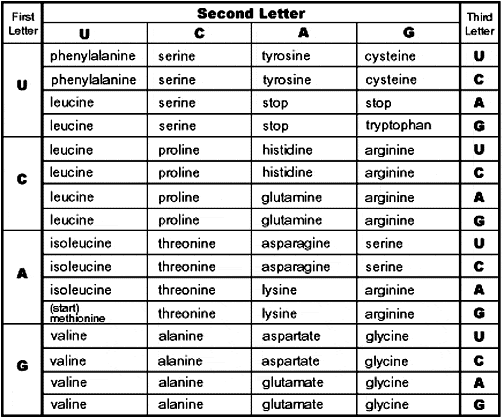
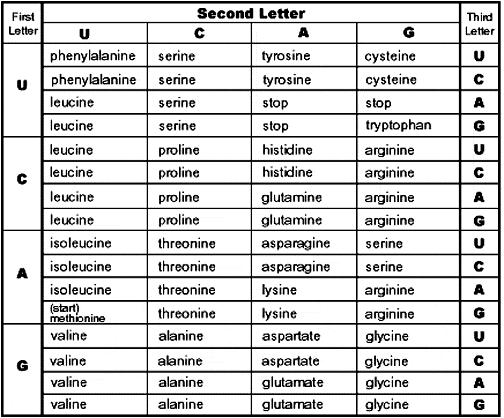
Which amino acid is made from the RNA codon UUA?
1
Phenylalanine
2
Leucine
3
Serine
4
Tyrosine

18

Multiple Choice

What is the process that copies information from DNA into RNA?
1
protein synthesis
2
transcription
3
translation
4
DNA Polymerase

19

Multiple Choice

What does mRNA do?
1
provides information from DNA to ribosomes
2
transfers amino acids to the ribosomes
3
makes up ribosomes
4
builds proteins

20

Multiple Choice

_______ is made during transcription and ________ is made during translation.
1
mRNA / a protein
2
a protein / mRNA
3
Ribosome / Nucleus
4
mRNA / tRNA

21

Multiple Choice

Question image

Label the picture in order:

1

phosphate ; sugar ; base

2

phosphate ; base ; sugar

3

base ; sugar ; phosphate

4

base ; phosphate ; sugar

22

Multiple Choice

Question image
The following picture must be
1
DNA because it's double stranded
2
RNA because it's single stranded
3
DNA because it's single stranded
4
RNA because it's double stranded

23

Multiple Choice

I include the bases Guanine, Cytosine, Adenine and Uracil .
1
DNA
2
RNA

24

Multiple Choice

I include the bases Guanine, Cytosine, Adenine and Thymine.
1
DNA
2
RNA

25

Multiple Choice

Question image

What does RNA contain the DNA does not?

1

RNA contains uracil and deoxyribose

2

RNA contains ribose and thymine

3

RNA contains uracil and ribose

4

RNA contains adenine and ribose

26

Multiple Choice

If a strand of DNA had bases in the following order - ATCCGTC, what would be the replicated complementary strand?

1

UAGGCAG

2

ATCCGTC

3

TAGGCAG

4

TUGGCTG

27

Multiple Choice

If a strand of DNA had bases in the following order - ATCCGTC, what would be the transcribed mRNA sequence?

1

TAGGCAG

2

UAGGCAG

3

TUGGCUG

4

None of the above are correct

28

Multiple Choice

Question image

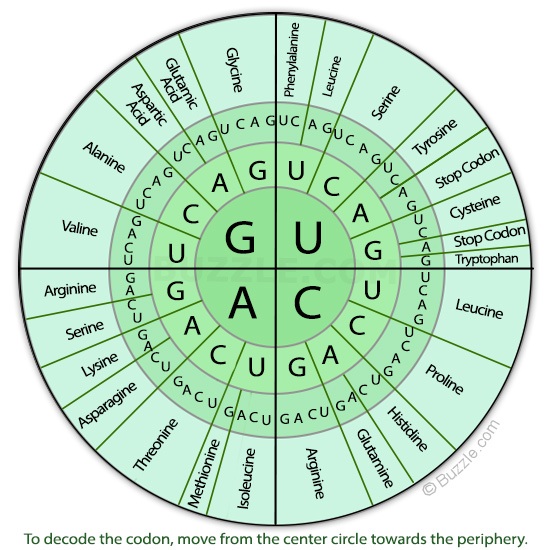
Use the codon chart to determine the amino acid sequence: (Hint: mRNA must be used to determine the AA sequence!)


ATT CGC ATC

TAA GCG TAG

AUU CGC AUC

UAA GCG UAG

1

tyrosine, alanine, stop

2

stop, alanine, tyrosine

3

start, arginine, methionine

4

Isoleucine, arginine, isoleucine

29

Multiple Choice

Which of the following base pairs with adenine in RNA?

1

thymine

2

guanine

3

uracil

4

cytosine

30

Multiple Choice

A section of DNA contains the following bases in this order: GAT CCT

Which of the following mRNA sequences complements this section of DNA?

1

CUA GGA

2

TCG AAG

3

CTA GGA

4

AGC UUC

31

Multiple Choice

How would the complementary strand of DNA appear in the original strand of DNA contained the bases TAGC respectively?

1

UACG

2

GCAT

3

TACG

4

ATCG

32

Multiple Choice

A strand of messenger RNA is transcribed from an original strand of DNA. The original DNA base strand were TACG. What is the base sequence on the RNA strand produced?

1

ATGC

2

AUGC

3

TAGC

4

UACG

33

Multiple Choice

Question image

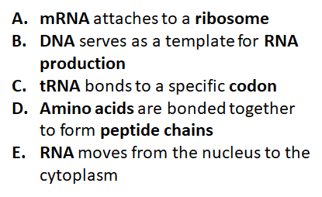
What is the correct order for the following events that occur during protein synthesis?

1

B,E,A,C,D

2

B,A,E,C,D

3

D,A,E,C,B

4

C,B,A,E,D

34

Multiple Choice

Question image

Which of the following polypeptides are coded for by the mRNA sequence


5' AUG GUU AAA 3'

1

Val, Lys, Phe

2

Met, Asp, Phe

3

Met, Val, Lys

4

Ile, Gln, Lys

35

Multiple Choice

Question image

A sequence of a DNA template strand is shown.


3' TCC AAT GGC TTA TTT 5'


Which of these is the correct amino acid chain produced from the DNA template strand?

1

Arginine, Leucine, Proline, Asparagine

2

Tryptophan, Phenylalanine, Leucine

3

Serince, Leucine, Proline, Asparagine

4

Tryptophan, Phenylalanine, Leucine, Glycine

36

Multiple Choice

Question image

DNA is found in the ...?

1

Ribosome

2

Nucleus

3

Cytoplasm

4

Chromosomes

37

Multiple Choice

Question image

The process of a complementary strand of DNA being copied is called?

1

Translation

2

DNA replication

3

Transcription

4

DNA sequencing

38

Multiple Choice

Question image

The ribosome is mainly made up of ..?

1

tRNA

2

mRNA

3

rRNA

4

DNA

39

Multiple Choice

Question image

Amino acids are joined together in a chain using what bond?

1

Ester bonds

2

Covalent bonds

3

Hydrolysis

4

Peptide bonds

40

Fill in the Blanks

media image

Type answer...

41

Multiple Choice

Question image

What type of RNA carries the DNA message out of the nucleus?

1

rRNA

2

mRNA

3

tRNA

4

RNA polymerase

42

Fill in the Blanks

media image

Type answer...

43

Multiple Choice

Question image

What has to happen to start the whole process of transcription and translation?

1

Gene is switched on

2

Gene is copied

3

mRNA leaves the nucleus

4

Gene is switched off

44

Multiple Select

Question image

What happens once a stop codon has been reached? (Multiple answers).

1

The process will restart once a start codon is reached again

2

The process will stop and the protein will be released

3

The protein will then take its shape in the cytoplasm

4

The tRNA molecule will continue to try to find a matching anticodon

45

Fill in the Blanks

media image

Type answer...

46

Multiple Choice

Question image

Whose model suggested that negative particles were mixed in with positively charged material - like seeds in a watermelon?

1

J.J. Thomson

2

Ernest Rutherford

3

Niels Bohr

4

Albert Einstein

47

Multiple Choice

Who discovered that the atom had an small, dense, positively charged center?

1

Ernest Rutherford

2

J.J Thomson

3

Robert Millikan

4

John Dalton

48

Multiple Choice

Place the following atomic models in order, from earliest to latest:


A) Rutherford B) Thomson C) Dalton

1

B, C, A

2

C, A, B

3

A, C, B

4

C, B, A

49

Multiple Choice

What can you conclude from the fact that scientists continue to update the atomic model?
1
New information about atoms continues to be discovered
2
Old information about atoms is completely useless
3
Scientists did not have any information about atoms until a few years ago
4
Scientists still have no idea what atoms look like

50

Match

Identify each model by the scientist who theorized it

Thomson

Rutherford

Bohr

51

Multiple Choice

Whose model of an atom would be described as a solid sphere?

1

Thomson

2

Rutherford

3

Dalton

4

Bohr

52

Multiple Choice

Which scientist was the first to provide evidence that atoms contained subatomic particles?

1

Schrodinger

2

Dalton

3

Thomson

4

Rutherford

53

Multiple Choice

Which of the following statements about Bohr's model of the atom is NOT true? 

1

The exact orbital path of an electron is not known.

2

Electrons are found in fixed circular orbits.

3

The model can be compared to planets revolving around the sun.

4

Electrons orbit the nucleus.

54

Multiple Choice

Which of the following statements about the modern quantum model of the atom is TRUE?

1

Electron clouds are formed by electron movement.

2

Only protons form the nucleus.

3

Protons and electrons form the nucleus.

4

Neutrons in the nucleus have a positive charge.

55

Fill in the Blanks

Type answer...

56

Multiple Choice

Who was the first person to "think" of an atom?

1

Democritus

2

J.J. Thompson

3

Rutherford

4

Bohr

57

Multiple Choice

Ernest Rutherford discovered that the atom was mostly _________________ and has a _______________ charged nucleus.
1
empty space, positively
2
empty space, negatively
3
full of protons, positively
4
full of neutrons, negatively

58

Match

Identify each model by the scientist who theorized it

Thomson

Rutherford

Bohr

59

Multiple Choice

Whose model of an atom would be described as a solid sphere?

1

Thomson

2

Rutherford

3

Dalton

4

Bohr

60

Multiple Choice

Which scientist was the first to provide evidence that atoms contained subatomic particles?

1

Schrodinger

2

Dalton

3

Thomson

4

Rutherford

61

Multiple Choice

Which of the following statements about Bohr's model of the atom is NOT true? 

1

The exact orbital path of an electron is not known.

2

Electrons are found in fixed circular orbits.

3

The model can be compared to planets revolving around the sun.

4

Electrons orbit the nucleus.

62

Multiple Choice

Which of the following statements about the modern quantum model of the atom is TRUE?

1

Electron clouds are formed by electron movement.

2

Only protons form the nucleus.

3

Protons and electrons form the nucleus.

4

Neutrons in the nucleus have a positive charge.

63

Fill in the Blanks

Type answer...

64

Multiple Choice

Who was the first person to "think" of an atom?

1

Democritus

2

J.J. Thompson

3

Rutherford

4

Bohr

65

Multiple Choice

Ernest Rutherford discovered that the atom was mostly _________________ and has a _______________ charged nucleus.
1
empty space, positively
2
empty space, negatively
3
full of protons, positively
4
full of neutrons, negatively

66

Apex 3.2 Review -

Atomic Models

Please follow along and participate in the questions!

media

67

Learning Objectives: I can...

  • Summarize the history of atomic models.

  • Identify the differences between the various atomic models.

  • Develop and use a model which shows that electrons orbit outside the center of the atom.

68

media

69

Multiple Choice

Why are models useful in the study of atoms?

1

Atoms are too dangerous to handle.

2

Atoms are too big too fit in a lab.

3

Atoms are too small to see with our eyes.

4

Atoms are too rare and valuable to use in lab studies.

70

media

71

media

72

media

73

media

74

Multiple Select

What were the two main advancements that J.J. Thomson's "Plum Pudding" model proposed?

1

Atoms contain smaller particles with a negative charge.

2

Atoms are solid spheres.

3

Atoms are made of negatively-charged particles floating in a positively-charged "sea."

4

Atoms cannot be destroyed or divided.

75

media

76

media

77

media

78

Multiple Choice

In the Rutherford model, where can the atom's positive charge be found?

1

In the electrons.

2

In the nucleus.

3

In the orbits.

4

In the plum pudding.

79

media

80

media

81

media

82

media

83

media

84

Multiple Choice

Question image

Match the atomic model in the picture with the scientist who developed it.

1

John Dalton (1808)

2

Ernest Rutherford (1909)

3

Erwin Shrödinger (1926)

4

JJ Thomson (1897)

85

Multiple Choice

Question image

Match the atomic model in the picture with the scientist who developed it.

1

JJ Thomson (1897)

2

John Dalton (1808)

3

Niels Bohr (1913)

4

Erwin Shrödinger (1926)

86

media

87

Learning Objectives: I can...

  • Summarize the history of atomic models.

  • Identify the differences between the various atomic models.

  • Develop and use a model which shows that electrons orbit outside the center of the atom.

88

Open Ended

Closing: With the objectives in mind, what are the important takeaways from this lesson that you should remember when we come back from Fall Break?

Where does transcription take place?

1

cell membrane

2

nucleus

3

cytoplasm

4

ribosome

Show answer

Auto Play

Slide 1 / 88

MULTIPLE CHOICE