Plate Boundaries
Presentation
•
Science
•
6th - 8th Grade
•
Medium
+3
Standards-aligned
Kurt Trout
Used 1+ times
FREE Resource
14 Slides • 69 Questions
1
Y9 Plate Boundaries
To check our understanding of plate boundaries
2
Earth Sciences: Plate Boundaries
In the theory of plate tectonics, the earth's crust is broken into plates that move around relative to each other. As a result of this movement, three types of plate boundaries are formed: divergent, convergent, and transform boundaries.
3
Divergent Boundaries
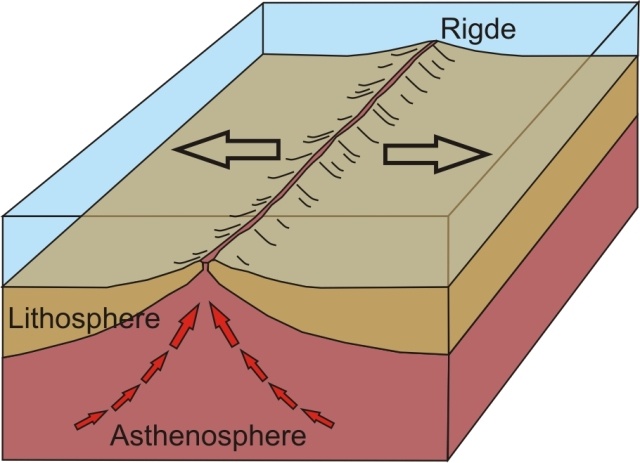
Divergent boundaries are boundaries where plates pull away from each other, forming mild earthquakes and volcanoes as magma comes to the surface.
4
The creation of oceanic crust, seafloor spreading, is the process that forms new land/crust on Earth.
The rock closest to the opening of the boundary is the youngest. The rock ages as you move further away from the fissure (opening).
5
Multiple Choice
How do plates move at DIVERGENT boundaries?
Collide (together)
Move apart
Slide past each other
6
Multiple Select
Choose all the features that can be formed at DIVERGENT boundaries.
Volcanoes/Mountains
Trenches
Mid Ocean Ridge
Rift Valley
7
Multiple Choice
At which boundary is new crust formed
Transform
Divergent
Convergent
8
Multiple Choice
How do DIVERGENT boundaries affect the crust?
They create crust
They destroy crust
They don't destroy or create
9
Convergent Boundaries
Convergent boundaries are boundaries where two plates are pushing into each other. They are formed when two plates collide, either crumpling up and forming mountains or pushing one of the plates under the other and back into the mantle to melt.
10
Formed when convergent continental boundaries collide and deform the crust, causing it to buckle, fold, and create new hills and mountains
Mountain Building
Continental - Continental
11
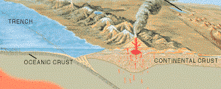
At convergent boundaries, continental crust is created and oceanic crust is destroyed as it subducts, melts, and becomes magma.
Convergent plate movement also creates mountains, earthquakes and often forms chains of volcanoes.
Subject | Subject
12
Multiple Choice
How will you describe the movement of the image here?
They are colliding or moving toward to each other
They are moving away from each other
They are sliding past each other
There is no movement at all
13
Multiple Choice
Volcano
Mountain
Rift
Island Arc
14
Multiple Choice
In what type of boundary are the plates move toward each other?
Convergent boundary
Divergent boundary
Transform Fault boundary
15
Multiple Choice
divergent
convergent
transform
strike slip
16
Transform Boundaries
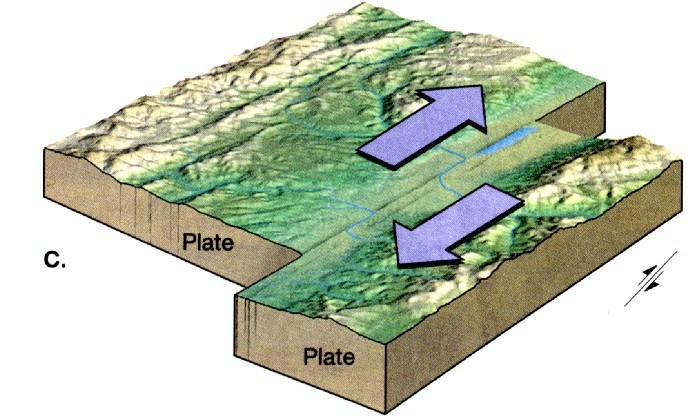
The third type is transform boundaries, or boundaries where plates slide past each other, forming strong earthquakes. All of this crashing, banging, and erupting are one reason why the surface of the earth has such a variety of landforms and features.
17
Transform Boundaries
Two plates sliding past each other forms a transform plate boundary. Natural or human-made structures that cross a transform boundary are offset—split into pieces and carried in opposite directions. Earthquakes are common along these faults.
18
A well-known transform plate boundary is the San Andreas Fault, which is responsible for many of California’s earthquakes.
San Andreas Fault
19
Multiple Choice
divergent
convergent
transform
submergent
20
Multiple Choice
Earthquakes
Volcanoes
Mountains
Rift Valleys
21
Multiple Choice
Divergent
Convergent
Transform
Actually, all of them
22
At divergent boundaries, NEW crust is created by magma coming up!
At convergent boundaries, crust is DESTROYED or recycled by being crushed or pushed underneath.
At transform boundaries, nothing happens to crust.
What happens to the crust?
23
Multiple Choice
Divergent
Convergent
Transform
24
Multiple Choice
Destroys or recycles crust:
convergent
divergent
transform
25
Multiple Choice
Neither creates or destroys crust
convergent
divergent
transform
26
Divergent boundaries-plates moves AWAY from each other
Convergent boundaries- plates moving towards/into each other
Transform-plates sliding past each other
lets review!
27
Multiple Choice
divergent
convergent
transform
subducting
28
Multiple Choice
divergent
convergent
transform
strike slip
29
Multiple Choice
Divergent
Convergent
Transform
30
Multiple Choice
Divergent
Convergent
Transform
Actually, all of them
31
Multiple Choice
Identify the plate boundary shown in the image.
Divergent
Convergent
Transform
Strike Slip
32
Multiple Choice
Identify the plate boundary shown in the image.
Divergent
Convergent
Transform
Submergent
33
Multiple Choice
New oceanic crust (sea floor) is created at this boundary.
Convergent Oceanic
Divergent Oceanic
Divergent Continental
Transform
34
Multiple Choice
Identify the divergent plate boundary.
35
Multiple Choice
Which plate boundary is this?
Convergent Continental to Continental
Convergent Continental to Oceanic
Convergent Oceanic to Oceanic
Divergent
Transform
36
Multiple Choice
Which plate boundary is this?
Convergent
Divergent
Transform
37
Multiple Choice
Which plate boundary is this?
Convergent
Divergent
Slip
Transform
38
Destroys/recyles crust
can create mountains
IF subduction zone, can create land based volcanos
Convergent
Creates new crust
sea floor spreading
ridges and trenches in ocean
can create small earthquakes and some sea volcanos
Divergent
Features
Transform-"creates" nothing, but MAJOR source of earthquakes!!
39
Multiple Choice
A boundary that doesn't create or destroy crust is called a:
Transform Boundary
Convergent Boundary
Divergent Boundary
Rift Valley
40
Multiple Choice
In what type of boundary is the only feature created going to be Mountains?
Oceanic to Oceanic Convergence
Oceanic to Continental Convergence
Rift Valleys
Continental to Continental Convergence
41
Multiple Choice
What geologic feature/event would you most likely to find at a divergent boundary between two pieces of oceanic crust?
Mid-Ocean Ridge
Island Arc
Flat land
42
Multiple Choice
A mid-ocean RIDGE is located at the boundary of two tectonic plates. Which diagram correctly models the relative plate motion on each side of a mid ocean ridge?
43
Multiple Choice
convergent plate boundary
divergent plate boundary
transform plate boundary
subduction
44
Multiple Choice
divergent plate boundary
transform plate boundary
subduction
45
Multiple Choice
Mountains form when a plates MOVE AWAY.
True
False
46
Multiple Choice
plate boundary
submersion
accretion
subduction
47
Multiple Choice
A divergent boundary in the ocean creates what feature?
Mid Ocean Ridge
Rift Valley
Deep Ocean Trench
Subduction Zone
48
Multiple Choice
diverging tectonic plates
erosion of the land by the ocean
converging tectonic plates
deposition of sediments by the ocean
49
Lets see if we got it!
50
Multiple Choice
Transform
Convergent
Divergent
Plate
51
Multiple Choice
The diagram shows a landform on Earth. How did the movement of Earth’s plates form the landform?
Two oceanic plates slid past each other.
Two continental plates collided.
One continental plate slid past an oceanic plate.
One continental plate subducted beneath an oceanic plate.
52
Multiple Choice
continental and oceanic
ocean and upper
lower and upper
pizza and subway
53
Multiple Choice
Divergent
Convergent
Transform
54
Multiple Choice
Divergent
Convergent
Transform
55
Multiple Choice
Divergent
Convergent
Transform
56
Multiple Choice
Divergent
Convergent
Transform
Actually, all of them
57
Multiple Choice
Divergent
Convergent
Transform
Actually, all of them
58
Multiple Choice
Divergent
Convergent/Subduction
Transform
Actually, all of them
59
Multiple Choice
What kind of plate boundary is shown here?
divergent
convergent
transform
60
Multiple Choice
New crust forms along a(n)
divergent boundary
convergent boundary
transform boundary
61
Multiple Choice
Crust can be destroyed along a(n)
divergent boundary
convergent boundary
transform boundary
62
Multiple Choice
Identify the type of tectonic boundary: Yesterday, there was a 5.4 Earthquake in San Francisco, U.S.A.
divergent boundary
convergent boundary
transform boundary
63
Multiple Choice
New oceanic crust (sea floor) is created at this boundary.
Divergent Oceanic
Divergent Continental
Convergent Oceanic
Transform
64
Multiple Choice
Oceanic crust (sea floor) is destroyed at this boundary.
Convergent Oceanic
Divergent Oceanic
Convergent Continental-Continental
Divergent Continental
65
Multiple Choice
Which plate boundary is this?
Convergent Continental to Continental
Convergent Continental to Oceanic
Convergent Oceanic to Oceanic
Divergent
Transform
66
Multiple Choice
Which plate boundary is this?
Convergent Continental to Continental
Convergent Continental to Oceanic
Convergent Oceanic to Oceanic
Divergent
Transform
67
Multiple Choice
Which plate boundary is this?
Convergent Continental to Continental
Convergent Continental to Oceanic
Convergent Oceanic to Oceanic
Divergent
Transform
68
Multiple Choice
Which plate boundary is this?
Convergent Continental to Continental
Convergent Continental to Oceanic
Convergent Oceanic to Oceanic
Divergent
Transform
69
Multiple Choice
Two plates come together or collide at what boundary?
Convergent
Divergent
Transform
70
Multiple Choice
When two continental plates converge (collide) what type of crustal feature is formed?
Mid Ocean Ridge
Subduction Zone
Rift Valley
Folded Mountains
71
Multiple Choice
What is the only event associated with plate boundaries, however LARGEST at transform boundaries
Volcanoes
Earthquakes
Subduction
Deep Trenches
72
Multiple Choice
When plates SLIDE PAST each other to make earthquakes?
Convergent
Divergent
Hot Spot
Transform
73
Multiple Choice
Convergent
Divergent
Hot Spot
Transform
74
Multiple Choice
Convergent
Divergent
Hot Spot
Transfomr
75
Multiple Choice
Convergent
Divergent
Hot Spot
Transform
76
Multiple Choice
Convergent
Divergent
Hot Spot
Transform
77
Multiple Choice
Convergent
Divergent
Transform
78
Multiple Choice
Convergent
Divergent
Transform
79
Multiple Choice
Convergent
Divergent
Transform
80
Multiple Choice
divergent
convergent
transform
subducting
81
Multiple Choice
divergent
convergent
transform
strike slip
82
Multiple Choice
Oceanic crust (sea floor) is destroyed at this boundary.
Convergent Oceanic
Divergent Oceanic
Convergent Continental-Continental
Divergent Continental
83
Multiple Choice
Circular currents in the mantle caused by the magma being heated by the core off the Earth.
convection currents
lava
magma
hot air
Y9 Plate Boundaries
To check our understanding of plate boundaries
Show answer
Auto Play
Slide 1 / 83
SLIDE

Similar Resources on Wayground
82 questions
Untitled Presentation
Presentation
•
6th - 8th Grade
69 questions
Grade 7 After Break Review 2022
Presentation
•
7th Grade
70 questions
Chapter 10 Earthquakes and Volcanoes
Presentation
•
8th Grade
78 questions
7.LS.1.2-DAY 2: Passive Transport — Diffusion and Osmosis
Presentation
•
7th Grade
75 questions
Rock Cycle
Presentation
•
5th - 9th Grade
86 questions
Study Guide for Module 1
Presentation
•
6th - 7th Grade
83 questions
Presentación sin título
Presentation
•
KG
Popular Resources on Wayground
10 questions
5.P.1.3 Distance/Time Graphs
Quiz
•
5th Grade
10 questions
Fire Drill
Quiz
•
2nd - 5th Grade
20 questions
Equivalent Fractions
Quiz
•
3rd Grade
22 questions
School Wide Vocab Group 1 Master
Quiz
•
6th - 8th Grade
20 questions
Main Idea and Details
Quiz
•
5th Grade
20 questions
Context Clues
Quiz
•
6th Grade
20 questions
Inferences
Quiz
•
4th Grade
12 questions
What makes Nebraska's government unique?
Quiz
•
4th - 5th Grade
Discover more resources for Science
8 questions
Amoeba Sister Asexual vs Sexual Reproduction
Interactive video
•
8th Grade
19 questions
Introduction to Properties of Waves
Presentation
•
6th - 8th Grade
16 questions
Interactions within Ecosystems
Presentation
•
6th - 8th Grade
10 questions
Exploring the Layers of the Earth
Interactive video
•
6th - 10th Grade
16 questions
Photosynthesis and Cellular Respiration Review
Quiz
•
7th Grade
20 questions
Abiotic & Biotic Factors
Quiz
•
7th Grade
15 questions
Punnett Squares
Quiz
•
6th Grade
10 questions
Exploring the Evolution of Cell Theory
Interactive video
•
7th Grade