

Evidence of Evolution

Presentation
•
Biology
•
9th - 12th Grade
•
Easy
+6
Standards-aligned

Stacy King
Used 13+ times
FREE Resource
24 Slides • 19 Questions
1
Evidence for Evolution
by
Natural Selection
2
Multiple Choice
Charles Darwin
Charles Derwin
Charlie Darwin
Chris Darwin
3
Multiple Choice
To change something
To change and adapt over time
To lose some original features
To improve ssomething over time
4
Multiple Choice
A group of similar organisms that can breed and produce fertile offspring.
species
population
mutation
group
5
Multiple Choice

What is population?
The number of organisms who live in a particular area.
The number of babies that born in a particular area.
The number of organisms that die in a particular area.
The amount of immigration that occurs in a particular area.
6


Evidence supporting evolution
▪ Fossil record
◆ shows change over time
▪ Anatomical record
◆ comparing body structures
▪ homology & vestigial structures
▪ embryology & development
▪ Molecular record
◆ comparing protein & DNA
sequences
▪ Artificial selection
◆ human caused evolution
7


1. Fossil record
▪ Layers of rock contain fossils
◆ new layers cover older ones (creates a
record over time)
◆ fossils show a series of organisms have
lived on Earth over a long period of time.
8

Regents Biology
Fossils tell a story…
the Earth is old
Life is old
Life on Earth has changed
9
Multiple Choice

Which layer contains the oldest fossil?
Layer 1
Layer 2
Layer 3
Layer 4
10


Fossil of Archaeopteryx
▪ lived about 150 mya
▪ links reptiles & birds
Evolution of birds
Today’s organisms descended
from ancestral species
(“common ancestor”)
Regents Biology
11
Multiple Choice
12


Land Mammal
?
?
?
Where are the
intermediate
fossils?
Ocean Mammal
Someone’s idea of a joke!
But the joke’s on them!!
Complete series
of transitional
fossils
We found the fossil — no joke!
13


Regents Biology
Evolution from sea to land
▪ 2006 fossil discovery of early tetrapod
◆ 4 limbs
▪ Missing link from sea to land animals
14


2. Anatomical record
Animals with different
structures on the surface
But when you look under
the skin…
It tells an evolutionary story
of common ancestors
15


Regents Biology
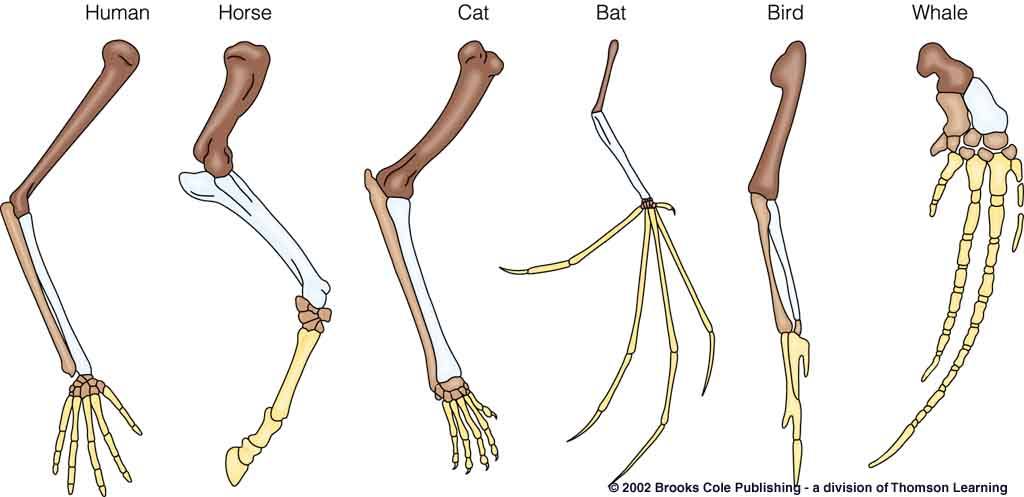
Compare the bones
▪ The same bones under the skin
◆ limbs that perform different functions
are built from the same bones
How could
these
very different
animals
have the
same bones?
16

Homologous structures
▪ Structures that come from the same origin
▪ homo- = same
▪ -logous = information
▪ Forelimbs of human, cats, whales, & bats
◆ same structure
▪ on the inside
◆ same development in embryo
◆ different functions
▪ on the outside
◆ evidence of common ancestor
17
Multiple Choice
The function of these bones is the same in all animals
They live in similar environments
They have a common ancestor
All organisms resemble humans
18
Multiple Choice
19


Regents Biology
But don’t be fooled by these…
▪ Analogous structures
◆ look similar
▪ on the outside
◆ same function
◆ different structure & development
▪ on the inside
◆ different origin
◆ no evolutionary relationship
Solving a similar problem with a similar solution
How is a
bird
like a bug?
20
Multiple Choice
Homologous structure
Analogous structure
Mimicry
Camoflague
21


Regents Biology
Analogous structures
▪ Dolphins: aquatic mammal
▪ Fish: aquatic vertebrate
◆ both adapted to
life in the sea
◆ not closely related
Watch the
tail!
22
Multiple Choice
True
False
23


Regents Biology
Convergent evolution
▪ 3 groups with wings
◆ Does this mean they have a
recent common ancestor?
Flight evolved 3
separate times—
evolving similar
solutions to similar
“problems”
They just
came up
with the
same
answer!
24
Multiple Choice

The three species pictured do not share a common ancestor, yet have evolved to have a similar anatomy and life style. This is an example of ?
Homologous Structures
Divergent Evolution
Vestigial Organs
Convergent Evolution
25


Regents Biology
Convergent evolution led to mimicry
▪ Why do these pairs look so similar?
Monarch male
poisonous
Viceroy male
edible
fly
bee
moth
bee
Which is the fly vs. the bee?Which is the moth vs. the bee?
26
Multiple Choice
Mimicry means:
A tree that has pink flowers in the spring
When one living thing looks like a different kind of living thing
A way an animal blends in with its environment
27
Multiple Choice
Camouflage means:
A special dessert
When an animal looks like another animal
A way an animal can look like its surroundings
28


Regents Biology
Vestigial organs
▪ Structures that are reduced in size and
have lost all or most of their original
function.
Why would whales have
pelvis & leg bones if they
were always sea creatures?
Because
they
used to
walk on
land!
29


Regents Biology
Vestigial organs
▪ Structures on modern animals that have
no function
◆ remains of structures that were functional
in ancestors
◆ evidence of change over time
▪ some snakes & whales have pelvis bones &
leg bones of walking ancestors
▪ eyes on blind
cave fish
▪ human tail bone &
appendix
30
Multiple Choice

Homologous
Vestigial
Analogous
31


Regents Biology
3. Comparative embryology
▪ Animals with backbones develop similarly
▪ During development, all vertebrates have a tail and paired
pharyngeal pouches.
-- In fish and amphibian larvae, the pouches become gills.
-- In humans, the pouches becomes the middle ear; tonsils, & glands
all vertebrate embryos have a “gill
pouch” at one stage of development
32
Multiple Choice
An organism in its early stage of development.
an infant
a calf
a cell
an embryo
33


Regents Biology
4. Molecular record
1
0
0
2
0
3
0
4
0
5
0
6
0
7
0
8
0
9
0
10
0
11
0
12
0
Lampre
y
Fro
g
Bir
d
Do
g
Macaqu
e
Huma
n
3
2
8
4
5
6
7
12
5
Comparing DNA & protein structure
◆ everyone uses the same genetic code!
▪ DNA sequences show how closely related 2
organisms are to each other.
▪ compare common genes
▪ compare common proteins
number of amino acids
different from human
hemoglobin
34
Multiple Choice

human and gorilla
horse and zebra
human and chimpanzee
chimpanzee and gorilla
35


Regents Biology
Building “family” trees
Closely related species are branches on the tree —
coming from a common ancestor
36


Regents Biology
5. Biogeography
▪ the study of the geographical distribution of living things
▪ The distribution of fossils show that the continents were
once joined together.
▪ Animals living in the same area evolve to have similar
traits.
37


Regents Biology
38
Multiple Choice
What is is the study of how and why plants and animals live where they do?
Evolution
Adaptive Radiation
Biogeography
Biogeology
39


Regents Biology
▪ How do we know natural selection can
change a population?
◆ we can recreate a similar process
◆ “evolution by human selection”
5. Artificial selection
“descendants” of wild mustard
40


Regents Biology
Selective Breeding
Humans create the
change over time
by
“descendants” of the wolf
41


Regents Biology
Artificial Selection
…and the
examples
keep coming!
I liked
breeding
pigeons!
42
Multiple Choice
A dog owner prefers very pointy noses for his dogs. So, he has dogs with the most pointed noses mate in hopes of getting puppies with very pointy noses. This process is called____________
mutation
gene therapy
natural selection
selective breeding
43
Multiple Choice
Which statement is true comparing natural selection and artificial selection?
In natural selection, traits benefit humans and in artificial selection, the traits benefit the species
In natural selection, traits benefit the species and in artificial selection, the traits benefit humans
In natural and artificial selection, the process takes hundreds of years to occur
In natural and artificial selection, nature determines what traits will be passed down to offspring.
Evidence for Evolution
by
Natural Selection
Show answer
Auto Play
Slide 1 / 43
SLIDE
Similar Resources on Wayground

40 questions
Writing and Naming Acids
Presentation
•
9th - 12th Grade
36 questions
Conjugaciones -ar, -er, -ir
Presentation
•
9th - 12th Grade
41 questions
Cell Unit
Presentation
•
9th - 12th Grade
39 questions
Kingdoms Notes
Presentation
•
9th - 12th Grade
40 questions
The Cell Cylce
Presentation
•
9th - 12th Grade
38 questions
Cellular Transport
Presentation
•
8th - 12th Grade
38 questions
Rhetorical Appeals and Strategies
Presentation
•
9th Grade
39 questions
Spanish 1 Review: Para Empezar Part 1
Presentation
•
9th - 12th Grade
Popular Resources on Wayground
10 questions
How much do you know about our Portrait of an Eagle?

Quiz
•
10th Grade
10 questions
Fast Food Slogans
Quiz
•
6th - 8th Grade
21 questions
Continents and Oceans
Quiz
•
6th Grade
20 questions
Parts of Speech
Quiz
•
5th Grade
16 questions
Subject & Predicate
Quiz
•
5th Grade
25 questions
Multiplication Facts
Quiz
•
5th Grade
12 questions
Map Skills
Quiz
•
3rd Grade
22 questions
Continents and Oceans
Quiz
•
5th Grade
Discover more resources for Biology
20 questions
Characteristics of Life
Quiz
•
9th - 10th Grade
10 questions
Exploring the 4 Major Macromolecules and Their Functions

Interactive video
•
9th - 12th Grade
20 questions
Cell organelles and functions
Quiz
•
10th Grade
20 questions
Cell Transport
Quiz
•
9th - 12th Grade
25 questions
photosynthesis and cellular respiration
Quiz
•
9th Grade
20 questions
Macromolecules
Quiz
•
10th Grade
16 questions
Population Ecology
Quiz
•
9th - 12th Grade
20 questions
Cell Organelles
Quiz
•
9th Grade