Search Header Logo
Cells & Microscope- TK

Cells & Microscope- TK

Assessment

Presentation

Biology

8th Grade

Hard

NGSS
HS-LS1-6, MS-PS1-1, MS-LS1-7

+5

Standards-aligned

Created by

Danielle Foraker

FREE Resource

18 Slides • 31 Questions

1

media
media

Carbohydrate structure

Elements: C H O

Structure: Rings

2

media
media

Carbohydrate building blocks

Simple sugar

3

media
media

Carbohydrate Function

4

Multiple Choice

Question image
Which of the following elements is required in an organic compound?
1

nitrogen

2

oxygen

3

carbon

4

sodium

5

Multiple Choice

Elements found in carbohydrates

1

C,H,O

2

C,H,O,N

3

C,H,O,N,P

6

Multiple Choice

Question image
Which compound is inorganic?
1

Glucose (C₆H₁₂O₆)

2

Ethane (C₂H₆)

3

Carbon Dioxide (CO₂)

4

Stearic Acid (C₁₈H₃₆O₂)

7

Multiple Choice

What is the main function of carbohydrates in the body?

1

Protect the organs

2

Keeps you feeling full

3

Supply energy for cells

4

Repairs body tissues

8

Multiple Choice

Sugars (glucose) and starch are examples of this organic molecule:
1

Carbohydrates

2

Lipids

3

Proteins

4

Nucleic Acids

9

media
media

Protein structure

Elements: C H O N

10

media
media

Protein building blocks

Amino Acids

11

media
media
media
media

Protein Function

Repair and build your body's cell parts & tissues

Help chemical reactions

12

Multiple Choice

Amino acids are the building blocks of

1

Carbohydrates 

2

Lipids

3

Proteins 

4

Nucleic Acids

13

Multiple Choice

Elements found in proteins

1

C,H,O

2

C,H,O,N

3

C,H,O,N,P

14

Multiple Choice

Proteins are made out of smaller molecules known as:

1

monosaccharides

2

amino acids

3

nucleic acids

4

lipids

15

Multiple Choice

Question image

What is chemical energy?

1

The energy stored in the bonds of molecules; fuel energy

2

The energy stored in the nucleus of an atom

3

gasoline in a car

4

The heat energy of substances due to the atoms and molecules vibration

16

media

Object under a microscope is

• Larger/magnified/bigger
• Upside down
• Backwards
• Detailed

17

media

18

media

19

media
media
media

20

media
media

Field of View (FOV)

• What you can see in the circle

21

media

Field of View

Low Power

• Large
• Bright

High Power

• Small
• Dark

e

22

media
media

Diaphragm

• Adjusts the amount of light

23

media

Movement of slide

•Opposite direction

–Ex: Move slide to the right;

specimen moves left

24

media
media

Total Magnification

(Ocular) x (Objective) = TM

25

media
media

A microscope has an ocular of
10xand objectives with 15x &
50x. What is the lowest total
magnification possible?

(10x) x (15x) = 150x

Example

26

media
media

A microscope has an ocular of
20xand objectives with 20x &
40x. What is the highest total
magnification possible?

(20x) x (40x) = 800x

Example #2

27

media
media

Diameter

• Diameter ÷

estimated # that fit
across

• 1mm = 1000µm

28

Multiple Choice

Question image

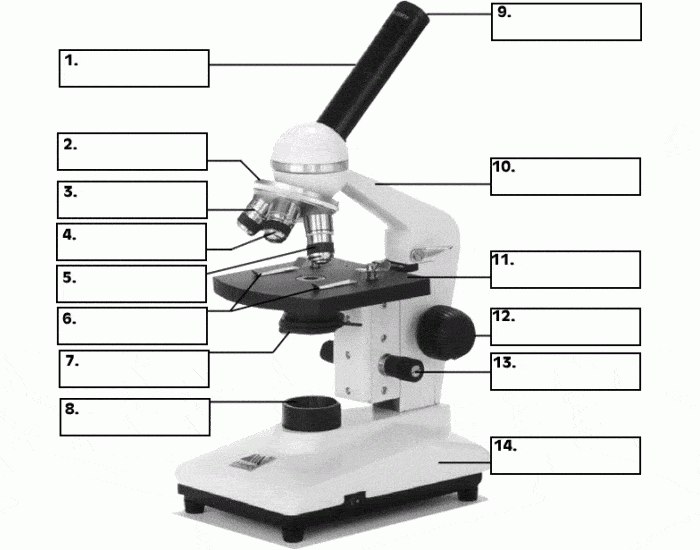
What is Part 12

1

Fine Adjustment Knob

2

Coarse Adjustment Knob

3

Diaphragm

4

Objective

29

Multiple Choice

Question image

What is Part 13

1

Fine Adjustment Knob

2

Course Adjustment Knob

3

Stage

4

Diaphragm

30

Multiple Choice

Question image

What is Part 7

1

Stage

2

Stage Clips

3

Light Source

4

Diaphragm

31

Multiple Choice

Regulates the amount of light on the specimen
1

Diaphragm

2

Stage

3

Ocular Lens

4

Objective Lenses

32

Multiple Choice

Field of view is......
1

The size of the specimen

2

The size of the slide

3

The area you can see under the microscope

4

The area from which your specimen came

33

Multiple Choice

As you move from low power to high power, the field of view becomes

1

Darker and larger

2

Darker and smaller

3

Brighter and larger

4

Brighter and small

34

Multiple Choice

Question image

The largest field of view shown is under the total magnification _____X.

1

40

2

100

3

400

35

Multiple Choice

Question image

If you wanted to center the image what direction would you move your slide in?

1

Down and left

2

Down and right

3

Up and left

4

Up and right

36

Multiple Choice

Which part of the microscope do you never use under high power?

1

Diaphragm

2

Coarse adjustment

3

Stage

4

Fine adjustment

37

Multiple Choice

Which part of the microscope should you use to focus the image?

1

Diaphragm

2

Coarse adjustment

3

Stage

4

Fine adjustment

38

Multiple Choice

What will be the total magnification if the ocular lens is 10X and the objective lens is 40X?
1

40X

2

10X

3

100X

4

400X

39

Multiple Choice

If the total magnification is 100x and the objective is 10x, what is the ocular?
1

90x

2

10x

3

110x

4

1000x

40

Multiple Choice

How many microns (µ) are in a millimeter (mm)?
1

10 µ

2

100 µ

3

1,000 µ

4

0.1 µ

41

Multiple Choice

Question image

How many microns μm = 1 mm?

1

1,000

2

1,000,000

3

10,000

4

100,000

42

Multiple Choice

You can find total magnification by which of the following methods?
1

ocular PLUS objective

2

ocular TIMES objective

3

ocular MINUS objective

4

ocular DIVIDED BY objective

43

Multiple Choice

Question image

If you look at a letter such as "e" under the microscope, then how does it look when you are viewing the image?

1

upside down and backward

2

upside down and distorted

3

upside down and front view

44

Multiple Choice

Question image

When making a wet mount, place the coverslip at a 45-degree angle to reduce air bubbles.

1

True

2

False

45

Multiple Choice

Question image

This picture shows that the microscope:

1

only flips images upside down

2

only flips images over backwards

3

flips the image upside down and backwards

4

doesn't flip the image at all

46

Multiple Choice

The best way to avoid air bubbles when making a wet mount slide is to:

1

drop the cover slip on at an angle

2

drop the cover slip on flat

3

squeeze the slide and cover slip after it is on

4

tap on the cover slip once it is in place

47

Multiple Choice

1.   Describe the purpose of staining cells before viewing them with a microscope

1

To clean them

2

So they absorb the liquid and grow

3

So the parts of the cells can be seen

4

So they shrink making them easier to look at

48

Multiple Choice

Question image

Which laboratory procedure is represented in the diagram below?

1

placing a coverslip over a specimen

2

removing a coverslip from a slide

3

adding stain to a slide without removing the coverslip

4

reducing the size of air bubbles under a cover- slip

49

Multiple Choice

Question image

Which laboratory technique is shown in the diagram?

1

testing a specimen for amino acids

2

determining the pH of a specimen

3

measuring the photosynthetic rate in a specimen

4

preparing a wet mount slide of a specimen

media
media

Carbohydrate structure

Elements: C H O

Structure: Rings

Show answer

Auto Play

Slide 1 / 49

SLIDE