Search Header Logo
Speed, Distance, Displacement Study Guide

Speed, Distance, Displacement Study Guide

Assessment

Presentation

English

10th Grade

Medium

CCSS
HSN.VM.A.3, HSN-VM.B.4A, HSN.VM.A.1

+7

Standards-aligned

Created by

Michael Wilson

Used 23+ times

FREE Resource

10 Slides • 20 Questions

1

media

2

Multiple Choice

The distance and direction an object has moved from the starting point.

1

Distance

2

Velocity

3

Displacement

4

Acceleration

3

media
media
media

11.1 Distance and Displacement

Distance is the length of a path between two
points. When an object moves in a straight
line, the distance is the length of the line
connecting the object’s starting point and its
ending point.

• The SI unit for measuring distance is the meter

(m).

• For very large distances, it is more common to

make measurements in kilometers (km).

• Distances that are smaller than a meter are

measured in centimeters (cm).

Measuring Distance

4

Multiple Choice

How far an object has moved (without its direction)

1

Dispacement

2

Distance

3

Acceleration

4

Speed

5

Multiple Choice

Distance

1

Scalar

2

Vector

6

media
media
media

11.1 Distance and Displacement

To describe an object’s position relative to a
given point, you need to know how far away
and in what direction the object is from that
point. Displacement provides this information.

Measuring Displacements

7

media
media
media

11.1 Distance and Displacement

Think about the motion of a roller coaster car.

• The length of the path along which the car has

traveled is distance.

• Displacement is the direction from the starting

point to the car and the length of the straight line
between them.

• After completing a trip around the track, the car’s

displacement is zero.

Measuring Displacements

8

Multiple Choice

Displacement

1

Scalar

2

Vector

9

media
media
media
media
media

11.1 Distance and Displacement

How do you add displacements?
A vector is a quantity that has magnitude and
direction.

Add displacements using vector addition.

Combining Displacements

10

media
media
media

11.1 Distance and Displacement

Displacement is an example of a vector.

• The magnitude can be size, length, or amount.
• Arrows on a graph or map are used to represent

vectors. The length of the arrow shows the
magnitude of the vector.

• Vector addition is the combining of vector

magnitudes and directions.

Combining Displacements

11

media
media
media

11.1 Distance and Displacement

Displacement Along a Straight Line
When two displacements, represented by two
vectors, have the same direction, you can add
their magnitudes.
If two displacements are in opposite directions, the
magnitudes subtract from each other.

Combining Displacements

12

media
media
media
media

11.1 Distance and Displacement

A.

Add the magnitudes of two displacement
vectors that have the same direction.

B.

Two displacement vectors with opposite
directions are subtracted from each other.

Combining Displacements

13

Multiple Choice

Scott drives a Jeep 12 km east, then 4 km north, then finally 3 km west. He traveled a total distance of:
1

5 km

2

10 km

3

13 km

4

19 km

14

Multiple Choice

Ivan walks 10 meters west to the water fountain, then runs 2 meters east to his class to avoid a lockout. His displacement would be:
1

8 meters

2

8 meters, east

3

8 meters, west

4

12 meters

15

media
media
media

11.1 Distance and Displacement

Displacement That Isn’t Along a Straight Path
When two or more displacement vectors have
different directions, they may be combined by
graphing.

Combining Displacements

16

Multiple Choice

Question image
When two displacements are added together you get a ....
1

resultant vector

2

vector sum

3

ultimate vector

4

magnitudes

17

Multiple Choice

Question image
When two displacements are not in a straight line you can...
1

use the pythagorean theorem

2

resultant vector

3

add their directions

4

add their magnitudes

18

Multiple Choice

Ronaldo runs across a soccer field, moving 10 meters north, then 8 meters west. His displacement would be:
1

10.2 m, NW

2

12.8 m, NW

3

15.4 m, NW

4

18.0 m, NW

19

Multiple Choice

Question image

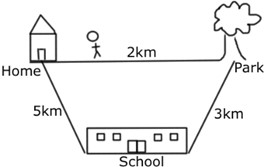
Jerry walked from home to school, then from the school to the park. What is his total displacement?

1

2 km

2

5 km

3

8 km

4

10 km

20

Multiple Choice

Question image

Jerry walked from home to school, then from the school to the park. What is his total distance?

1

2 km

2

5 km

3

8 km

4

10 km

21

media

Figuring Speed, Distance, and Time

22

Multiple Choice

Question image

Adam is driving his car for a distance of 500 km in 3 hr. What is his speed?

1

1500 km/hr

2

166.7 km/hr

3

500 km/hr

4

100 km/hr

23

Multiple Choice

Question image

Kendra is walking home and her house is 200 m away. It takes her 20 seconds to get home. What was her speed?

1

400 m/s

2

200 m/s

3

25 m/s

4

10 m/s

24

Multiple Choice

Question image

Abby is driving at a speed of 30 km/hr over a distance of 600 km. How long will it take her to go 600 km?

1

300 hr

2

20 hr

3

15 hr

4

90 hr

25

Multiple Choice

Question image

Mr. Mellon is walking to school at a pace of 5m/s and the school is 500 s away. How long will it take him to get to school?

1

100 s

2

2500 s

3

10 s

4

150 s

26

Multiple Choice

Question image

Aaron is driving 70 km/hr for 3 hours. What distance did he cover?

1

25 km

2

210 km

3

70 km

4

1.5 km

27

Multiple Choice

Question image

Mike is running at a pace of 8 m/s for 8 seconds. What distance did he cover in 8 seconds?

1

64 m

2

1 m

3

8 m

4

24 m

28

Multiple Choice

Total distance traveled divided by the total time of travel

1

Displacemetn

2

Velocity

3

Average Speed

4

Instantaneous Speed

5

Acceleration

29

Multiple Choice

The speed and direction of an object

1

Displacement

2

Acceleration

3

Distance

4

Velocity

30

Multiple Choice

The speed of an object at a particular moment in time

1

Velocity

2

Acceleration

3

Average Speed

4

Instantaneous Speed

media

Show answer

Auto Play

Slide 1 / 30

SLIDE