

MASTERS OF ARCHITECTURE

Presentation
•
Architecture
•
1st Grade
•
Practice Problem
•
Hard

doroty castro
Used 7+ times
FREE Resource
65 Slides • 0 Questions
1
PREPARED BY : ARCHT. DOROTHY P. CASTRO, UAP
UNIVERSITY OF PANGASINAN
–
PEN
COLLEGE OF ENGINEERING & ARCHITECTURE
ARC 082 :
THEORY OF ARCHITECTURE 02

2

HOW
ARCHITECTURE
PROFESSION
START IN
PHILIPPINES
N E X T
3

1705
•Corps of engineer was established in Manila.
•Construction of obras publicas or public works was assigned to a crops of military engineers
•Juan De Ciscara y Ramirez – first military engineer , who arrived in October 1705 .
•Early churches were built under the direction of maestros de obras ( master builder) which are
the friar-architects.
•During this Spanish colonial era, the architectural profession was essentially embodied by the
maestro de obra.
1854
•
Felix Rojas y Arroyo – first Filipino professional architect who returned to
the Philippines from his academic training from the Real Academia de
Notables Artes de San Fernando, Madrid and started his architectural
practice in 1858
•
1866 he was appointed as the interim head/ Municipal architect of manila of
the Public Works office
•
During this mid-nineteenth century when numerous professional architects
and engineers arrived from Spain.
•
Spanish government founded the first school , Escuela Practica y Profesional de Artes y
Oficios de Manila and granted the title Maestro de Obra.
•
There were two classes: first, was with academic title Maestro de Obras-Academico; and
second, those who acquired their expertise through practical experience licensed by the
Ayuntamiento de Manila called Maestro de Obras-Practico.
•
Arcadio Arellano, Juan Carreon, Julio Hernandez, and Isidro Medina – were the first
graduates of this school.
•
Liceo De Manila – has granted an academic title of Maestro de Obra.
1890
4

1902
•Academia de Arquitectura y Agrimensura De Filipinas (AAAF) – the first
professional organization of architects, engineers, and surveyors that was formed.
•This was headed by :
•Guillermo Gardiner (Maestro de Obras /Surveyor) as President;
•Arcadio Arellano (Maestro de Obras / Surveyor) as vice President,
•Jose Perez Siguereza, (Surveyor) Secretary
•Tomas Arguelles and Jose Paras (Maestro de Obras / Surveyor) as Directors.
1903
•
the organization was transformed as the Academia de Arquitectura, Ingenieria y
Agremnsura de Filipinas (AIAAF). The Academia promulgated the first standards of
professional practice for the practice of civil engineering and architecture, known as the
Tarifa de Honorios which was patterned from the AIA documents
•
AIAAF offered a four-year course in civil engineering and architecture thus becoming the
first school of architecture in the Philippines
1904
1911
• the AIAAF was dissolved when the civil engineers withdrew to form their own professional
organization, but not before it has struggled for the passage of an Engineers and Architects
Law.
5

1921
• Philippine Assembly Act No. 2985 (An Act to Regulate the Practice of the Professions
of Engineers and Architect) - the founding of the architectural profession in the Philippines
was formalized by Act and signed into law on February 23, 1921, prepared by AIAAF.
• This law created separate Board of Examiners for Architecture and Civil Engineering. The law
also allowed practicing Maestro de Obras to be automatically registered as Architects Tomas
Mapua was given the number 1 license as architect and Carlos Barreto and Antonio Toledo as
numbers 2 and 3
• Mapua Institute of Technology (MIT) - was a pioneer architectural school established in 1925
by Tomas Mapua after his return from the United States. MIT, originally a night school for
working students, offered courses leading to degrees in architecture and engineering.
• The curriculum for the Bachelor of Science in Architecture offered at MIT and UST during this
time has reflected a French school lineage through the emphasis on rendered drawings and
perspectives, highly symmetrical planning and massing; and Classical Revival preferences in
details and motifs. Even up to now, vestiges of this Beaux-Arts system are still widely practiced
in architecture schools in the Philippines.
1925
1930
• UST established its School of Architecture and Fine Arts
6

1934
1935
• Mercedes Raffiñan –first female architect, a graduate of MIT, passed
the board examination. She earned the distinction as the first woman
architect in the history of Philippine architecture and the rest of
Southeast Asia. She was also the first woman to graduate with a degree in
architecture in the country.
• Apart from the training received from an academic setting, another form of tutelage was the
master-apprentice system that existed within the office of the Bureau of Public Works
(BPW).
• As the BPW was basically tasked to supervise the design and construction of public
structures and landscapes in the islands, it operated like an architectural firm.
• by the time of the Commonwealth period, almost all of the 96 registered architects in the
Philippines were either trained at an American university or the BPW. That is how pervasive
the influence and bearing of the BPW was on the creation of public architecture in the
Philippines during that time.
1933
• In 1933 the organization was transformed as the Philippine Architects’ Society with Don
Juan Nakpil as president, Tomas Mapua as Vice president, Harold Keyes as Secretary-
Treasurer, Carlos Baretto and Fernando Ocampo as Directors. The Constitution and Bylaws of
the Society was patterned after American Institute of Architects.
7

1938
• the Society drafted Bill Number 1850, proposing the separate statute for the practice of
Architecture from that of Engineering, which was approved in the second reading by the
National Assembly.
• During the American colonial period, colonial tutelage was accomplished through the pensionado
scholarship program in which Pensionado Architects -have spurred the establishments of
architectural schools where they are recruited to be faculty members, advisers, and consultants.
• Their architectural training from the United States and Europe served as the backbone for the
pedagogical framework disseminated in these schools, which was basically oriented towards the
Beaux-Arts method
1941
• The Professional Services of the Philippine Architects Society was promulgated. The
architects in government service were allowed to become members of PAS, thus, Juan Arellano,
Antonio Toledo and Elias Ruiz joined the society.
• The name of the organization was changed to the Philippine Institute of Architects and
Planners (PIAP) which was later changed to the Philippine Institute of Architects (PIA)
by a Resolution presented by Carlos da Silva.
• the Philippine Architect’s Society re-organized with :
•Fernando Ocampo as President,
•Cesar H. Concio as Vice President,
•Jose Zaragoza as Secretary, Luis Ma. Araneta as Treasurer;
•Juan Nakpil, Andres Luna de San Pedro, Gines Rivera and Gabriel Formoso as Directors
1945
8

1948
• PIA presented to the President of the Philippines Elpidio Quirino a resolution offering
professional services of its members to the government to assist in the preparation of plans for
public works projects under the War Damage Commission.
• Under the 6th President of the PIA Cesar H. Concio, the repealing of Act No. 2985 was
approved by Congress which was vetoed by President Quirino.
• PIA was working on the preparation of the Documents for the Practice of the Profession, such
as the standard Forms of Membership, Architectural Competition, Awards, etc
• Congress enacted Republic Act No. 472, amending Administrative Code, Section 1901; which
legalized the awarding of the design of public works and buildings to private architects and
engineers, which may be considered as the magna carta of the practice of private architects
against bureaucratic architecture and engineering.
1949
• the Law which separates the statutes of the Architects from the Engineers was passed as
Republic Act No. 544 and Republic Act No. 545 (R.A. 545 has been repealed as R.A. 9266, as
R.A. 544 still governs).
1951
• 1950, At about this time 15 members of PIA formed another organization: the League of
Philippine Architects (LPA) headed by eminent architects of the time – Pablo S. Antonio,
Antonio V. Bañas, Pablo D. Panlilio, Jose L. Reynoso and Elias L. Ruiz – the splinter group
elected the much younger Jose V. Herrera as its first president.
• the Standards of Professional Practice prepared by the PIA was printed and released.
9

1973
1974
• On January 1, 1974, the Ad-Hoc Commission assumed its function and formulated the Constitution
and By-Laws of the proposed new organization which was approved on December 19, and ratified by
the membership of APGA, LPA, and PIA on January 15, 1974.
• A Committee on Organizational Name was constituted on June 8, 1974, and composed of Architects
Felipe M. Mendoza (PIA), Jose V. Herrera (LPA) and Deogracias Atienza (APGA) was tasked to
submit to the Ad-Hoc Commission a list of names from which one may be chosen, suitable for
adoption by the new national organization.
• The United Architects of the Philippines (UAP) was born on December 12, 1974 out of the
noble vision of unifying the three (3) existing architectural associations at that time – the Philippine
Institute of Architects (PIA), the League of Philippine Architects (LPA) and the Association of
Philippine Government Architects (APGA)
• was the year when the illusive goal of professional unity was explicitly conceptualized.
• In April 1973, the LPA President Arch. Edilberto Florentino invited PIA President Ariston Nakpil to
a meeting which started a series of conferences between the two organizations and eventually with
Deogracias Atienza, APGA President. This culminated to the formation of the Panel of Negotiators.
• On June 1973 President Ferdinand Marcos issued PD 223 creating the Professional Regulation
Commission (PRC) for the purpose of regulating the practice of all professions.
• The Joint Board Resolution laid down the objectives and concepts of the integration and created the
Ad-Hoc Commission to implement the terms of integration and to prepare the constitution and
bylaws of the proposed organization.
10

1975
• March 26, 1975 - where the UAP was registered with the Philippines’ Securities and Exchange
Commission (SEC).
• On May 12, 1975, the UAP was granted Certificate No. 001, the first professional organization to
be accredited by the Professional Regulation Commission (PRC).
• Finally on December 12, 1975, the members of the UAP elected the First Regular Board of
Directors, namely: Jose Herrera (President), Manuel Mañosa, Jr. (VP for Private Practice),
Ruperto Gaite (VP for Government Service), Cesar Concio (VP for Allied Fields), Urbano Caasi, Jr.
(Secretary), Librado Macalinao (Treasurer), and Felipe Mendoza, Ricardo Poblete, Constantino
Agbayani, Corazon Tandoc, Jesse Mackay, Antonio Ascalon, Johnny Sulit as directors while
Norberto Nuke as ex-officio.
1976
• UAP became one of the founding members of the Philippine Federation of Professional
Organizations (PFPA, the Philippine Technological Council (PTC), and the Philippine Council for
Planning and Housing (PCPH).
11

I.MASTERS OF
ARCHITECTURE
FILIPINO ARCHITECTS
AND THEIR WORKS
LET’S GET STARTED
N E X T
12

PART I.A FILIPINO ARCHITECTS
NATIONAL ARTISTS & THEIR
WORKS
MASTERS OF
ARCHITECTURE
N E X T
PART I.B OTHER FAMOUS
FILIPINO ARCHITECTS AND
THEIR WORKS
13

I.A FILIPINO
ARCHITECTS
NATIONAL ARTISTS
N E X T
14

JUAN NAKPIL
• He was regarded as the Father of Philippine
Architecture and the very first National Artist for
Architecture, 1973.
• Philosophy: He believed that there is indeed such
thing as “Philippine Architecture” –
a style that
works with local climate, seismological conditions and
naturalenvironment.
14
15

Quezon Hall, UPD
15
16

Capitol Theater
16
17

PABLO ANTONIO Sr.
He was a pioneer of modern Philippine architecture.
The
rank
and
title
ofNational
Artist
ofthe
Philippines was conferred on him in 1976.
Philosophy: He believed that buildings “should be
planned with austerity in mind and its stability
forever
as the
aim
oftrue
architecture,
that
buildings must be progressive, simple in design but
dignified, true to a purpose without resorting to an
applied set of aesthetics and should eternally
recreate truth.
17
18
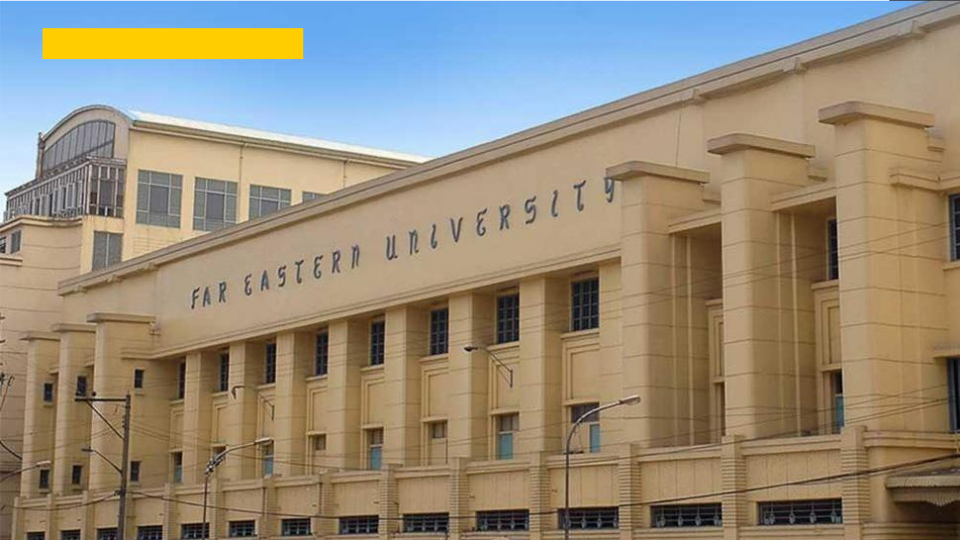
Far Eastern Univeristy
18
19

LEANDRO LOCSIN
He is known for his use of concrete, floating
volume and simplistic design.
Philosophy:
He
believes
that
the
true
Philippine Architecture is “the product of two
great streams of culture, the oriental and the
occidental… to produce a new object of
profound harmony.
19
20

Church of the Holy Sacrifice
20
21

Cultural Center of the Philippines
21
22

Philippine International Convention Center
22
23

JOSE MARIA ZARAGOZA
23
He is known for designing several edifices
during the postwar era. Traditional features
from
Spanish
colonial
architecture
were
mixed with basic, unadorned designs from
the International style
24

Commercial Bank Trust Company Building, Escolta
24
25

Santo Domingo Church, QC
38
26

Meralco Building
26
27

ILDEFONSO “IP” SANTOS
He is known for being the Father of Philippine
Landscape Architecture.
Philosophy:
“A
beautiful
environment
is
necessary if only to buoy sagging spirits and
offer hope for the future.
27
28

San Miguel Corporation HQ
28
29

Paco Cemetery
29
30

FRANCISCO “Bobby” MAÑOSA
30
He was a forerunner in the art of Philippine
neo-vernacular
mastered,
and
untapped DNA
architecture.
interpreted
of Philippine
He
studied,
the
largely
architecture,
particularly the Bahay Kubo and Bahay na
Bato.
Philosophy:
He
believes
that
the
true
Philippine Architecture must be “true to itself,
its land and its people.”
31

Coconut Palace
31
32

I.B OTHER
FAMOUS FILIPINO
ARCHITECTS AND
THEIR WORKS
N E X T
33

34

ANTONIO, PABLO
Full Name: Pablo Sebero
Antonio
Born: January 25, 1901
Place of Birth: Binondo,
Manila
Died: June 14, 1975 (aged 74)
Occupation: Filipino architect
Awards:
•National Artist of the
Philippines (1976)
•Asia-Pacific Heritage
Awards (2003)
35

ANTONIO, PABLO
Style:
• Modernism
-The pioneer of modern
Philippine Architecture
36

ANTONIO, PABLO
Notable Works:
Ideal Theater (1933)
Avenida Rizal, Manila
•Demolished – 1970’s
•First major work
Far Eastern University Campus
West Sampaloc, Manila
•Art Deco style – 1938 to 1950
•The campus is considered as the
largest collaborative of surviving
Art Deco architecture in Manila
37

ARANETA, LUIS
Full Name: Luis Maria
Zaragosa
Araneta
Born: 1916
Place of Birth: Manila,
Philippines
Died: 1984 (aged 68)
Occupation: Filipino architect
38

ARANETA, LUIS
Notable Works:
Makati Medical Center
Makati City
•Opened – May 31, 1969
•Most prominent hospital in the
Philippines
Times Theatre
Quezon Boulevard, Quiapo
•Art Deco Style – Art Moderne
•Construction – 1939
•Accomodation: 800 people
39

ARELLANO, JUAN
Full Name: Juan Marcos
Arellano
Born: April 25, 1888
Place of Birth: Tondo, Manila,
Philippines
Died: December 5, 1960 (aged
72)
Occupation:
• Filipino architect
• Painter
40

ARELLANO, JUAN
Notable Works:
Legislative Building (Congress Building)
Padre Burgos Avenue in Ermita, Manila
•Neoclassical Style
•Home to various legislative bodies of
the Philippine government (1987 to
1997)
•It houses the National Art Gallery of
the National Museum of the
Philippines
Manila Central Post Office
Liwasang Bonifacio, Manila
•Neoclassical Style
•Construction: 1926
•Designed with Tomas Mapua
•Renovation: 1946
41

ARELLANO, OTILIO
Full Name: OtilIo Arellano
Born: February 9, 1916
Place of Birth: San Juan,
Manila,
Philippines
Died: May 31, 1981 (aged 52)
Occupation: Filipino architect
42

ARELLANO, OTILIO
Style:
• Modern
-first postwar architect in his
homeland who was inspired by
Filipino symbols
43

ARELLANO, OTILIO
Notable Works:
Palacio del Governador
Intramuros, Manila
•12 storey-building
•Houses the Commission of Elections
•Historical Landmark
Philippine Pavilion
New York World Exhibition (1964)
•Roof form- “Salakot “, a traditional Filipino
hat with wide brim
44

ARGUELLES, CARLOS
Full Name: Carlos D.
Corcuera
Arguelles
Born: September 15, 1917
Place of Birth: Manila,
Philippines
Died: August 19, 2008 (aged
91)
Occupation: Filipino architect
45

ARGUELLES, CARLOS
Style:
• International Style
(1960’s)
46

ARGUELLES, CARLOS
Notable Works:
Philamlife Building
Ermita, Manila
•Completed: 1962
•20,000 sqm office space
•It was one of the first structures built in the
international style of architecture
Development Bank of the Philippines
Makati City
•Headquarters
•Founded: 1935
•Finance and insurance industry
47

CONCIO, CESAR
Full Name: Cesar Homero
Concio,
Sr.
Born: November 30, 1907
Died: April 27, 2003 (age 96)
Occupation: Filipino architect
Firm: Concio Cesar H &
Associates
48

CONCIO, CESAR
Notable Works:
University of the Philippines, Palma Hall
Diliman, Quezon City
•Asymmetrical structure inspired by
international style and Filipino design
expression
•One of the first buildings in UP
•Named after Rafael Palma - president of
the university (1923 -1933)
•The heart of UP Diliman
Insular Life Building
Makati City
•Completed: 1962
•Curving façade entirely covered by narrow
vertical aluminum
•Renovated: 2005 by Japanese firm
49

COSCOLLUELA, WILLIAM
Full Name: William Vargas
Coscolluela
Occupation: Filipino architect
Firm: W.V Coscolluela &
Associates
(established 1957)
50

COSCOLLUELA, WILLIAM
Awards:
•Recipient of the President’s
Gold
•Medal for Architecture 1956-
1957
•Recipient of the Gold Medal of
Merit Award from Philippine
Institute of Architects (PIA) –
1997
•Awardee for Architecture Diwa
ng Lahi at Patnubay ng mga
Sining at Kalinangan Araw ng
Maynila – 1997
•Gawad Gintong Likha from the
Architectural Archives
Philippines 2005
•Vertical Transportation in
Architecture Award 2005
•International Patron’s Award –
BCI Asia Top 10 Award –
51

COSCOLLUELA, WILLIAM
Notable Works:
Ayala Twin Towers
Ayala Avenue, Makati City
•26 Storey – apartment
•Construction: 2000
SM City North Edsa
Quezon City
•Opened: 1985
•120,000 square meters
•Largest shopping mall in the Philippines
•Third largest mall in the world
52

DE CASTRO, CRESENCIANO
Full Name: Cresenciano de
Castro
Career:
He graduated in University of
Santo Tomas in 1950 and
passed the Architect’s
Licensure Exam on the same
year – Third highest rating
Occupation: Filipino architect
53

DE CASTRO, CRESENCIANO
Notable Works:
Philippine Science High School
Diliman, Quezon City
•Operated: 1964
•75,000 square meter lot
Philippine Nuclear Research Institute
Commonwealth Avenue
•An arc-shaped nuclear laboratory building
•The first nuclear research laboratory in the
Philippines
54

FORMOSO, GABRIEL
Career:
• 1950’s to 1960’s – Most
popular architect of the
residence in Makati villages
• Planning and working
committee – Pamantasan ng
Lungsod ng Maynila
Firm: GF and Partners
Awards:
• Public Cultural Heritage
Awards (1973)
• Patnubay ng Sining at
Kalinangan (1977)
• PRC Outstanding Architect of
the Year (1979)
• UAP Likha Awards (1990)
55

FORMOSO, GABRIEL
Notable Works:
Bangko Sentral ng Pilipinas (BSP)
Manila, Philippines
•Established: July 3, 1993
•Headquarters
Asian Institute of Management
Makati City, Metro Manila
•Founded: 1968
•The campus consists of fully air-conditioned
buildings that house the academic,
administrative, and dormitory facilities.
56

ILUSTRE, FEDERICO
Born: 1912
Died: 1989 (age 77)
Occupation: Filipino architect
–
Bureau of
Public
Works
57

ILUSTRE, FEDERICO
Notable Works:
Quezon Memorial Shrine
Quezon City
•Constructed: 1978
•66-meter trylon monument
•The monument’s three columns and angels
bowed in grief, holding sampaguita wreaths,
represent Luzon, Visayas, and Mindanao.
•Dedicated to Manuel L. Quezon.
Quirino Grandstand
Rizal Park, Manila
•Opened: 1949
•Independence Grandstand – former name
•Capacity: 10, 000
•Originally, it was neoclassical designed by
Juan Arellano
•Currently, renovated simpler with some
Art Deco influence
58

LOCSIN, LEANDRO
Born: August 15, 1928
Place of Birth: Silay, Negros
Occidental,
Philippine
Islands
Died: November 15, 1994(age
66)
Occupation:
•Filipino architect
•Artist
•Interior designer
Awards:
• National Artist of the
Philippines for Architecture
in 1990
Firm: L. V. Locsin and
Partners
59

LOCSIN, LEANDRO
Known:
- for his use of concrete, floating
volume and simplistic design
60

LOCSIN, LEANDRO
Notable Works:
Cultural Center of the Philippines
Manila, Philippines
•Founded: September 1966
•The façade is dominated by a two-storey
travertine block suspended 12 meters
(39 ft) high by deep concave cantilevers
on three sides
•The rest of the structure is clad in
concrete, textured by crushed seashells
originally found on the reclamation site
Philippine International Convention Center
Pasay, Metro Manila
•Construction: 1974
•Completed: 1976
•Inagaurated: September 5, 1976
•Renovated: 1996
•Floor Area: More than 70,000 sqm
•Arch’l style: Brutalism
61

LUNA DE SAN PEDRO, ANDRES
Born: September 9, 1887
Place of Birth: Paris, France
Died: 1952 (age of 64)
Occupation: Filipino architect
Awards:
• Gold Medal of Merit as the
first architect of the
Philippine Institute of
Architects (PIA) in 1949
62

LUNA DE SAN PEDRO, ANDRES
Style:
• Modern
• Revival
63

LUNA DE SAN PEDRO, ANDRES
Notable Works:
Malacañang Palace
San Miguel, Manila
• The official residence and principal
workplace of the President of the
Philippines
• Spanish colonial and Neo-classical
style
St. Vincent de Paul Parish
San Marcelino, Manila
•1833 – originally built as a chapel
•1912 – built a concrete church
•2010 - renovation
64

MAÑOSA, FRANCISCO
Born: February 4, 1931
Place of Birth: Manila,
Philippines
Occupation:
• Retired but decorated
architect
• Pianist – The Executive Band
65

MAÑOSA, FRANCISCO
Known:
- Noted for his Filipino inspired
architectural designs
PREPARED BY : ARCHT. DOROTHY P. CASTRO, UAP
UNIVERSITY OF PANGASINAN
–
PEN
COLLEGE OF ENGINEERING & ARCHITECTURE
ARC 082 :
THEORY OF ARCHITECTURE 02
Show answer
Auto Play
Slide 1 / 65
SLIDE
Similar Resources on Wayground

57 questions
Science Grade 1 2nd Grading Period Final Assessment Reviewer
Presentation
•
1st Grade
57 questions
Place Value Lesson
Presentation
•
2nd Grade
58 questions
Review 2nd children
Presentation
•
2nd Grade
62 questions
Island 1 Preparation
Presentation
•
KG
57 questions
KISI-KISI ASAS BAHASA INGGRIS - KELAS 2
Presentation
•
2nd Grade
55 questions
Punctuation Lesson
Presentation
•
KG
59 questions
Pinyin
Presentation
•
1st Grade
62 questions
KISI-KISI SAT KELAS 1
Presentation
•
1st Grade
Popular Resources on Wayground
6 questions
PRIDE Always and Everywhere
Presentation
•
12th Grade
20 questions
Lab Safety Quiz

Quiz
•
6th Grade
26 questions
KOR Review Kahoot Questions
Quiz
•
8th Grade
21 questions
Continents and Oceans
Quiz
•
6th Grade
12 questions
Unit Zero lesson 2 cafeteria
Presentation
•
9th - 12th Grade
20 questions
Parts of Speech
Quiz
•
5th Grade
10 questions
Riddles Riddles fun Riddles
Quiz
•
6th - 12th Grade
16 questions
Subject & Predicate
Quiz
•
5th Grade
Discover more resources for Architecture
10 questions
Soup, Salad, or Sandwich?
Quiz
•
1st Grade - Professio...
20 questions
place value
Quiz
•
1st Grade
15 questions
Addition and Subtraction
Quiz
•
1st Grade
17 questions
Greetings and Farewells in Spanish
Quiz
•
1st - 6th Grade
20 questions
Addition and Subtraction facts
Quiz
•
1st - 3rd Grade
20 questions
Place Value
Quiz
•
KG - 3rd Grade
10 questions
Identifying Physical and Chemical Changes

Interactive video
•
1st - 5th Grade
15 questions
Chromebook Care and Maintenance
Quiz
•
1st - 5th Grade