

Chapter Five: Section Three: Creating the Constitution

Presentation
•
•
Practice Problem
•
Hard

Christian Therrien
FREE Resource
22 Slides • 0 Questions
1

2
The plan of government we used towards the end of the Revolutionary War
Ratified (approved) March 1781
Strengths were it negotiated the Treaty of Paris of 1783, passed the Land Ordinance of 1785 and Northwest Ordinance of 1787
Weaknesses were no chief executive, no power to tax, no courts to settle disputes, and states had more power than the Articles


3
In May 1787, delegates from the 13 colonies return to Philadelphia to create a stronger government. Some come to strengthen the Articles of Confederation others came to craft a completely new constitution.
4


He firmly believed in a strong national government and took detailed notes of the convention.
James Madison
He refused to attend the Constitutional Convention because he believed in the Articles of Confederation
Patrick Henry
He was elected president of the Constitutuional Convention.
George Washington
He agreed that the central government created by the Articles of Confederation was too weak.
Alexander hamilton
5
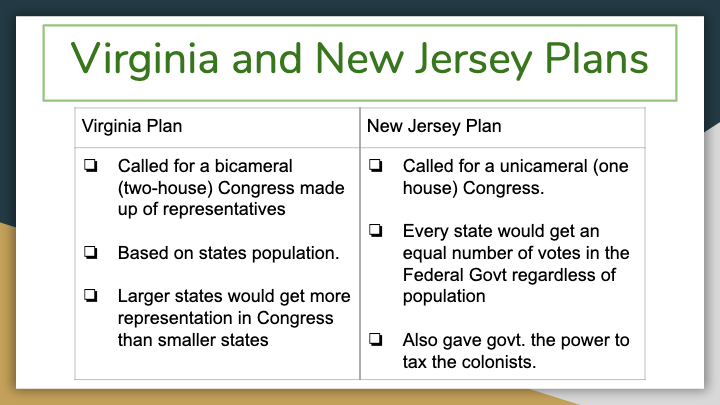
Some delegates wanted to strengthen the Articles of Confederation. Others wanted to make a completely new constitution or governing plan. Two plans were debated at the convention. Both plans called for executive and judicial branches.
6
The Constitutional Convention began on May 15th, 1787 in Philadelphia. (Independence Hall)

7
The Framers
-12 of the 13 states sent delegates to the convention
-Rhode Island did not send any delegates
-There was a total of 55 delegates
Subject | Subject
Some text here about the topic of discussion

8
George Washington
-Elected the president of the convention
-Demanded complete secrecy as the delegates set about the controversial task of not just revising the Articles of Confederation, but scrapping them all together
-Brought respect and honor
Important Individuals

9
James Madison
-Kept notes during the meetings
-Argued strongly for a strong central government that would unify the country
-Became known as the "Father of the Constitution"
Important Individuals (Continued)

11
12

13

14
Proposed by Roger Sherman, a delegate from Connecticut.
Solved the question of how states should be represented in the new government.
Great Compromise: the plan of government adopted at the Constitutional Convention that established a two-house Congress.
In the House of Representatives, representation from each state is based on state population. In the Senate, each state is represented by two senators.
15
Northern states did not want to count slaves
Southern states did
It was only for representational purposes for the south to have more power in Congress
Instead of "slavery," new Constitution said "all other persons" to avoid the word slavery

16
In 1790, each state got ONE representative for every 30,000 people
3/5th of the enslaved population was included in this count

17
Many Delegates wanted a strong national government because of the failures of the articles of confederation
They still wanted to protect Popular Sovereignty or the idea that political authority belongs to the people.
This was one of the main idea of the Declaration of Independence.

18

Montesquieu said to stop government from becoming too strong the powers should be separated into three branches.
Some text here about the topic of discussion.
Separation of Powers
19
The U.S. Constitution - Creates a constitutional government with three separate branches, each with separate powers
Legislative Branch
Some text here about the topic of discussion
Executive Branch
Judicial Branch
Article 1: Makes the Law
Article 2: Enforces the Law
Article 3: Interprets and Applies the Law
20

21
Allows the different branches to check, stop or limit each other.
This creates a balance of power amongst all branches (equal power).

Show answer
Auto Play
Slide 1 / 22
SLIDE
Similar Resources on Wayground

17 questions
Culinary Arts Pretest
Presentation
•
6th - 8th Grade
17 questions
4th Rotation and Revolution
Presentation
•
4th Grade
17 questions
Add/Subtract Fractions
Presentation
•
5th - 6th Grade
17 questions
Ancient Egypt / Geography
Presentation
•
4th - 6th Grade
17 questions
Graphs of Exponential Functions
Presentation
•
9th - 11th Grade
17 questions
Potential Energy
Presentation
•
7th - 12th Grade
17 questions
Treble Clef
Presentation
•
6th - 8th Grade
17 questions
5.9D Fossils
Presentation
•
5th Grade
Popular Resources on Wayground
10 questions
Safety Day 2026 – Student Review

Quiz
•
9th Grade
21 questions
Continents and Oceans
Quiz
•
6th Grade
20 questions
Parts of Speech
Quiz
•
5th Grade
16 questions
Subject & Predicate
Quiz
•
5th Grade
25 questions
Multiplication Facts
Quiz
•
5th Grade
12 questions
Map Skills
Quiz
•
3rd Grade
22 questions
Continents and Oceans
Quiz
•
5th Grade
15 questions
Rounding Decimals
Quiz
•
5th Grade
Discover more resources for
26 questions
SLIME!!!!!
Quiz
•
KG - 12th Grade
20 questions
Place Value
Quiz
•
KG - 3rd Grade
4 questions
K-2 Force and Motion Lesson
Presentation
•
KG - 2nd Grade
12 questions
Tone and Mood
Presentation
•
KG
10 questions
Day and Night Patterns
Quiz
•
KG
20 questions
Disney Characters
Quiz
•
KG
12 questions
Nouns and Verbs
Quiz
•
KG - 2nd Grade
15 questions
Short Vowels
Quiz
•
KG - 2nd Grade