

Greek architecture PPT

Presentation
•
Architecture
•
7th Grade
•
Practice Problem
•
Medium

Jacqueline Lam
Used 1+ times
FREE Resource
19 Slides • 2 Questions
1

B. Legacy and significance of classical civilization
■ Ancient Greek buildings had great artistic value
(i) Ancient Greece
(d) Architecture
The Temple of Olympian
Zeus in Athens
■ Important buildings (such as temples) were
surrounded by tall stone columns
2


B. Legacy and significance of classical civilization
■ The capitals (tops) of the columns were carved with beautiful
patterns: the Doric Order, Ionic Order and Corinthian Order
The Parthenon in Athens was built in the
5th century BC. It was used to worship
Athena, the guardian of Athens.
Doric Order

3

4

B. Legacy and significance of classical civilization
■ Pediments were commonly found at the top of
ancient Greek buildings
The British Museum in
London, Britain
The pediment over the
British Museum’s main
entrance
■ These basic elements of Greek architecture have been
adopted by architects for centuries
5

B. Legacy and significance of classical civilization
■ The ancient Roman cities were well-planned
Ancient Roman street in the ruined
city of Jerash in Jordan
(ii) Ancient Rome
(d) Architecture
■ They had a huge road network linking Rome
and other provinces
6


B. Legacy and significance of classical civilization
■A good water supply and sewerage system was supported by the
construction of aqueducts and pipelines
A Roman aqueduct in Spain
7


7
Stadiums
●Greek sporting events were held to honor various Greek gods such as Zeus, Apollo, or Poseidon.
●The games were held every two or four years in stadiums that were regarded as religiously
important sanctuaries.
●The oldest athletic contest held by the Greeks is a foot race over a specified distance, usually
around 200 meters in length.
●Spectators at these prestigious races wore a crown of olive leaves, now a popular symbol of
Greek culture.
Sports day is coming up soon! If you could
redesign a stadium for it, what would it look
like?
8
Sports day is coming up soon! If you could build a stadium in the school for it, what would it look like?

efficient use of space
make sure everyone gets a good view
accomodate more then 4 types of games
9
Poll
The shape of the stadium would be...
a square
a hexagon
a circle
a rounded rectangle
10


8
11


B. Legacy and significance of classical civilization
■ The Romans also built various facilities, such as temples,
forums, theatres, stadiums, and bathhouses
Ruins of the Roman theatre in Turkey
12
A good theatre design should...

13
Multiple Select

A good theatre design should...
have a good sound system
incorporate its surrounding beauty
make sure most seats have a good view of the stage
aesthetically beautiful
14
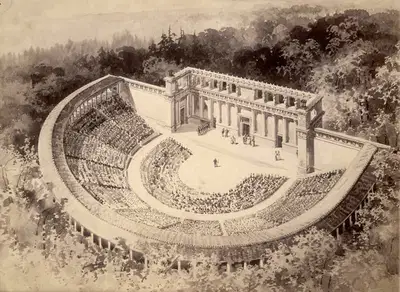
The climate of Greece is mild, with both the coldness of winter and the heat of summer calmed by gentle sea breezes.
This led to a lifestyle where many activities and gatherings took place outdoors.
Attending plays and religious ceremonies at theatres was a favorite outdoor pastime.
Theatres were often built into a naturally occurring hillside so the audience could sit and view the stage below. The larger theatres could hold up to 25,000 spectators.
15

16


B. Legacy and significance of classical civilization
■ The Roman forums were open
spaces between buildings
The Roman Forum at the
center of the city of Rome
Dome
Columns
Arch
■ It was used to hold political, religious and commercial
activities
■ Colonnades (row of columns) were built around the forum
17


B. Legacy and significance of classical civilization
■ Today, the concept of forum is still widely used in city
planning
■ This design often seen in later European architecture
18


B. Legacy and significance of classical civilization
The Colosseum
History
IN DEPTH
The Colosseum was a famous building in ancient Rome. It was built in the 1st
century AD. It was oval in shape and built of stone and cement. It had sixty rows of
seats and could house about 100,000 spectators. It was mainly used to stage gladiator
fights.
19


B. Legacy and significance of classical civilization
The Colosseum shows the talents and genius of Roman architecture. Inside
there were many columns and arches. Each arch had an exit allowing spectators
to leave as soon as the programme ended. Originally, there was also a
retractable roof to keep out wind and rain. Hundreds of people were needed to
operate the roof.
The Colosseum
History
IN DEPTH
20


P.26 Circle the elements of
ancient Greek architectural
style in HK
14
21


P.26 Circle the elements of
ancient Greek architectural
style in London and New York?
15
B. Legacy and significance of classical civilization
■ Ancient Greek buildings had great artistic value
(i) Ancient Greece
(d) Architecture
The Temple of Olympian
Zeus in Athens
■ Important buildings (such as temples) were
surrounded by tall stone columns
Show answer
Auto Play
Slide 1 / 21
SLIDE
Similar Resources on Wayground

16 questions
Adding Integers with Different Signs
Presentation
•
7th Grade
16 questions
Gummy bear pre-lab day 1
Presentation
•
7th Grade
17 questions
SETS
Presentation
•
7th Grade
15 questions
SS7G8 Christianity
Presentation
•
7th Grade
16 questions
Adding and Subtracting Integers
Presentation
•
7th Grade
16 questions
Characteristics of Synthetic Materials
Presentation
•
7th Grade
16 questions
Empresarios
Presentation
•
7th Grade
16 questions
Exponents & PEMDAS
Presentation
•
7th Grade
Popular Resources on Wayground
11 questions
Hallway & Bathroom Expectations

Quiz
•
6th - 8th Grade
10 questions
HCS SCI 03 Summer School Assessment 2
Quiz
•
3rd Grade
11 questions
Home Scope
Quiz
•
7th - 8th Grade
12 questions
2026 TAP Technology in the Classroom
Presentation
•
Professional Development
15 questions
HCS SCI 05 Summer School Assessment 2 Review
Quiz
•
5th Grade
15 questions
HCS SCI 04 Summer School Review 2
Quiz
•
4th Grade
59 questions
Geometry Unit 3 Review
Quiz
•
9th - 12th Grade
14 questions
FAST ELA READING SMAPLE TEST MATERIALS

Passage
•
3rd Grade