

Pronouns & Antecedents

Presentation
•
Other
•
9th - 12th Grade
•
Practice Problem
•
Hard

Giovanna Miranda
Used 1+ times
FREE Resource
12 Slides • 0 Questions
1
Pronouns and Antecedents
2
NOUNS:
Identify common and proper nouns CODE: ERT
Form and use plurals of nouns ending in f, fe, o, and y CODE: 3C6
Identify and correct errors with plural and possessive nouns CODE: PMQ
PRONOUNS:
Use possessive pronouns CODE:N82
Choose between personal and reflexive pronouns CODE: A5T
Use relative pronouns: who, whom, whose, which, and that CODE: R6F
PRONOUNS AND ANTECEDENTS:
Identify pronouns and their antecedents CODE: 5AR
Use the pronoun that agrees with the antecedent CODE: EXW
3
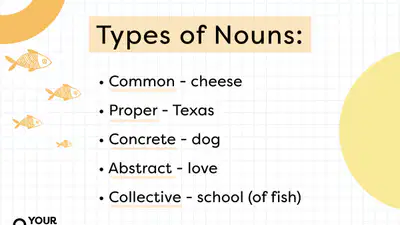
NOUN: a word that generally functions as the name of a specific object or set of objects, such as living creatures, places, actions, qualities, states of existence, or ideas.

4
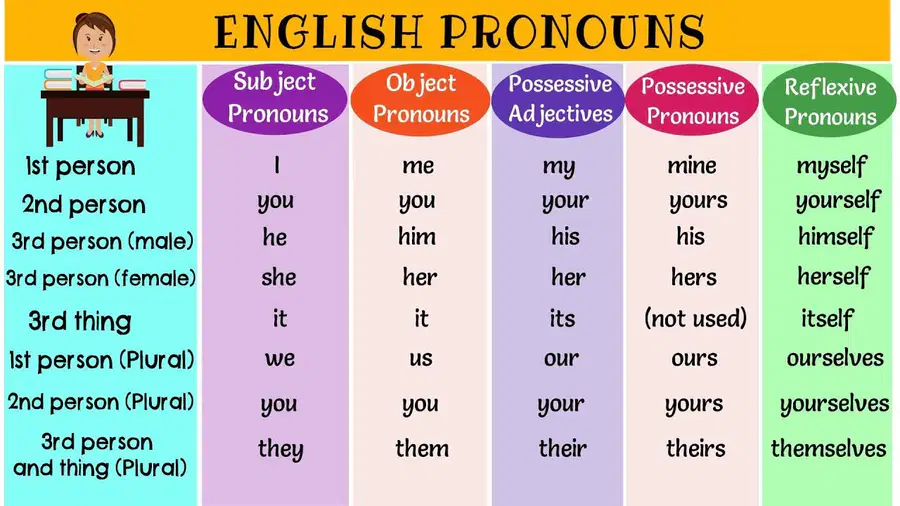
PRONOUN: a word that stands in for a noun, often to avoid the need to repeat the same noun over and over. Like nouns, pronouns can refer to people, things, concepts, and places.
5
PRONOUN: a word that stands in for a noun, often to avoid the need to repeat the same noun over and over. Like nouns, pronouns can refer to people, things, concepts, and places.
Let's look at some examples:
It runs on gas.
They are running late for their HiSET appointment.
We did not want to drive in the rain this morning.
6
ANTECEDENT: a phrase, word, or clause indicated by a pronoun
Take a look at these two sentences:
He needs to go outside
The dog's been barking for hours—he needs to go outside.”
7
A few tips:
A pronoun must agree with its antecedent in number, gender, and person
If the antecedent is singular, use a singular pronoun. If it is plural, use a plural pronoun.
EX: Because this dollhouse is almost 300 years old, it is historically important.
EX: The furnishings are noticeably different from their modern counterparts.
8
A few tips:
Keep an eye out for multiple subjects
EX: The tiny chest and dresser still have their original hardware.
9
A few tips:
A pronoun that refers to nouns or pronouns joined by or or nor should agree with the noun or pronoun nearest to it.
EX: Neither the astronauts nor NASA neglected its duties.
Neither NASA nor the astronauts neglected their duties.
10
A few tips:
A collective noun such as class, crew, team, audience, or family may be referred to by either a singular or a plural pronoun, depending upon the meaning of the noun in the sentence.
The pronoun of a collective noun should be singular if the collective noun names a group acting as a unit.
EX: The family that owns the house loaned its treasure to the library
The pronoun of a collective noun should be plural if the collective noun names the members or parts of a group acting individually.
EX: The family wanted their friends to see the house.
11
Let's practice!
Directions: In each sentence underline once the personal pronoun and underline twice its antecedent
As a child, Aunt Livia often played with her dollhouse.
In the 1500s, dollhouse owners used the dollhouses to show off their wealth.
The dollhouses were made to imitate their owners’ homes.
In one place, a rich woman could show visitors how beautifully her whole house was decorated.
12
Let's practice!
Directions: In each sentence underline once the personal pronoun and underline twice its antecedent
The man of the house could give guests an idea of treasures he kept in storage.
These houses were not small; some of them were six feet high.
Dutch merchants made their dollhouses much smaller.
Pronouns and Antecedents
Show answer
Auto Play
Slide 1 / 12
SLIDE
Similar Resources on Wayground

11 questions
Elements & Principles of Design
Presentation
•
9th - 12th Grade
10 questions
4 types of Expenses
Presentation
•
9th - 12th Grade
9 questions
TSFA Color
Presentation
•
9th - 12th Grade
10 questions
Graphing Linear Systems
Presentation
•
9th - 12th Grade
10 questions
Karyotypes
Presentation
•
9th - 12th Grade
10 questions
Computer Network
Presentation
•
9th - 12th Grade
8 questions
Trust Lesson section 3
Presentation
•
9th - 12th Grade
10 questions
Adobe Photoshop Shortcut Keys
Presentation
•
9th - 12th Grade
Popular Resources on Wayground
6 questions
PRIDE Always and Everywhere
Presentation
•
12th Grade
20 questions
Lab Safety Quiz

Quiz
•
6th Grade
26 questions
KOR Review Kahoot Questions
Quiz
•
8th Grade
21 questions
Continents and Oceans
Quiz
•
6th Grade
12 questions
Unit Zero lesson 2 cafeteria
Presentation
•
9th - 12th Grade
20 questions
Parts of Speech
Quiz
•
5th Grade
10 questions
Riddles Riddles fun Riddles
Quiz
•
6th - 12th Grade
16 questions
Subject & Predicate
Quiz
•
5th Grade
Discover more resources for Other
6 questions
PRIDE Always and Everywhere
Presentation
•
12th Grade
12 questions
Unit Zero lesson 2 cafeteria
Presentation
•
9th - 12th Grade
21 questions
Lab Safety
Quiz
•
10th Grade
10 questions
Riddles Riddles fun Riddles
Quiz
•
6th - 12th Grade
6 questions
PRIDE in the Hallways and Bathrooms
Presentation
•
12th Grade
10 questions
Would you Rather?
Quiz
•
9th - 12th Grade
20 questions
Characteristics of Life
Quiz
•
9th - 10th Grade
10 questions
Scientific Method (The scientific method)

Interactive video
•
9th Grade