Unit 7 Test Review
Presentation
•
Physics
•
11th Grade
•
Easy
+1
Standards-aligned
Thomas Pickett
Used 6+ times
FREE Resource
7 Slides • 60 Questions
1

Unit 7 Test Review:
Waves and Sound
2
Waves
waves transfer energy. not matter
pulse wave: single disturbance
continuous wave: oscillation produces waves on a regular bases
standing wave: the reflection of the wave makes it appear like the wave doesn't move
3
particles move in the same direction as energy of the wave
compressions rarefactions
move faster in more dense media
cannot travel in space
sound is a longitudinal wave
Longitudinal
particles move perpendicular to energy of wave
Crests, troughs
move faster with less dense media
can travel through space
Light is a transverse wave
Transverse
Types of Waves
4
​Properties of Waves
waves reflect. they bounce off of surfaces
waves refract. waves bend when they strike a boundary and go through a medium of a different density.
waves diffract. waves bend around openings.
waves interfere. waves combine with other waves to form a new wave. each wave retains its own properties.
5
amplitudes subtract to form a wave with a smaller amplitude than any constituent wave
SOFTER. MAY BE ZERO.
​Destructive interference
amplitudes add to form a wave with a greater amplitude than any constituent wave.
LOUDER
​Constructive interference
Principle of Superposition
6
Multiple Choice
This is an example of a ...
Longitudinal Wave
Wiggly Wave
Transverse Wave
Standing Wave
7
Multiple Choice
This is an example of a ....
Longitudinal Wave
Squishy Wave
Transverse Wave
Standing Wave
8
Multiple Choice
The number 3 is pointing to the ...
Trough
Crest
Wavelength
Amplitude
9
Multiple Choice
Red line #1 is the ...
Trough
Crest
Wavelength
Amplitude
10
Multiple Choice
Number 4 is pointing to the ...
Trough
Crest
Wavelength
Amplitude
11
Multiple Choice
Red line #2 is the ...
Trough
Crest
Wavelength
Amplitude
12
Multiple Choice
The length traveled in one cycle is the ...
Wave Speed
Frequency
Wavelength
Amplitude
Period
13
Multiple Choice
This is an example of a ...
Longitudinal Wave
Wiggly Wave
Transverse Wave
Standing Wave
14
Multiple Choice
Sound waves are _______ waves.
Transverse
Seismic
Longitudinal
Slow
15
Multiple Choice
Sound waves travel the fastest through _______.
Gases
Solids
Liquids
Plasma
16
Multiple Choice
True or False: Sound waves can travel through space.
True
False
17
Multiple Choice
True or False: The speed of sound depends on the loudness of the sound.
True
False
18
Multiple Choice
The amount of energy a wave carries is the _________.
Amplitude
Height
Loudness
Volume
19
Multiple Choice
Human perception of sound volume
Amplitude
Loudness
Intensity
Decibel
20
dβ = 10log(I/I0)
I0 = 1E-12 W/m2
​Equations
sound level is measured in decibels
sound level is logarithmic
a sound level of 70 is 10 times louder than a sound level of 60
sound levels are referential; this depends the threshold of hearing
Sound Level and Intensity
21
Multiple Choice
Sound intensity is measured in _____.
Hertz
Nanometers
Decibels
22
Multiple Choice
Pitch is _____.
How often a sound wave occurs
How high or low a sound seems to be
The energy behind a wave
23
Multiple Choice
True or False: The higher the pitch, the lower the frequency.
True
False
24
Multiple Choice
True or False: According to the Doppler Effect, if an sound source is moving TOWARDS you, the pitch should be getting higher.
True
False
25
Multiple Choice
What is the Doppler Effect?
A change in frequency due to the relative motion of a wave source and an observer
When a wave overlaps with another wave
When a wave bounces off of another object
When a wave bends due to traveling through a different medium
26
Multiple Choice
A car is not moving but the horn is on. You run towards the car to investigate what's going on. As you approach the car, what happens to the frequency of the sound waves from the horn?
They increase
They decrease
27
Multiple Choice
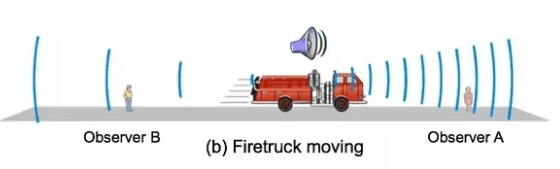
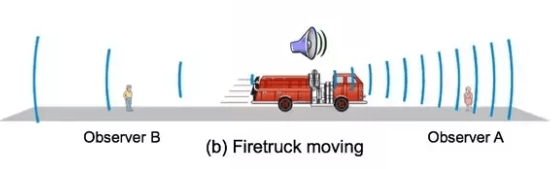
Look at the picture. Who is experiencing a higher pitched sound?
Observer A
Observer B
There's no difference
28
Multiple Choice
Look at the picture. Who is experiencing a lower pitched sound?
Observer A
Observer B
There is no difference
29
Multiple Choice
You are driving in a car and honk the horn at a person standing in the street. As you approach the person, what happens to the pitch of the horn according to you in the car?
It increases
It decreases
It stays the same because you are in the car moving with the sound.
30
Multiple Choice
Moving to the North (up).
Moving to the South (down).
Moving to the West (left).
Moving to the East (right).
31
Multiple Choice
Points A, C, and E are showing
nodes where constructive interference is occurring
nodes where destructive interference is occurring
antinodes where constructive interference is occurring
antinodes where destructive interference is occurring
32
Multiple Choice
A pipe that is closed at one end and open at the other resonates at a fundamental frequency of 240 Hz. The next frequency it resonates at is most nearly.
80 Hz
120 Hz
480 Hz
720 Hz
960 Hz
33
Multiple Choice
1/4
1/2
1
2
34
Multiple Choice
147 m/s
293 m/s
660 m/s
1320 m/s
35
Multiple Choice
The pictured tube is 1.2 meters long. What is the wavelength of the wave inside?
.6 m
1.2 m
1.6 m
36
Multiple Choice
This wave is found in or on a
String
Bar
Open Tube
Closed Tube
37
Multiple Choice
This wave is found in/on a
String
Rod
Open Tube
Closed Tube
38
Multiple Choice
This string is in the
1st harmonic
2nd harmonic
3rd harmonic
4th harmonic
39
Multiple Choice
This closed end tube is in the
6th harmonic
7th harmonic
8th harmonic
9th harmonic
40
Multiple Choice
What is the frequency of the pictured wave on a string if the speed of the string wave is 1000 m/s and the length of the string is .75 meters?
1,667 Hz
3,333 Hz
1133 Hz
340 Hz
41
Multiple Choice
When the frequency of a wave on a string increases, what happens to the wavelength?
The wavelength is not directly affected by the frequency of a wave.
The wavelength increases.
The wavelength decreases.
More specific information is needed to form a conclusion about the wavelength.
42
Multiple Choice
1/4
1/2
1
2
43
Multiple Choice
You stand on the sidewalk next to the street. A fire truck is moving towards you. The frequency of the siren on the fire truck is 600 Hz.
What should you hear?
Frequency higher than 600 Hz
Frequency lower than 600 Hz
Exactly 600 Hz
No sound, silence.
44
Multiple Choice
You stand on the sidewalk next to the street. A fire truck is away from you. The frequency of the siren on the fire truck is 600 Hz.
What should you hear?
Frequency higher than 600 Hz
Frequency lower than 600 Hz
Exactly 600 Hz
No sound, silence.
45
Multiple Choice
dB is a mathematical representation with a ____ scale
Multiplicative
Division
Longitudinal
Logarithmic
46
Multiple Choice
The Relative change in a sound beams intensity is measured in
Watts/cm
dB
watts
Pascals
47
Multiple Choice
331 m/s
365 m/s
621 m/s
343 m/s
48
Multiple Choice
This is an example of a ....
Longitudinal Wave
Squishy Wave
Transverse Wave
Standing Wave
49
Multiple Choice
The number 3 is pointing to the ...
Trough
Crest
Wavelength
Amplitude
50
Multiple Choice
Red line #1 is the ...
Trough
Crest
Wavelength
Amplitude
51
Multiple Choice
Number 4 is pointing to the ...
Trough
Crest
Wavelength
Amplitude
52
Multiple Choice
Red line #2 is the ...
Trough
Crest
Wavelength
Amplitude
53
Multiple Choice
The length traveled in one cycle is the ...
Wave Speed
Frequency
Wavelength
Amplitude
Period
54
Multiple Choice
The number of wave cycles in a unit of time is the ...
Wave Speed
Frequency
Wavelength
Amplitude
Period
55
Multiple Choice
The time for one cycle is the ...
Wave speed
Frequency
Wavelength
Amplitude
Period
56
Multiple Choice
The maximum displacement from the midpoint is the ...
Wave speed
Frequency
Wavelength
Amplitude
Period
57
Multiple Choice
How fast the wave travels along the medium is the ...
Wave speed
Frequency
Wavelength
Amplitude
Period
58
Multiple Choice
What is the purpose of a wave?
To confuse people.
To transfer energy from one point to another.
To transfer matter from one point to another.
To alter the medium it travels through.
59
Multiple Choice
The motion of the medium and the motion of the particles are parallel.
Transverse Wave
Longitudinal Wave
60
Multiple Choice
The motion of the medium and the motion of the particles are perpendicular.
Transverse Wave
Longitudinal Wave
61
Multiple Choice
Electromagnetic waves cannot travel through a medium.
True
False
62
Multiple Choice
Traveling Waves are waves that go from one place to another.
True
False
63
Multiple Choice
Which of the following is an example of a longitudinal wave?
light
sound
radio
EM
64
Multiple Choice
Waves with a higher frequency have a ...
longer wavelength
shorter wavelength
higher amplitude
shorter amplitude
65
Multiple Choice
A wave with a very long wavelength has a ...
high frequency
low frequency
large amplitude
short amplitude
66
Multiple Choice
A wave has a wavelength of 15m and a frequency of 10Hz. What is the wave speed?
1.5 m/s
1.5m/s2
150 m/s
150 m/s2
67
The end
Unit 7 Test Review:
Waves and Sound
Show answer
Auto Play
Slide 1 / 67
SLIDE

Similar Resources on Wayground
63 questions
Distinguish between primary, secondary and tertiary alcohols
Lesson
•
11th Grade
60 questions
How Hertz produced Radiowaves
Lesson
•
11th Grade
62 questions
Honors US2 Final Exam Review 2025
Lesson
•
11th Grade
61 questions
Foundations 11 Quadratics Review
Lesson
•
11th Grade
63 questions
EOC Standard 2 Review
Lesson
•
11th Grade
62 questions
Final exam Review part 1
Lesson
•
11th Grade
60 questions
Israeli- Palestinian Conflict
Lesson
•
10th Grade
61 questions
Greece
Lesson
•
KG
Popular Resources on Wayground
15 questions
Fractions on a Number Line
Quiz
•
3rd Grade
14 questions
Boundaries & Healthy Relationships
Lesson
•
6th - 8th Grade
13 questions
SMS Cafeteria Expectations Quiz
Quiz
•
6th - 8th Grade
20 questions
Equivalent Fractions
Quiz
•
3rd Grade
25 questions
Multiplication Facts
Quiz
•
5th Grade
12 questions
SMS Restroom Expectations Quiz
Quiz
•
6th - 8th Grade
20 questions
Main Idea and Details
Quiz
•
5th Grade
10 questions
Pi Day Trivia!
Quiz
•
6th - 9th Grade