
Renaissance

Presentation
•
Geography
•
9th - 12th Grade
•
Practice Problem
•
Hard

Deyanira Rojas
Used 8+ times
FREE Resource
19 Slides • 0 Questions
1

THE RENAISSANCE
Political, Intellectual, Artistic, Economic, and Religious impacts
2

WORLD HISTORY TEKS
• HISTORY 1(D): Identify major causes and describe the effects of the
Renaissance and Reformation.
• HISTORY 5(A): Explain the political, intellectual, artistic, economic, and
religious impact of the European Renaissance.
3


BELL RINGER
1. Recall, what problems started to happen towards the end of the
Middle Ages? Describe personal hobbies, actions, sports, or
something that you would do to help you distract yourself from
those problems and try to move on from them. (Think of the
quarantine).
4

MIDDLE AGES END
• Trade between empires contributed to the rise of a middle class. This contributes to the waning of
the feudal class system.
• THE GREAT FAMINE (1313-1322)
• Immense rains flooded lands and crops.
• Work animals were slaughtered for food and seeds were becoming scarce.
• Many questioned the Church for these problems.
• THE BLACK DEATH (1347-13522) also known as the bubonic plague
• Rats with fleas carrying the disease entered Europe from Asia on ships.
• 25 million people died.
• Deaths created labor shortages and people were being buried without blessings from the Church.
5

MIDDLE AGES END CONT.
• HUNDRED YEARS’ WAR (1337-1453)
• War between England and France broke out after French king died without an heir and the King
of England claimed the French throne.
• Royal power was being strengthened in both countries. Advanced use of weapons with
gunpowder and cannons were introduced. Knights no longer relevant.
• THE GREAT SCHISM (1378-1417)
• The Church with its head, the Pope, often clashed with Kings who wanted to subject priests to
courts and tax their lands.
• Frenchman elected Pope who moved Papacy from Rome to Avignon then Italian elected Pope
moved it back. Because of this, it created a divide between the Church and the Church
weakened.
• THE CRUSADES
• War between the Christians and the Muslims.
6


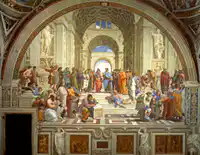
THE RENAISSANCE
• Rebirth (renacer): What happens when someone is “reborn”?
Do they completely change themselves or is it easier to bring
back the good stuff from the past and change it up a little?
Both?
• Renewed interest in Greek and Roman culture brought
intellectual debate back.
• City-states in Italy (not under a single ruler) flourished in
economy (mostly trade) and culture.
• Wealthy nobles started to fund artists, writers, and scholars
who taught secularism: which teaches to look at today and all
actions of naturalness.
• Humanists emphasized dignity, worth, and uniqueness of each
person.
7


ARTISTIC IMPACT
• Painting and Sculpture
• Giotto: painted in new style using scenes with figures in lifelike
space.
• Leonardo Da Vinci: sculptor, inventor, and painter. Famous works
Mona Lisa and The Last Supper. Concepts of further shading in eye
and mouth area. Human anatomy and inventions like parachute and
machine gun.
• Michelangelo: sculptor that created David, Moses, and the Pieta.
Carved from marble. Sistine Chapel in Rome is considered great
work of art. His paintings and sculptures glorified human form.
• Architecture
• Filippo Brunelleschi moved from pointed structures and roofs to
more rounded and arched entrances.
8

9


10


11

12


INTELLECTUAL IMPACT
• Scholarship and Literature
• Erasmus’ writings questioned the Church.
• Authors wrote secular writing or non-religious writings.
• Vernacular writing: which means local language writings instead of
Latin.
• Shakespeare in England and Cervantes in Spain
• Science and Technology
• Nicholas Copernicus: challenged Church view that the Earth was in
the middle and said Earth revolves around the sun.
• Galileo Galilei: inventor of telescope and said Earth revolves around
sun and physics. Challenged Church and was convicted to house
arrest.
13


14


POLITICAL AND ECONOMIC IMPACT
• POLITICAL
• Niccolo Machiavelli: wrote the Prince that
said power is held by the strong at any
means necessary. Human intellect over
any mandate or good conscience. Part of
this made rulers be unfair and collect
more taxes to remain in power.
• ECONOMIC
• Ideas and products spread quickly all
across. Improved material conditions and
the wealthy got more rich. Trade increase
on luxurious products like clothing, food,
wines, and furnishings with the growth of
the cities.
15


DISCUSS
16


REVOLUTION IN PRINTING
• Johan Gutenberg (German) invented the printing
press
• Printer cut every word on the face of a wooden
block.
• Block would then be inked and piece of paper
placed on top to press and print.
• Then you would cut the papers and make book but
it still took long.
• Direct impact was that books could spread ideas
and people could get influenced.
17

18

19


EXIT TICKET
THE RENAISSANCE
Political, Intellectual, Artistic, Economic, and Religious impacts
Show answer
Auto Play
Slide 1 / 19
SLIDE
Similar Resources on Wayground

14 questions
DIDLS - Imagery
Presentation
•
9th - 12th Grade
14 questions
Sin & Cos of Complementary Angles
Presentation
•
9th - 12th Grade
14 questions
Elements of Art: Value & Texture
Presentation
•
9th - 12th Grade
13 questions
Distance & Slope Formula Review
Presentation
•
9th - 12th Grade
15 questions
Energy
Presentation
•
9th - 12th Grade
12 questions
PENGINDRAAN JAUH
Presentation
•
KG
14 questions
Multiple Alleles/Blood Types
Presentation
•
9th - 12th Grade
14 questions
4.1a Central Angles and Arcs
Presentation
•
9th - 12th Grade
Popular Resources on Wayground
10 questions
Safety Day 2026 – Student Review

Quiz
•
9th Grade
21 questions
Continents and Oceans
Quiz
•
6th Grade
20 questions
Parts of Speech
Quiz
•
5th Grade
16 questions
Subject & Predicate
Quiz
•
5th Grade
25 questions
Multiplication Facts
Quiz
•
5th Grade
12 questions
Map Skills
Quiz
•
3rd Grade
22 questions
Continents and Oceans
Quiz
•
5th Grade
15 questions
Rounding Decimals
Quiz
•
5th Grade
Discover more resources for Geography
13 questions
5 Themes of Geography
Presentation
•
9th - 12th Grade
25 questions
Unit 4 Exam Review
Quiz
•
9th Grade
10 questions
Reteach Unit 4: Latin America Review
Presentation
•
9th - 10th Grade
42 questions
AP Human Geography Unit 2
Quiz
•
9th Grade
20 questions
US & Canada Physical and Political Geography
Quiz
•
9th - 12th Grade
7 questions
Prairie, Pacific, and Territories
Presentation
•
9th - 12th Grade
8 questions
The Fight Against Terrorism
Presentation
•
9th - 12th Grade
45 questions
WG North America Test Review
Quiz
•
9th Grade