Search Header Logo
The Sun Teacher's edition

The Sun Teacher's edition

Assessment

Presentation

Science

6th - 8th Grade

Medium

NGSS
MS-ESS1-1, MS-PS4-1, HS-PS4-1

+11

Standards-aligned

Created by

Aguado Angelica

Used 6+ times

FREE Resource

19 Slides • 24 Questions

1

Question of the Day

  • How does energy move from the Sun's core to the Earth's surface?

media

2

Multiple Choice

Question image

Two stars are identified on the Hertzsprung-Russell diagram below.

Based on this diagram, how do the characteristics of Star 1 and Star 2 compare?

1

Star 1 is cooler and less bright than Star 2

2

Star 1 is hotter and brighter than Star 2

3

Star 1 is cooler and brighter than Star 2

4

Star 1 is hotter and less bright than Star 2

3

The sun

media

The sun is a yellow dwarf star. It's small compared to other stars but it's just the right size for our solar system.

4

Life Span of the Sun

  • Main-Sequence Star

  • 4.6 billion years old (based on mass)

  • Estimated life span = 10 billion years

media

5

media

The sun looks different depending on the type of wavelength. Here are some examples of how the sun looks when NASA looks at them through different "eyes."

Some text here about the topic of discussion.

Sun in different wavelengths

6

Reorder

Reorder the following according to the spectrum

red

orange

yellow

green

blue

1
2
3
4
5

7

Reorder

Reorder the following from shortest wavelength to the longest wavelength.

gamma waves

x-rays

ultraviolet waves

visible light

infrared rays

1
2
3
4
5

8

Multiple Choice

Question image
What is a repeating pattern that can transfer energy?
1

Motif

2

Prism

3

Radio

4

Wave

9

Multiple Choice

Question image
What is the distance from the peak of one wave to the next peak?
1

Amplitude

2

Frequency

3

Period

4

Wavelength

10

Multiple Choice

Question image
What is the height of a wave from its resting point?
1

Amplitude

2

Frequency

3

Period

4

Wavelength

11

Multiple Choice

Question image

In which list are forms of electromagnetic energy arranged in order from longest to shortest wavelength?

1

Microwave -> Radio wave -> Infrared rays

2

Visible light -> x-ray -> radio wave

3

Microwave -> infrared -> visibile light

4

Infrared -> radio wave -> ultraviolet

12

Multiple Choice

Question image

Which wave has the highest frequency?

1

A

2

B

3

C

4

None (same frequency)

13

Reorder

Reorder the following from shortest wavelength to the longest wavelength.

gamma waves

x-rays

ultraviolet waves

visible light

infrared rays

1
2
3
4
5

14

media

The corona and chromosphere make up the sun's atmosphere. The sun's atmosphere was recently discovered by the Parker Solar Probe.

Some text here about the topic of discussion.

The sun's atmosphere

15

Fuel of the Sun

  • Uses Hydrogen as a fuel source

  • Powered by nuclear fusion

media

16

Fill in the Blanks

Type answer...

17

Radiation

  • Product of something that produces energy

  • Transfers energy through waves

  • Waves can travel through matter, as well as through empty space

media

18

Layers of the Sun

  • Core

  • Radiative Zone

  • Convection Zone

  • Photosphere

  • Chromosphere

  • Corona

media

19

Core

  • Extremely hot and dense

  • Plasma gas (charged Hydrogen atoms)

  • Hydrogen atoms are moving fast and constantly colliding

  • Upon collision they form Helium atoms and release radiation energy

  • 15,000,000 degrees Celsius

media

20

Multiple Choice

What is the formula for density?
1

density = mass x volume

2

density = mass / volume

3

density = mass + volume

4

density = mass - volume

21

Multiple Choice

Frank has a paper clip. It has a mass of 9g and a volume of 3cm3. What is its density?
1

3 g/cm3

2

1/3 g/cm3

3

27 g/cm3

4

39 g/cm3

22

Multiple Choice

Question image

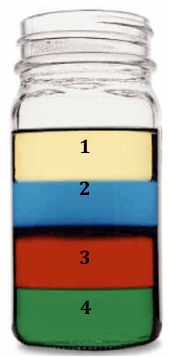
Put the liquids in order from most dense to least dense?

1

4, 3, 2, 1

2

1, 2, 3, 4

3

3, 4, 2, 1,

4

4, 3, 1, 2

23

Radiative Zone

  • Photons (light waves) travel via radiative diffusion

  • Area between the Core and Convective zone

  • Between 2,000,000 - 7,000,000 degrees Celsius

media

24

Convective Zone

  • Extends from 200,000km to surface

  • 2,000,000 degrees Celsius

  • Radiation travels via convection currents

  • "Lava lamp"

media

25

Multiple Choice

Question image
If differences in air pressure produce winds, what can you conclude about temperature and air pressure based on the figure?
1

As warm air rises, it creates an area of lower pressure, and cooler air flows in as wind

2

Warm air is denser than cold air is, creating an area of high pressure the produces wind.

3

Winds flow from areas of low pressure to areas high pressure when temperature is warmer

4

Air pressure decreases at night because temperature is lower, producing land and sea breezes

26

Multiple Choice

Question image

Name the type of heat transfer shown in the picture.

1

convection

2

conduction

3

radiation

27

Photosphere

  • the visible "surface" of the sun

  • 6,000 degrees Celsius

media

28

Chromosphere

  • Reddish gaseous layer

  • Part of Sun's outer-atmosphere

  • 4,000 - 50,000 degrees Celsius

media

29

Corona

  • Aura of plasma

  • Outer-layer of Sun's atmosphere

  • 10 million times less dense than Sun's surface

media

30

Space Weather

  • Hot, electric, magnetic, gas is released from the sun into space

  • Solar winds

  • Sun spots

  • Solar flares

  • Coronal Mass Ejections

media

31

Sunspots

Sunspots are areas of plasma that are cooler than the plasma around them.

media

32

Prominences

Huge loops of polarized plasma that connect sunspot regions

media

33

Solar Flares

When prominences connect, they produce a large amount of energy. When the energy become too much, it explodes. These eruptions are called solar flares.

media

34

media

Solar flares cause an increase in solar winds coming from the corona. This can cause gas molecules to glow in Earth's atmosphere. This glow is known as Aurora Borealis. Solar winds can also disrupt radio and electrical waves.

Solar Wind:

35

Match

Match the following

Huge loops that link sunspots together

Areas of cooler Gas

Occurs when loops connect, causing a release of magnetic energy

Can cause a glow of gas molecules in Earth's atmosphere

The glowing white halo in The Sun's atmosphere

Prominence

Sunspots

Solar Flare

Solar Wind

The Corona

36

Multiple Choice

How many planets orbit the Sun?
1

1

2

4

3

8

4

10

37

Multiple Choice

The sun is a _______.
1

star

2

planet

3

satellite

38

Multiple Choice

What is the sun mostly made up of
1

Helium

2

Core

3

Carbon

4

Hydrogen

39

Multiple Choice

Question image
What model does this represent?
1

Geocentric 

2

Heliocentric 

40

Multiple Choice

Question image
A model of the solar system in which Earth and the other planets revolve around the SUN.
1

Heliocentric

2

Geocentric

41

Multiple Choice

Question image
Which type of eclipse is this
1

Solar Eclipse

2

Lunar Eclipse

42

Multiple Choice

Question image
What is the name for this giant loop of energy leaping from the solar surface? 
1

aurora

2

prominence

3

solar flare

4

sunspot

43

Multiple Choice

Question image
What is an explosion on the sun that gives out huge amounts of energy?
1

Sun Spot

2

Solar Flare

3

Sun Ray

4

Sun Gases

Question of the Day

  • How does energy move from the Sun's core to the Earth's surface?

media

Show answer

Auto Play

Slide 1 / 43

SLIDE