

VUS 9

Presentation
•
Social Studies
•
9th - 12th Grade
•
Practice Problem
•
Medium

Melissa Peart
Used 26+ times
FREE Resource
29 Slides • 35 Questions
1

The US Involvement in
Latin America and Asia
2

Latin American- The Spanish-American War
Causes:
●Cubans desire for independence from Spain
●Damage to America’s investment in Cuba ($50
million)
●Yellow journalism- exaggerated stories
●Destruction of the US battleship Maine in the
Havana harbor (266 persons died)
Effects:
●President McKinley asked congress for
authority to use force on Spain on April 11,
1898.
●Spain declared war on America
●The war lasted less than 4 months with a U.S.
victory
●The Treaty of Paris is signed in 1898
●Results:
●Cuba gains its independence
●U.S. gets the Philippines, Puerto Rico, and
Guam
●
3


4

5
Multiple Choice
All of these were gained by the US in the Spanish American War EXCEPT for
Philippines
Hawaii
Puerto Rico
Guam
6
Multiple Choice
Which country gained its independence as a result of the Spanish American War?
Spain
Puerto Rico
Cuba
Guam
7
Multiple Choice
What caused the Americans to enter the war?
Bombing of the U.S.S. Maine
Teddy Roosevelt's Rough Riders
Bombing of Key West Florida
Battle of San Juan Hill
8
Multiple Choice
Which of the following is NOT a reason for the United States' involvement in the Spanish American War?
To protect the U.S. business interests in the Caribbean.
To prevent the spread of Communism.
To establish dominance over the Western Hemisphere
9

The United States Right to
Intervene in Cuba
10


The United States Asserted its Rights to Intervene in Cuban
11
Multiple Choice
What ensured that Cuba would remain tied to the United States?
Foraker Act
Roosevelt Corollary
Anglo-Saxonism
Platt Amendment
12


13


14


15
Multiple Choice
The U.S.’s responsibility to be an international “police power” in the Western Hemisphere to “keep order
Imperialism
Roosevelt Corollary
Expansionism
Dollar Diplomacy
16
Multiple Choice

Which U.S. President advocated for Big Stick Diplomacy?
James Monroe
Theodore Roosevelt
Woodrow Wilson
John F Kennedy
17
Multiple Choice
Which of the following was intended to prevent Europe from becoming involved
in the affairs of the Western Hemisphere?
Monroe Doctrine
Yellow Journalism
Roosevelt Corollary
Big Stick Diplomacy
18
Multiple Choice
Threatening use of force in Latin America if need be
Shuttle Diplomacy
Dollar Diplomacy
Big Stick Diplomacy
Moral Diplomacy
19


20


21


22


23
Multiple Choice

What event does this cartoon depict?
US building the Panama Canal
Dollar diplomacy in action
Beginning of the Big Stick policy
Roosevelt fighting in the Spanish American War
24
Multiple Choice
Who was the U.S. President who oversaw the construction of the Panama Canal?
Abraham
Lincoln
George Washington
Theodore Roosevelt
William Mckinley
25
Multiple Choice
Which two oceans does the Panama Canal connect?
Pacific and the Arctic
Pacific and the Indian
Atlantic and the Mediterranean
Atlantic and the Pacific
26
Multiple Choice
What are some benefits of the Panama Canal, click all that apply.
Lowers the cost of goods
Has traffic jams
Allows for easy trade between Europe, Asia, and South America
Expensive tolls
27
Multiple Choice
Taking over other smaller countries for our benefit
Imperialism
Roosevelt Corollary
Domestic Policy
Monroe Doctrine
28


29
Multiple Choice
Which of the following states the U.S. has the right to interfere in economic
matters of the other nations in the Americas?
Big Stick Diplomacy
Monroe Doctrine
Yellow Journalism
Roosevelt Corollary
30
Multiple Choice
According to the Roosevelt Corollary, what was the role of the US in the Western Hemisphere?
Okay for Europeans to imperialize
allow imperialism in the Americas
prevent Europeans from intervening in Latin American affairs
remain neutral and not interfere in foreign affairs
31

Asia and the Pacific
32


33

UNITED ANNEXATION OF HAWAII
Causes:
●Changes in the Hawaiian constitution
resulted in an increase of power for
wealthy plantation owners
●Tariff law
●Queen of Hawaii resented the power of
white planters
●Abolition the constitution that gave
political power to the white minority
Effects:
●The queen was overthrown in 1893
●New Government led by Santon B. Dole
●In 1898 congress proclaimed Hawaii as
official U.S. territory
34


35


36
Multiple Choice
The Open Door Policy was important to US merchants because its goal was to
control the economy of Latin America
Limit commercial activity in Europe
ensure freedom of trade with China
Grant exclusive trading rights with Hawaii
37
Multiple Choice
Which European country colonized the Philippines?
Spain
France
Portugal
Russia
38
Multiple Choice
The new government in Hawaii was led by
Santon B. Dole
George Washington
T. Roosevelt
JFK
39

Racial conflict in the Spanish-American War and the Philippines
● African American soldiers and sailors eagerly enlisted to fight
but were kept in segregated units
● The long fight against the Filipinos after the American arrival
was often interpreted in the United States as a struggle between
white and “colored” peoples
40

41

42
Multiple Choice
Who were the Central Powers in WWI?
Germany, Russia, France
Germany, China, Kenya
Austria-Hungary, Italy, Germany, and the Ottoman Empire
Spain, Germany, and Italy
43
Multiple Choice
Which of the following countries comprised the Allied Powers during World War I?
Great Britain, France, United States
France, Germany, United States
Great Britain, France, Spain
Italy, Germany, and Austria-Hungary
44
Multiple Choice
What sparked World War I?
The assassination of Archduke Franz Ferdinand
Germany sank the Lusitania
The Treaty of Versailles
The Zimmerman Telegram
45

46
United States' involvement in World War I
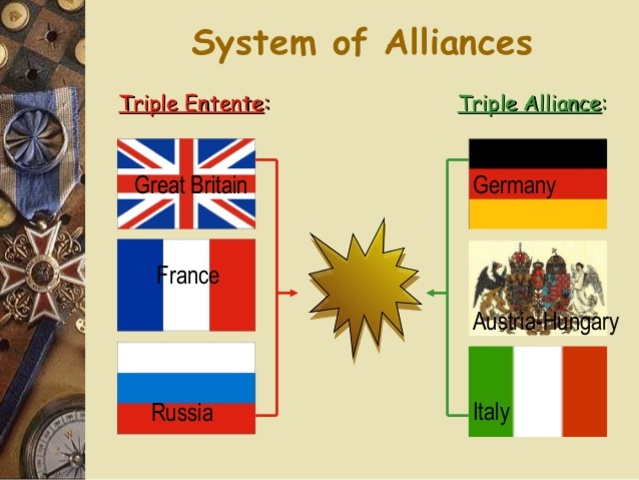
The war began in Europe in 1914 when Germany and Austria-Hungary went to war with Britain, France, and Russia.
For three years, America maintained neutrality due to popular support for isolationism.
The decision to enter the war was the result of continuing German submarine warfare (violating freedom of the seas) and American ties to Great Britain.
More than 350,000 African Americans fought for the Allied forces, often restricted to support roles but sometimes on the front lines
47
United States' involvement in World War I
Immigration from Europe stopped and factories in the North needed laborers;
Americans wanted to “make the world safe for democracy.” (Woodrow Wilson)
America’s military resources of soldiers and war materials tipped the balance of the war and led to Germany’s defeat.
48
Multiple Choice
When did the U.S. join WWI?
1918
1914
1939
1917
49
Multiple Choice
What side did the U.S. help in WWI?
Axis Powers
Triple Entente
Triple Alliance
Central Power
50
Multiple Choice
When war broke out in 1914, the U.S. had a policy of _________.
Naivety
Involvement
Capitalism
Neutrality
51
Multiple Choice
What does neutrality mean?
Not taking a side in a conflict
Not taking a side in a conflict in order to help one side more than the other.
Fighting the people you disagree with in a conflict
Helping out the people you agree with in a conflict
52

53
Multiple Choice
Which was NOT an event that caused America to join World War I?
Unrestricted submarine warfare by the Germans
interception of the Zimmerman telegram
yellow journalism about the sinking of the Lusitania
Prohibition
54
Multiple Choice
What was the Zimmerman Telegram?
It was a telegram from Germany asking Mexico to be friends with the US
It was a telegram from Germany asking Mexico to attack the US
A letter from Great Britain to Mexico to attack Japan
It was a telegram from Britain asking the US to join forces with them
55
Multiple Choice
Which of these was not a reason for US involvement in World War I?
Germany's unrestricted Submarine Warfare
The sinking of the Lusitania
The Zimmerman Telegram
The sinking of the USS Maine
56

Wilson’s plan to eliminate the causes of war
Key points
Self-determination
Freedom of the seas
League of Nations
Fourteen Points
57
Treaty of Versailles
The Treaty of Versailles failed to secure a just and lasting peace.
The French and English insisted on the punishment of Germany.
A League of Nations was created.
National boundaries were redrawn, creating many new nations.
The Mandate System was established in the Middle East.
58
Multiple Choice
The Treaty of Versailles was based on which of the following?
Wilson's 14 Points
The Monroe Doctrine
War Reparation
U-boats
59
Multiple Choice
Who had to take the blame for World War I according to the Treaty of Versailles?
Italy
Germany
France
Austria-Hungary
60
Multiple Choice
Who was the President of the United States during WWI?
Teddy Roosevelt
Franklin D. Roosevelt
Woodrow Wilson
Grover Cleveland
61
Multiple Choice
What was not a provision of the treaty of Versailles?
Germany + Austria Hungary had to give up territories
Germany did not have to repay the countries for the war
Germany was not allowed the export weapons
Germany had to accept full responsibility
62
League of Nations debate in the United States
Many senators objected to United States foreign policy decisions being made by international organizations rather than United States leaders.
The United States Senate’s failure to approve the Treaty of Versailles led to the United States not joining the League of Nations.
63
Multiple Choice
Why did the United States Senate refuse to ratify the Treaty of Versailles?
They wanted Germany to take more responsibility for their role in causing the war in the first place
They feared joining the League of Nations would limit the ability of the US to declare war if needed
They didn't want the war to end
64
Multiple Choice
What were the senator's thoughts about the League of Nations?
If the US signed, it would drag us into more wars
If the US signed, we would be protected from future world wars
If the US signed, we would not be able to follow Fourteen Points.
If the US didn't sign, we would declare war on Germany
The US Involvement in
Latin America and Asia
Show answer
Auto Play
Slide 1 / 64
SLIDE
Similar Resources on Wayground

57 questions
Columbian Exchange 2025
Presentation
•
9th - 12th Grade
57 questions
Mitosis vs Meiosis
Presentation
•
9th - 12th Grade
59 questions
Personal Qualities of a Health Care Worker
Presentation
•
9th - 12th Grade
59 questions
EOC Review part one from original 180 slides
Presentation
•
10th - 12th Grade
59 questions
African American Studies
Presentation
•
KG - 12th Grade
59 questions
African American History Lesson
Presentation
•
KG - 12th Grade
60 questions
Supersenses
Presentation
•
9th - 12th Grade
Popular Resources on Wayground
10 questions
How much do you know about our Portrait of an Eagle?

Quiz
•
10th Grade
10 questions
Fast Food Slogans
Quiz
•
6th - 8th Grade
21 questions
Continents and Oceans
Quiz
•
6th Grade
20 questions
Parts of Speech
Quiz
•
5th Grade
16 questions
Subject & Predicate
Quiz
•
5th Grade
25 questions
Multiplication Facts
Quiz
•
5th Grade
12 questions
Map Skills
Quiz
•
3rd Grade
22 questions
Continents and Oceans
Quiz
•
5th Grade
Discover more resources for Social Studies
10 questions
Exploring the Age of Exploration: Key Events and Figures

Interactive video
•
6th - 10th Grade
17 questions
1.3 Review
Presentation
•
11th Grade
10 questions
Exploring the 13 Colonies Regions
Interactive video
•
6th - 10th Grade
8 questions
Smith Unit 5 Quick Check #1 Big Business, Monopolies &Technology
Quiz
•
11th Grade
46 questions
Unit 1 Test REVIEW Ancient Greece and Rome
Quiz
•
9th - 12th Grade
10 questions
Exploring Ancient Mesopotamia Through Song
Interactive video
•
6th - 10th Grade
27 questions
Supply & Demand Test Review
Quiz
•
12th Grade
36 questions
Unit 5 Key Terms
Quiz
•
11th Grade - University